 Raising
Toy Story 5 Lilypad: What the Tablet Teaches Kids About Screens
In Toy Story 5, Lilypad is the new tablet with its own ideas about what's best for Bonnie, and her toys suddenly matter less. The movie treats screens with more nuance than a simple good-versus-evil story. Still, young children may copy what looks exciting more than the moral at the end. Here is what Toy Story 5 Lilypad gets right, what your child might take away from it, and a two-step routine for ending screen time without a meltdown. No major spoilers.

Does Toy Story 5 teach kids a bad habit?!
The 30-second version: what kids copy from Lilypad, and two steps for turning a screen off without a fight.
Toy Story 5 Lilypad, explained
Lilypad is a frog-themed kids' tablet, voiced by Greta Lee. According to the official synopsis, Lilypad shows up with her own ideas about what's best for Bonnie, and the toys start to wonder whether playtime will ever be the same. In the trailer, Jessie worries that they're losing Bonnie to the device.
Woody, Buzz, Jessie, and the rest of the gang see their place in Bonnie's life shrinking. The movie's conflict isn't toys against a classic villain. It's toys against a new pull on Bonnie's attention.
Director Andrew Stanton has described Lilypad less as a mustache-twirling villain than as an antagonist who means well. That framing is useful for parents too. A screen doesn't have to be the enemy. It is a strong pull, and young children need help managing it.
Toy Story 5 rating: what age is it for?
Short answer: It's rated PG in the US: parental guidance suggested, with no age limit.
In the US, the MPA (Motion Picture Association) rates it PG for some thematic elements and rude humor. In the UK, the BBFC (British Board of Film Classification) lists mild bad language and rude humor.
New Zealand's Classification Office notes that the girl in the story is teased by other children for still playing with toys and is hurt by peers on social media. It also notes that a toy mispronounces a swear word a few times, and that a large hog nearly eats some toys, which may be a little scary for some children. The film runs about 102 minutes.
What Toy Story 5 gets right about screens
The movie shows something many parents recognize: a child's attention drifting toward a screen while older favorites sit untouched.
It also hints at why a tablet wins so easily. A tablet can always offer something new, respond instantly, and never get bored of you. Old toys need a child to bring the story, and that takes more effort.
And the movie doesn't make Bonnie a bad kid for loving the tablet. That honesty is what makes the film a good starting point for a conversation at home.
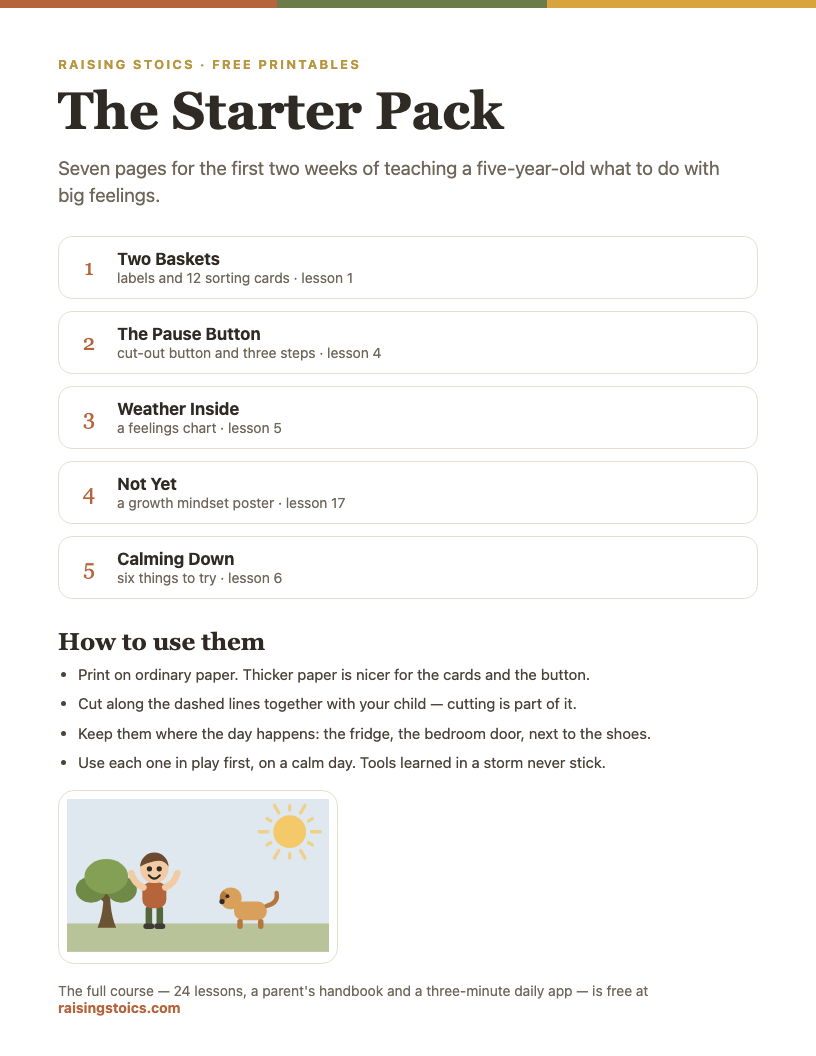
The Big Feelings Starter Pack
Nine pages for the first two weeks: a sorting game, a pause button, a feelings chart and a calm-down poster.
Download the free PDF See all 9 pages
Part of a free 9-page starter pack. Sign in with a code from your email — no password.
The habit kids may copy
Here is the catch. Young children may copy what looks fun on screen more than the lesson the story builds toward. For a 5-year-old, the takeaway from Toy Story 5 may be "the tablet is the exciting thing, and everything else is boring."
You may notice it in small ways after the movie: asking for the tablet the moment they wake up, getting upset when it's time to stop, or saying that toys are "for babies." None of this means the movie is harmful. It means your child may be trying out what they just watched.
For many families, the hardest moment isn't the screen itself. It's when the screen has to turn off.
How to turn screens off without a fight
Two steps, and both happen before anyone is upset.
Step 1: set the rules before the tablet is in their hands. Agree on three things in advance: where the tablet lives when it's not in use, how long this session is, and what happens next. "Twenty minutes in the living room, then we build the tower." A rule agreed on before the screen turns on is often easier to keep than one announced in the middle of a show.
Step 2: a two-minute warning, then let your child press off. Give one calm warning: "Two more minutes, then we build the tower." When time is up, hand the job of turning it off to your child. Pressing the button themselves can give a child a small sense of control at the exact moment they feel they are losing something.
Name the next fun thing out loud, every time. The hard part of stopping is the empty space after the screen. A concrete next step fills it.
If your child melts down anyway
Some days the routine won't be enough, especially when your child is tired or hungry. That's normal at 4 to 7.
Stay close and keep it short: "You really wanted more. It's hard to stop." Naming the feeling often helps more than explaining the rule again. Wait for the wave to pass before you talk about it.
Don't hand the tablet back to end the meltdown. If crying works once, the next stop can get harder. Instead, keep your plan and move to the next activity with them, even if they join a few minutes late.
Later, when everyone is calm, you can ask: "What would make turning it off easier next time?" Kids often come up with good ideas, like a song for the last minute or choosing the next activity themselves.
How much screen time is typical?
In the US, a lot of children spend long stretches on screens. In the National Survey of Children's Health, parents of about 1 in 5 children ages 6–11 reported four or more hours a day on screens on most weekdays in 2024, not counting schoolwork. For children ages 0–5, it was about 1 in 13. You can see the full numbers and chart in how to reduce screen time for kids.
The American Academy of Pediatrics' 2016 advice suggested about an hour a day of quality programming for children ages 2–5. Its updated 2026 policy looks beyond hours: what children watch and play, what screens replace, such as sleep, movement, and time with people, and whether media is designed to keep kids hooked. It still encourages watching together and making a family media plan.
The point isn't a perfect number. It's that screens fit into the day instead of taking it over, which is exactly the shift Toy Story 5 is about.
Talking about the movie with your child
Toy Story 5 is a good conversation starter, because your child already cares about the characters. A few questions that work at 4 to 7:
"Why do you think Bonnie wanted the tablet so much?"
"How do you think Woody felt?"
"What do you like to play when the tablet is off?"
You don't need to steer the answers or deliver a lesson. Listening is the lesson. And if your child says something like "the tablet is more fun," that's honest, and it gives you a starting point: "It is fun. What else is fun for you?"
Making toys win again
The best counterweight to a screen isn't a ban. It's play that is actually appealing.
Put a few toys within reach and rotate them, so old toys feel new again. Join in for the first five minutes: young children often need an adult to get a game started. Leave unfinished projects out, like a half-built tower or a story with the next chapter missing, so there's something to come back to.
And make the screen less automatic. If the tablet lives in a drawer instead of on the couch, it may get picked up less often, without any rule at all.
FAQ
Why is Toy Story 5 rated PG?
Toy Story 5 is rated PG by the MPA for some thematic elements and rude humor. It's the first PG among the main Toy Story films; the first four were rated G (the 2022 spinoff Lightyear was also PG). Reviews mention its screen-use themes and some bathroom humor, so previewing it can help with sensitive kids.
How long is Toy Story 5?
Toy Story 5 runs about 102 minutes, or 1 hour and 42 minutes. For younger children, that's a long sit. A short break in the middle at home, or a snack ready before it starts, can make the second half easier.
Is Toy Story 5 on Disney Plus?
Yes. Toy Story 5 began streaming on Disney+ on September 23, 2026, about three months after it opened in theaters on June 19. Watching at home also makes it easier to pause and talk about Lilypad and the toys as you go.
What is Toy Story 5 about?
Toy Story 5 is about what happens when Bonnie gets Lilypad, a new tablet with her own ideas about what's best for Bonnie. Woody, Buzz, Jessie, and the gang have to figure out their place in a kid's life when the new favorite isn't a toy at all.
Shaun the Sheep Movie: The Quick-Fix Habit Kids Copy
The new Shaun the Sheep movie is a Halloween comedy about a giant fix gone wrong. What kids may copy from it, and how to teach a calmer Plan B.
Read next →Raising Stoics is a 12-week program for ages 5–6. One lesson is "I'm the boss of my want": practicing the pause between wanting something and getting it.