 Raising
Free preschool curriculum: 17 programs you can download today
You can find a free preschool curriculum for a full year: two public school systems, in Boston and New York City, publish the programs they use in their own classrooms. We opened every program below on October 28, 2026, and list what's inside, the ages, the length, the license, and whether you have to sign up, with links straight to the owner's files.

Four full-year programs from public school systems
Boston's two editions have a week-by-week plan for each unit; NYC's units and Explorations give guidance, sample plans, and planning templates. None needs a sign-up. We wrote a separate page on each.
Boston Focus on Pre-K (4s)
4 themed units, each with a week-by-week plan; read-alouds, centers, vocabulary, Building Blocks math, take-home links
Boston Focus on Pre-K (3s)
5 themed units, each with a week-by-week plan; read-alouds, centers, storytelling, Building Blocks math
NYC Pre-K Units of Study
10 units in 3 themes; each unit has one sample weekly plan, book lists, and center ideas; Unit 1 also has lesson plans
NYC 3-K Explorations
Instructional guidance for 3 Explorations over a 10-month year: center ideas, book lists, read-aloud questions, and a blank weekly planning template
Free preschool curriculum: all 17 compared
Complete = a full year with a plan for each week (Boston) or a lesson for each day (home programs). Units and guidance = a full year of units with sample plans or planning templates, not a plan for every week (NYC). One subject = a full year in one area only. Guidelines = what children typically learn, with no plans. Program names link to our page where we have one; downloads go to the owner's own site.
| Program | Ages | What's inside | Length | License | Sign-up | Download |
|---|---|---|---|---|---|---|
| Focus on Pre-K: 4s Boston Public Schools, Department of Early Childhood Complete | 4 | 4 themed units, each with a week-by-week plan; read-alouds, centers, vocabulary, Building Blocks math, take-home links | 4 units of 43–45 school days (about 175 days, 2026–27 calendar) | CC BY-NC-SA 4.0 | No | Unit 1 plan (PDF export from Google Docs) |
| Focus on Pre-K: 3s Boston Public Schools, Department of Early Childhood Complete | 3 | 5 themed units, each with a week-by-week plan; read-alouds, centers, storytelling, Building Blocks math | 5 units of 34–41 school days (about 177 days, 2026–27 calendar) | CC BY-NC-SA 4.0 | No | Unit 1 plan (PDF export from Google Docs) |
| NYC Pre-K for All Interdisciplinary Units of Study New York City Department of Education Units and guidance | 4 | 10 units in 3 themes; each unit has one sample weekly plan, book lists, and center ideas; Unit 1 also has lesson plans | 10 units over a school year (Unit 1 runs four weeks) | Educational, nonprofit use only | No | Unit 1: Welcome to Pre-K (PDF) |
| NYC 3-K for All Interdisciplinary Explorations New York City Department of Education Units and guidance | 3 | Instructional guidance for 3 Explorations over a 10-month year: center ideas, book lists, read-aloud questions, and a blank weekly planning template | 3 Explorations over 10 months | Educational, nonprofit use only | No | Exploration One (PDF) |
| NYC Pre-K Units of Study, Explore editions New York City Department of Education Units and guidance | 3–4 | Alternate editions of the same 10 NYC units | 10 units | Educational, nonprofit use only | No | Unit 1 Explore edition (PDF) |
| Let's Play! Family Child Care Curriculum New York City Department of Education Units and guidance | Mixed ages, up to 5 | 10 monthly topics in 3 themes (Our Community, Our Environment, Our Impact) with a one-page weekly planner for each month | 10 months | Educational, nonprofit use only | No | Introduction (PDF) |
| Pre-K for ME Maine Department of Education Complete | 4 | 6 units with lesson plans, a pacing calendar, and a sample daily schedule; adapted from Boston's Focus on K1 | 6 units | Free state curriculum; no separate license found | No | Guiding documents (PDF) Opened and checked earlier on October 28, 2026; on our second check the Maine DOE site returned errors, so the link may be temporarily down. |
| CKLA Preschool (Core Knowledge Language Arts) Core Knowledge Foundation One subject: Language and literacy | 3–4 | Literacy units built around topics; each has a teacher guide with daily plans, activity pages, a flip book, and picture cards | 7 topic units of about 20 teaching days each | CC BY-NC-SA (where the site says so) | No | All About Me unit (archive of PDFs) |
| Eureka Math Pre-Kindergarten Great Minds PBC One subject: Math | 4 | 5 math modules with numbered daily lessons and a pacing guide | 146 lessons in a 180-day year | Free to download; all rights reserved | Form on the page; the PDF links open directly | Module 1 teacher edition (PDF) |
| Easy Peasy All-in-One Preschool (Getting Ready 1) Easy Peasy All-in-One Homeschool (Lee Giles) Complete | 4 | 180 online lessons: letters in alphabet order (about five lessons per letter), sounds, shapes, colors, counting, crafts; printable worksheet packet (Christian) | 180 lessons (one a day) | Free; all rights reserved, no commercial use or reposting | No (optional account for tracking) | Lesson 1 printable (PDF) |
| Letter of the Week Preschool Curriculum Freedom Homeschooling Complete | 4 | 35 weeks of five days: read-aloud videos or ebooks, a song, activities, crafts, a snack recipe, about five worksheets a week | 35 weeks × 5 days | Free; copyrighted, no separate license | Yes, for the workbook (email and newsletter opt-in) | Week 1 (web page) |
| 2022 Texas Prekindergarten Guidelines Texas Education Agency Guidelines | 3 and 4 | Outcomes and examples of child behaviors in 10 domains; domain introductions include notes for educators | 87-page guide; 6 domains for PK3 and PK4, 4 domains for PK4 only | State publication; no separate license found | No | PK3 and PK4 comprehensive guide (PDF) |
| Head Start Early Learning Outcomes Framework (ELOF) U.S. Department of Health and Human Services, Office of Head Start Guidelines | Birth to 5 (separate preschool section) | 5 central domains and the skills children typically show by age, birth to 5 | 82 pages | U.S. government publication | No | ELOF (PDF, GovInfo copy) |
| Washington State Early Learning and Development Guidelines Washington State Department of Children, Youth, and Families Guidelines | Birth to 8 (section for 3–5) | Skills by age, each with ideas for supporting them at home and in a group | 153 pages | State publication; no separate license found | No | Guidelines (PDF) |
| New York State Prekindergarten Learning Standards New York State Education Department Guidelines | 4 | Learning standards in 5 domains | 81 pages | State publication; no separate license found | No | Standards (PDF) |
| Development Matters (England) Department for Education, England Guidelines | Birth to 5 | What children typically do and what adults can do, across 7 areas of learning | 128 pages | Open Government Licence v3.0 | No | Development Matters (PDF) |
| Early Years Learning Framework for Australia (V2.0) Australian Government Department of Education Guidelines | Birth to 5 | Principles, practices, and 5 learning outcomes | 72 pages | CC BY 4.0 (except photos) | No | EYLF V2.0 (PDF) |
Checked October 28, 2026. Programs and links change; the owner's page has the latest version.
How to choose a free preschool curriculum
You want a full year, ready to go
Start with Boston's Focus on Pre-K (4s or 3s), which has a week-by-week plan for each unit. The NYC Pre-K Units of Study cover a year in ten single PDFs that are easy to print, with one sample weekly plan per unit, so you'll plan more of the weeks yourself.
You only need one subject
For early literacy, CKLA Preschool gives you topic units with daily plans. For math, Eureka Math Pre-K has 146 lessons across five modules. Both can sit alongside a theme-based program or your own plans.
You're teaching at home, not in a classroom
Letter of the Week (Freedom Homeschooling) and Easy Peasy Preschool are written for parents teaching at home, with one lesson a day. Classroom programs work at home too, but you'll trim the parts that need a group.
You want a faith-based or a secular program
Easy Peasy is Christian. Everything else in the table is secular, including Letter of the Week and all the public school programs.
Your child is 3, not 4
Look at Focus on Pre-K 3s and NYC 3-K Explorations. Both are written for 3-year-olds.
You don't want to give an email address
Every program here opens without a sign-up except the Letter of the Week workbook (email) and Eureka Math (a form on the page; the PDF links open directly). The Letter of the Week weekly pages themselves are open.
You want a reference for what to cover
Read a set of guidelines, such as the Head Start ELOF, next to whatever program you pick, as a reference to notice what your week leaves out. The Texas Prekindergarten Guidelines are useful the same way, though they say they're not meant as a checklist.
What a preschool curriculum should cover
The Head Start Early Learning Outcomes Framework (ELOF) is a U.S. government publication that describes what children from birth to 5 typically learn. Head Start programs use it in planning, and NYC's 3-K Explorations are built on it. For preschoolers ages 3 to 5, it groups learning into five central domains, two of which are split into smaller parts:
- Approaches to learning: how children learn — paying attention, sticking with a task, curiosity, and creativity.
- Social and emotional development: relationships with adults and other children, a sense of self, and managing feelings and behavior, including handling frustration.
- Language and literacy: understanding and using spoken language, then the early steps of reading and writing, such as noticing sounds in words, knowing letters, and enjoying books.
- Cognition: early math (counting, comparing, shapes, patterns) and scientific reasoning (observing, asking questions, trying things out).
- Perceptual, motor, and physical development: big movements like running and climbing, small ones like using scissors, and health and self-care.
Two things stand out when you read the framework next to the programs in this list. First, social and emotional skills and approaches to learning get as much space as letters and numbers. Second, the framework describes ranges, not deadlines: children reach these skills at different times. If a program you're considering is all worksheets and no play, talk, or feelings, the ELOF is a good reason to add those back in.
Source: Head Start Early Learning Outcomes Framework: Ages Birth to Five (2015), PDF. Summary in our words.
Free preschool lesson plans, themes, and guidelines: what's the difference?
Search results for "free preschool curriculum" mix several different things, and it helps to know which one you're looking at.
A curriculum is a plan for a whole year. It says what to teach, in what order, and roughly how long each part takes. Boston's Focus on Pre-K and the NYC units are curricula, though NYC's give guidance and sample weeks rather than a plan for every week.
Free preschool lesson plans are single activities or single weeks. They're useful for filling gaps, but they don't add up to a year on their own, and quality varies a lot.
Preschool themes are topics such as animals, weather, or community helpers that hold a few weeks together. Most full-year programs here are built on themes; you can borrow their theme lists even if you plan the activities yourself.
Guidelines or standards, like the Texas guidelines or the ELOF, describe what children typically learn. They don't tell you what to do on Monday, but they can show you what a plan leaves out.
How to use a free curriculum at home without burning out
Classroom programs assume a full school day, a trained teacher, and a room full of children. At home you have none of that, and you don't need it.
- Pick one program and stick with it for a theme. Mixing three free programs in one month is an easy way to end up overwhelmed.
- Keep the core small. A daily read-aloud, some counting with real objects, a conversation, and time outside cover a lot of what these programs aim for.
- Print less. Open the plan on a screen, note one or two things for the week, and print only what your child will actually use.
- Let interest set the pace. School calendars give each unit a fixed number of days. At home, move on when your child is ready, or stay longer when they're hooked.
- Keep short records. A photo and a sentence per week is enough to see progress over a year and to answer "what did you do?" from relatives or, where it applies, your state.
- Leave room for feelings. Waiting, losing a game, and "I can't do it" come up often at this age. They're part of the day too, even if the plan doesn't list them.
What "free" means here: licenses in plain words
Every program in the table costs nothing to download. What you may do with it afterward differs:
- CC BY-NC-SA 4.0 (Boston): you may use, copy, and adapt the material if you credit the owner and share your changes under the same license. You may not use it commercially (for example, in a paid class or product). The license covers the owner's own material; third-party items, such as children's books or Building Blocks, may carry other terms.
- CC BY-NC-SA (CKLA): Core Knowledge's terms apply this license to materials "where expressly identified," with the same noncommercial limit.
- Educational, nonprofit use only (NYC): the PDFs say they "may be used for educational, nonprofit purposes only" and ask anyone who isn't a Pre-K for All or 3-K for All provider to email the department for permission.
- All rights reserved (Eureka Math, Easy Peasy): free to download, but not to copy, repost, or use commercially.
- U.S. government publication (Head Start ELOF): published by the federal government; we summarize it in our own words.
- Open Government Licence (England) and CC BY 4.0 (Australia): open for reuse with credit, including commercial use.
If you plan to use any of these in a paid class, a product, or a website, read the owner's terms first.
How we checked
On October 28, 2026, we opened each program's own page and its main files, checked that the download links work, read the license or terms on the page or in the PDF, and noted the size, page count, and date. Unit names, day counts, and domains come from the owners' pacing calendars, scope and sequence documents, and tables of contents. We describe each program in our own words and link to the owner's files; we don't copy or host their materials.
Some sources we couldn't verify: the Louisiana Department of Education's early childhood planning pages, the Head Start website (we used the government's GovInfo copy of the ELOF), the California Preschool Curriculum Framework, Georgia's pre-K lesson plans, and Florida's early learning standards all blocked or failed our checks twice, so they're not in the table. The Maine Pre-K for ME site was working earlier the same day but returned errors on our second check.
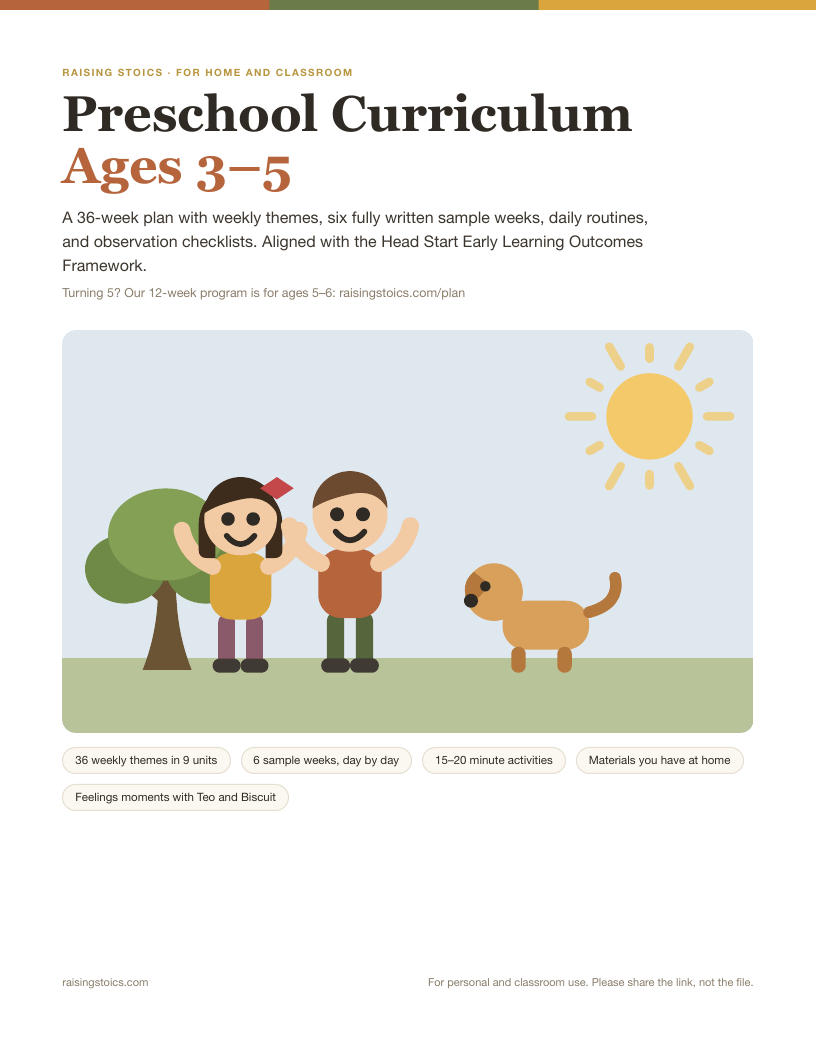
Our own 36-week preschool plan
Alongside the programs above, we made a plan of our own for the part of the day most curricula give little room to: feelings, waiting, trying again, and getting along. Sign in with a code from your email and the PDF downloads right away.
FAQ
What is a preschool curriculum?
A preschool curriculum is a plan for what children ages 3 to 5 learn over a year and in what order. It usually covers themes, read-alouds, early math, early literacy, play, and social skills. A full curriculum has weekly or daily plans, while guidelines such as the Head Start ELOF describe the skills children typically learn without telling you what to do each day.
Is there a free homeschool preschool curriculum?
Yes, there are free programs written for parents at home. Letter of the Week from Freedom Homeschooling runs 35 weeks of five days, and Easy Peasy Preschool has 180 lessons with a Christian outlook. Classroom programs such as Boston's Focus on Pre-K can also work at home for noncommercial use if you trim the activities meant for a group.
Where can I find free preschool lesson plans?
Two public school systems publish full-year preschool programs for free. Boston's Focus on Pre-K has a week-by-week plan for each unit, and New York City's Pre-K Units of Study include one sample weekly plan per unit, with lesson plans in Unit 1. Check the license before reusing them: Boston's is noncommercial, and NYC's is for educational, nonprofit use.
Is there a free printable preschool curriculum?
Yes, several free programs come as printable PDFs. The NYC Pre-K Units of Study and 3-K Explorations are long PDFs you can print, and Boston's unit plans export to PDF from Google Docs. For worksheets, Letter of the Week has a printable workbook of about 185 pages, which is emailed to you after you sign up for its newsletter.
What are good preschool themes?
Free full-year programs use themes that start close to the child and move outward: all about me, family and friends, community, the five senses, colors, transportation, light, water, animals, plants, and growing and changing. You can borrow any of these theme lists from the programs above and plan your own activities around books, outings, and things you already have at home.
Is there a free pre-K curriculum PDF?
Yes, there are several. New York City posts each of its ten pre-K units as a single PDF, Maine's Pre-K for ME has PDF guides, and the Texas Prekindergarten Guidelines and Head Start ELOF are free PDFs, though both are guidelines rather than lesson plans. Boston's Focus on Pre-K files are Google Docs that you can save as PDF.