 Raising
Self-control is a skill. It can be taught.
We teach children letters and numbers, and almost nothing about what to do with anger, with fear, or with the sentence "I can't do it." This program is meant to fix that imbalance — practical philosophy that is two thousand years old, put into words a five-year-old can actually say.
"Stoic" here doesn't mean holding feelings in. It means feeling them, and still choosing what to do.
twice a week 3 minyour child's app
once a day $0materials
you already own
Why now, at five
Between five and seven, the part of the brain that stops an impulse is growing faster than it ever will again. The same year, imagination outruns the ability to check what's real, so fears multiply. A child at this age can learn to notice a feeling rising and choose what to do with it — and they cannot learn it from being told to calm down.
What they can learn it from is doing something twenty minutes at a time, with you, using two baskets, a paper button and a story about a wave.
How it works
Two lessons a week
Twenty minutes each, at the kitchen table. You run them from the handbook — every lesson is scripted, including what to say.
One key phrase in between
Each week has a phrase — "Stop. Breathe. Choose." — that you use in ordinary life. This is where the learning actually happens.
Three minutes in the app
The child opens it alone: one small mission in the morning, three short questions in the evening. It ends by itself. There is no feed and nothing to buy.
Books you already have
Ideas arrive through characters your child already trusts — Jabari, Sophie, Mike Mulligan, the Color Monster. One question per book, before the lesson.
What your child ends up able to do
- Tell the difference between what depends on them and what doesn't — and stop wasting energy on the second kind.
- Notice anger in their body before it reaches their hands, and put a pause there.
- Name what they feel with more than four words, which is what makes a feeling manageable.
- Say "not yet" instead of "I can't", and go back to the thing that beat them.
- Wait — using a trick, not willpower.
- Change the plan when the first one fails, instead of ending the day.
While your child learns it, you practice it
Every week of the program has a parent half on the same idea. When your child learns the Pause Button, you practice the pause before you raise your voice. When they sort Two Baskets, you sort what's up to you from what your child does.
- Two minutes a day. One small practice and one tap to mark it. No streaks, no guilt.
- A story from Teo's family, told from the grown-up side, with a fork in the middle: what would you do?
- A garden around your child's fort. Every week you practice grows one plant your child sees in their app. Nothing is ever taken away.
- Read it or listen: three minutes, in a calm voice.
You practice it first. Then you teach it.
Thursday, 7:15 p.m. Teo knocks water across the library book, and you feel your jaw lock.
What you get
24 scripted lessons
Aim, materials, minute-by-minute flow, the exact sentences to say, what not to do, and how to tell it landed.
A parent's handbook
The developmental psychology of 5–6 in plain language: why each lesson is shaped the way it is, and what to say instead of the things most of us say.
Your child's app
Twenty-four illustrated stories, two a week, plus daily missions, evening questions, and a fort they build a brick at a time. Works offline.
Look inside before you sign up
Three lessons are open in full — one from each month, so you can see how a lesson is actually built.
The Starter Pack
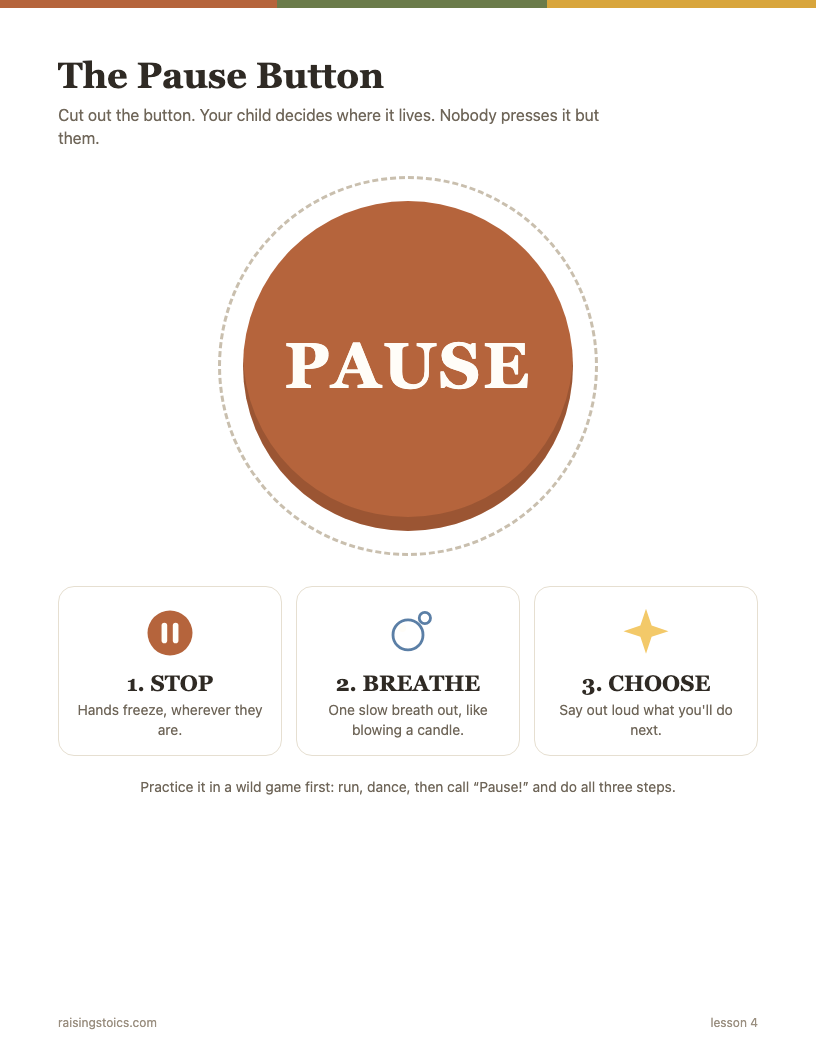
Seven printable pages for the first two weeks: sorting cards, a pause button to cut out, a feelings chart, a calm-down poster and growth mindset phrases.
Guides for parents
Open articles on the situations that actually come up, written question by question.
Growth Mindset for Kids
What growth mindset actually means for a 4–7 year old, why praising cleverness backfires, and the specific sentences that work instead.
Emotional Regulation Activities for Kids Aged 4–7
Which activities actually build emotional regulation in young children, why naming feelings comes before calming them, and what to do in the moment.
Calm Down Strategies for Kids That Actually Work
Why telling a child to calm down fails, what to do during a meltdown, and the strategies worth rehearsing beforehand.
Self-Control Activities for Kids
How self-control develops between 4 and 7, which games genuinely train it, and why instructions don't.
Start week 1
New here or coming back, it's the same: your email and a six-digit code. No password.
- 12 weeks, 24 lessons
20 minutes with you, twice a week - A handbook for you
what to say and do in each lesson - Your child's app
3 minutes a day, progress saved - $0 materials
things you already have at home