 Raising
Is Santa Real? How to Answer Kindly When Your Child Asks
Sooner or later, a child looks up and asks: is Santa real? It's a big moment for a parent, and you usually have about two seconds to decide what to say. This guide is for grown-ups: how to find out what your child is really asking, and how to answer in a way that fits your family and your child. A note for grown-ups: lower down, this page talks openly about how families handle Santa. If a child is reading with you, you may want to stop after the first two sections.

Is Santa real? First, find out what your child is really asking
When a child asks "Is Santa real?" it can sound like a request for a verdict. Often it's something smaller. A friend said something on the bus. A cousin is suspicious. They saw two different Santas at two different stores on the same afternoon. Or they simply want to be reassured.
So before you answer, ask. Short answer: turn the question back, gently. "What do you think?" or "What made you wonder about that?"
Then listen properly. What comes back tells you which conversation you're in. A child who says "Mia says he's not, but I think he is" is usually looking for comfort, not a lecture. A child who has a list of problems ready (the chimney, the time zones) may be asking for something more.
Either way, you haven't said anything you'll need to take back, and your child knows their question was welcome.
Is Santa real for kids who aren't ready for a big talk?
Many young children ask the question and are happy with a short, warm reply. They may simply be checking in, the way they might ask whether the park will still be there tomorrow.
For a child like this, you can answer the feeling rather than the fact: "It sounds like you really love Christmas." "What do you hope happens this year?" Many children go straight back to talking about cookies and reindeer, and that tells you where they are.
Follow their lead, not the calendar. A child who drops the subject may not be hiding a doubt you need to dig out. A child who keeps coming back to it, with more and sharper questions, is telling you something too.
The rest of this page is written for grown-ups. If a child is reading over your shoulder, this is a good place to stop together.
For grown-ups: when your child wants the real answer
At some point, a child asks in a way that isn't a test of the story but a direct question, and they mean it. They may ask "Is Santa real or is it you?" and look you in the eye.
At that point, many parents find it helps to answer honestly. Saying "Yes, he's real" to a child who has already worked it out, and is checking whether you'll tell them the truth, can leave them feeling foolish later.
A few things make the moment easier:
Ask once more. "Do you really want to know? Some kids like to keep the story a bit longer." Let them choose. Some say "No, never mind," and that's a real answer too.
Tell them privately and calmly. Not in front of younger siblings, and not as a joke at the dinner table.
Lead with what's true. The presents were real, the love behind them was real, and the fun was real. What was pretend was who carried them in.
Praise the thinking. "You noticed things didn't add up, and you asked. That's exactly what I'd want you to do."
Then let them have their reaction, whatever it is: relief, pride, a few tears, or "I knew it!" Most of it passes quickly.
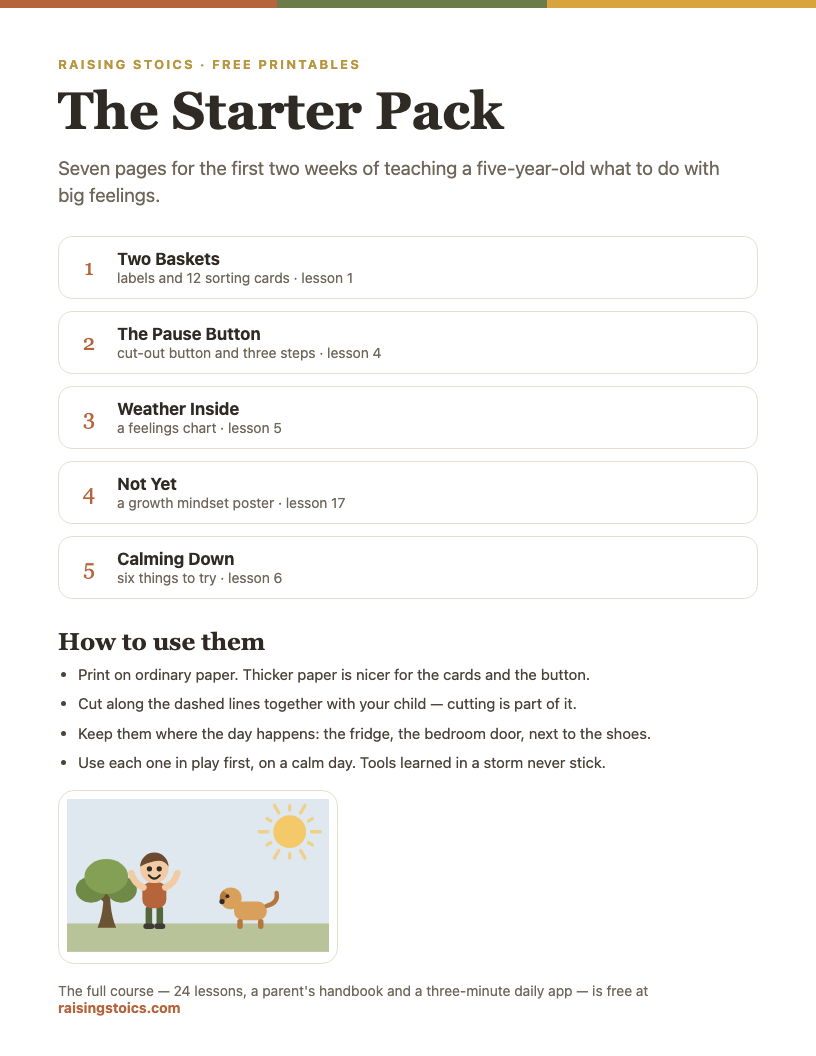
The Big Feelings Starter Pack
Nine pages for the first two weeks: a sorting game, a pause button, a feelings chart and a calm-down poster.
Download the free PDF See all 9 pages
Part of a free 9-page starter pack. Sign in with a code from your email — no password.
What age do kids usually figure out the truth about Santa?
Short answer: around 8 on average, with a lot of variation from child to child.
In a 2024 study in *Developmental Psychology*, researchers asked 48 children ages 6 to 15, and separately 383 adults looking back, how they came to stop believing in Santa. In both groups, the average age of disbelief was around 8, but some children got there much earlier and some later. Everyone in the study had already stopped believing, so these numbers can't tell us when a child who still believes will stop. Most said that something someone told them played a part, and some worked it out from what they saw or by reasoning it through.
So if you have a 5- or 6-year-old who is starting to ask, that's not unusual. And if your 8-year-old still believes, that's within the ordinary range too. There's no correct age, and no deadline for having the conversation.
The same study found that about a third of children and half of adults remembered some negative feelings when they found out. Those feelings were generally short-lived, and most said they would celebrate Santa with their own children or already did.
"The spirit of Santa": a gentle way to tell the truth
Many families use a version of the same conversation, and it works because it's honest without being blunt.
It goes something like this: "Santa started as a real person a long time ago, a man named Nicholas who was known for giving gifts in secret. People loved that idea so much that they kept it going. Santa is the spirit of giving without needing anything back. Grown-ups, including me, help that spirit happen."
This keeps the parts that were never pretend: kindness, surprise, and generosity. It lets your child see the story as something people chose to keep alive, not a trick played on them.
Use your own words. A 7-year-old needs a few sentences, not a speech. And let them ask follow-up questions, including the awkward ones (the Tooth Fairy tends to come up next). Answer those honestly too.
The "now you become a Santa" tradition
Some families turn the end of believing into a beginning. Once a child knows the truth, they're invited into the secret: now they get to be a Santa for someone else.
Together, you pick a person: a neighbor, a grandparent, a younger cousin, a classmate who might be having a hard year. Your child chooses or makes a small gift, and it's delivered without a name on it. The rule is that nobody can find out who did it.
The point isn't the gift. It's the feeling of giving without getting thanked, which is a different and often surprising kind of fun for a child. It turns "I found out" into "I'm in on it now," and it puts the focus on what Santa was always about.
If you'd like more ideas for small, everyday giving, see how to teach kids kindness. Gratitude makes a natural partner, too: a few gratitude activities for kids fit easily into the weeks before the holidays.
Siblings, cousins, and keeping the secret
Once one child knows, there's a younger one who doesn't. This is where the "become a Santa" idea earns its keep: the older child now has a job, which is to protect the story for their little brother or sister.
Say it plainly: "Your brother still believes, and it's his turn to enjoy it. Can you help me keep it special for him?" Many children take this seriously and feel proud to be trusted.
It may not hold perfectly. A 6-year-old keeping a big secret is a lot to ask, and slips happen. If the younger child hears something, start again with the first step: "What do you think?" They may well decide to keep believing anyway.
When a classmate spoils it
It's very common for the news to arrive from another child, often with no warning and not much tact. Your child may come home upset, confused, or angry at the friend.
Start with the feeling, not the facts: "That sounds like a surprise. How did it feel when she said that?" Then ask what they think. Some children want the whole truth right away. Others decide the friend is wrong and keep believing, at least for now.
If your child is ready, the gentle conversations above still work. If they're upset with the classmate, it can help to point out that families do things differently. "Some families do Santa and some don't. Maybe her family tells it a different way."
This is also a chance to talk about the other side: if your child knows and a friend doesn't, it's kind to let the friend's family tell them. That's a small, real lesson in empathy, and it fits well with teaching empathy to children more broadly.
Families who don't do Santa
Many families don't do Santa at all, for religious, cultural, or personal reasons, or because they just never felt comfortable with it. That's a perfectly reasonable choice.
If that's your family, the main thing to prepare your child for is the other kids. Children who know the truth early sometimes feel it's their job to tell everyone. A simple family rule helps: "In our family we don't do Santa. Other families do, and it's not our job to tell them. That's their family's story."
You can still enjoy the stories, the songs, and the movies the way you'd enjoy any other story. Children are good at loving a story they know isn't literally true, as long as they understand whose story it is.
Honesty versus magic: is it OK to do Santa?
Parents land in very different places on this, and there isn't a single right answer.
Some feel that any pretend story told as true is a kind of lie and would rather skip it. Others see Santa as a shared family game, like pretend play, that most children grow out of with fond memories. The research above suggests that for most people, finding out is a short-lived disappointment rather than lasting harm, though that's what people report, not a guarantee for every child.
The same study offers a few things worth noticing. In both groups, people whose parents promoted Santa more heavily were more likely to remember some negative feelings when they found out. Negative feelings were also more likely when people found out abruptly, at an older age, or by being told directly.
A practical middle ground, if you do Santa: keep it light rather than elaborate, don't use Santa as a threat ("he's watching, so behave"), and don't double down with ever-bigger proof when your child starts asking sharp questions. When they really want to know, tell them.
Your child is learning to check what's true
A child who starts asking "How does he get to every house in one night?" isn't being difficult or losing the magic. They're often doing something good: holding an idea up against what they know about the world and checking whether it fits.
In our program, "True or Made Up" is the lesson where children ages 5–6 practice exactly that skill, though with fears rather than Santa: a frightening thought is checked against what they can actually see. The habit is the same. Look, notice, ask.
So when the questions come, treat them with respect. "That's a really good question. What do you think?" A child who learns that their careful thinking is welcome, even when the answer is a little disappointing, is learning something worth more than any one story.
FAQ
Is Santa Claus real?
Santa Claus grew out of the legend of Saint Nicholas, a bishop in the fourth century in what is now Turkey, remembered for secret gift-giving. The Santa of today, with the sleigh and the North Pole, grew from that story over many centuries. For young children, it's best to ask what they think first; see the first section above.
Is Santa real or is it your parents?
This is a question best answered by a parent, privately, once a child really wants the real answer. Ask first whether they want to know, and listen to what they already think. When they're ready, many parents explain the spirit of Santa: giving in secret, without needing thanks. See the section "For grown-ups" above.
Is Santa real, yes or no?
That depends on the child and the family. If a young child is asking, start with "What do you think?" and listen before you answer. Many children are happy with a short, warm reply. When a child really wants to know, many parents find that honesty, given privately and kindly, works best.
Is it lying to tell kids about Santa?
Parents disagree, and both views are reasonable. Some see it as a lie and skip it; others see it as a shared pretend game. Research on people who stopped believing found that most remembered the disappointment as short-lived. If you do Santa, keep it light, avoid using it as a threat, and answer honestly once your child truly wants to know.
How to Teach Kids Kindness: Noticing Comes Before Niceness
How to teach kids kindness at ages 4–7: why it starts with noticing, what to do instead of a forced apology, and kindness activities a 5-year-old can really do.
Read next →Checking a thought against the facts is "True or Made Up," lesson 12 of the program for children ages 5–6.