 Raising
Coping Skills for Kids: 12 Strategies to Try at Ages 4–7
Coping skills for kids are the small, concrete things a child can do when a feeling gets big: breathe out slowly, say what they feel, move, ask for help. At 4 to 7, children can learn several of these, but they learn them first with an adult beside them and only later on their own. This guide gives a list of 12 strategies that fit this age, how to practice them, and what to do in the moment.

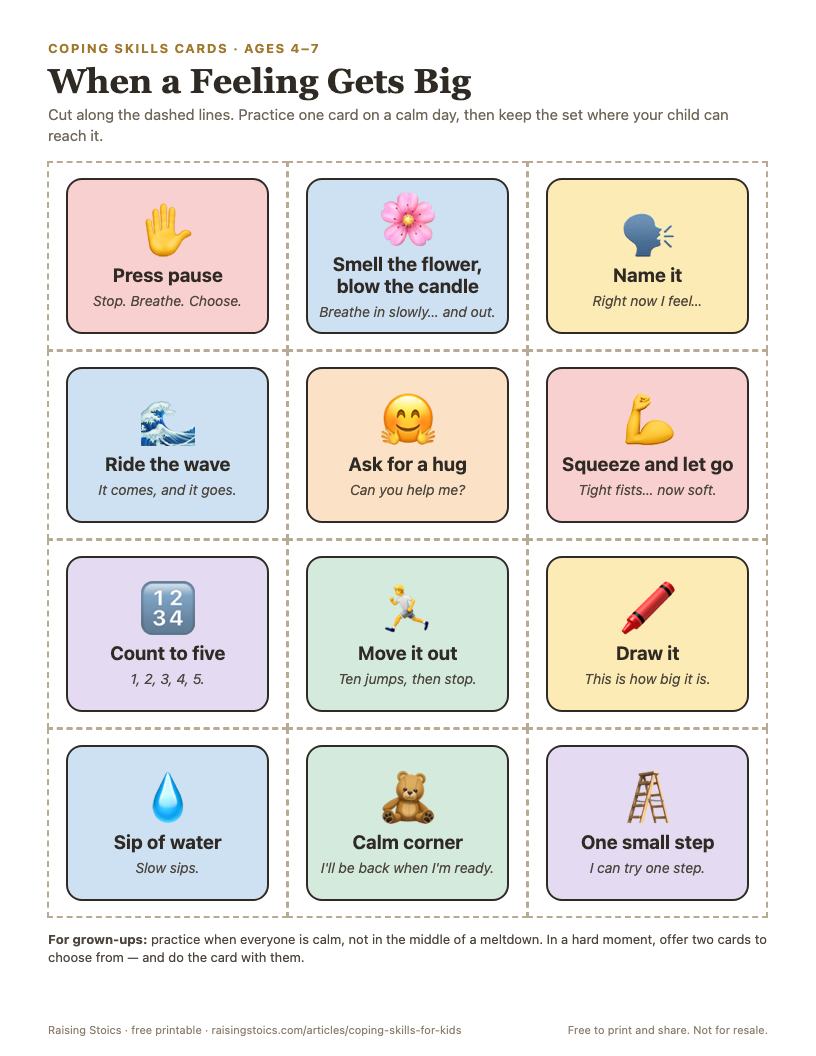
Free coping skills cards (12 cards)
Twelve cut-out cards with a picture, an action, and a short phrase your child can say: press pause, smell the flower and blow the candle, name it, ride the wave, ask for a hug, and more. US Letter, prints fine on A4.
What are coping skills for kids, and why start at 4–7?
Coping skills are the things a person does to get through a strong feeling or a hard situation without making it worse. For an adult that might be going for a walk or calling a friend. For a five-year-old it's simpler: a slow breath, a word for the feeling, a squeeze of the fists, a hug.
The early years are when children start to manage feelings with words and tools instead of only with their bodies. A preschooler who could only cry or hit at three can, by six, often say "I'm mad!" and stomp instead. That shift doesn't happen by itself; it grows out of hundreds of moments when an adult names the feeling, stays calm, and shows what to do.
There's also research on teaching it on purpose. A 2018 meta-analysis of social-emotional programs in childcare and preschool, covering children ages 2 to 6, found the largest gains in emotional competence: knowing, understanding, and regulating feelings. These were group programs in early-learning centers, not at home, but the skills are the same ones you can practice at home.
Why a child needs you first: co-regulation
Young children borrow calm from the adults around them before they can make their own. Researchers call this co-regulation. A 2017 practice brief for the federal Administration for Children and Families describes three kinds of support: a warm relationship, a predictable environment, and coaching in specific skills.
In practice, that means the first coping skill is yours. Take a slow breath yourself. Get down to your child's eye level. Use a calm, low voice. Name what you see: "You're really angry that the tower fell." Then offer one strategy and do it with them.
This is also why coping skills taught in the middle of a meltdown rarely stick. A child who is flooded has a hard time taking in anything new. They can only use what's already practiced, and only with help. The learning happens on calm days.
A coping skills list for kids ages 4–7
These 12 strategies are short, concrete, and doable without anything special. Each one fits on a card in the free printable above.
Press pause: stop, breathe, then choose what to do. Smell the flower, blow the candle: a slow breath in through the nose and a long breath out. A long breath out can help the body settle. Name it: "Right now I feel…" Putting a word to a feeling helps children recognize it and feel more in control. Ride the wave: the feeling rises, peaks, and goes down; you can wait for it to pass.
Ask for a hug, or for help. Squeeze and let go: tight fists for a count of three, then soft hands. Count to five, slowly. Move it out: ten jumps, a fast walk, a dance, then stop. Draw it: show how big the feeling is on paper. A sip of water, slowly. A calm corner: a quiet spot to go to and come back from when ready. One small step: for fear, try just the first, smallest part.
You don't need all 12. Most children do well with two or three that they've practiced many times.
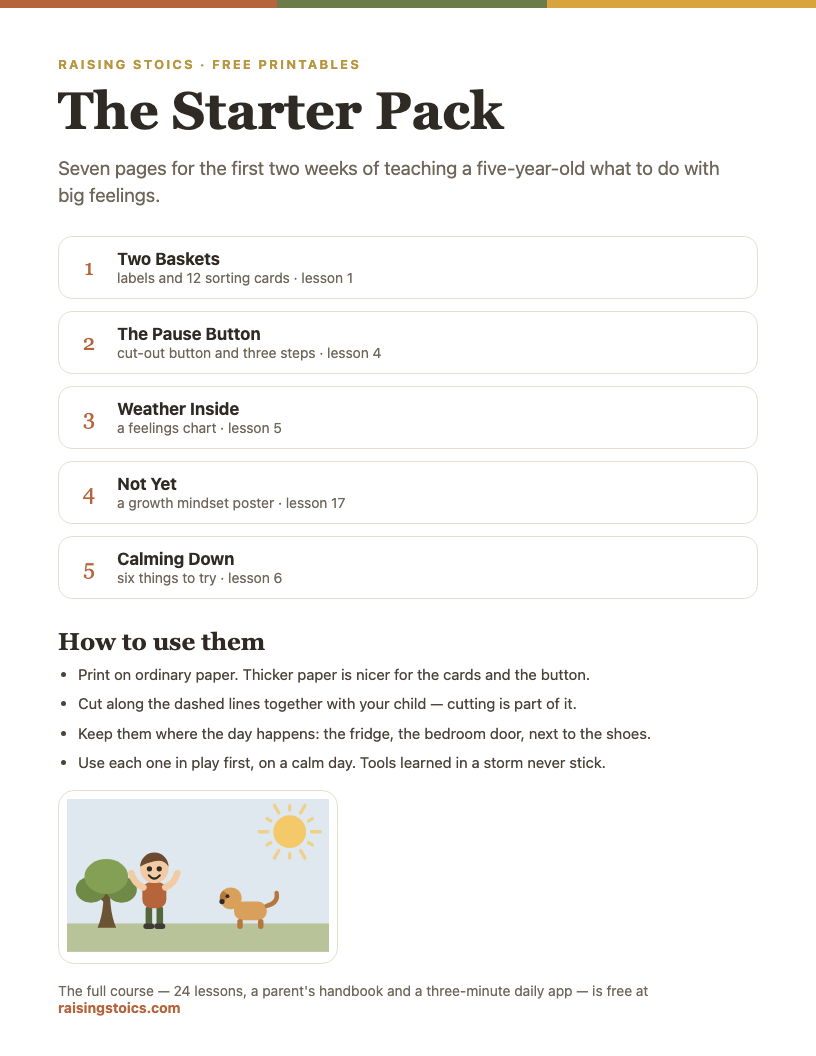
The Big Feelings Starter Pack
Nine pages for the first two weeks: a sorting game, a pause button, a feelings chart and a calm-down poster.
Download the free PDF See all 9 pages
Part of a free 9-page starter pack. Sign in with a code from your email — no password.
How to teach coping skills to a child
Teach on a calm day, practice often, and use it with them in the hard moment.
Pick one strategy a week. Introduce it as a game when everyone is relaxed: blow out pretend candles on your fingers, make your fists into tight rocks and then into soft jelly, see who can count to five the slowest.
Practice in small moments. Waiting in line, a slightly frustrating puzzle, a sad part of a story. "Want to try our candle breath?" These low-stakes moments are where the skill gets built.
Model it out loud. "I'm getting frustrated with this jar. I'm going to press pause and take a breath." Children learn a lot by watching how you handle things.
In the hard moment, keep it short. Name the feeling, offer two cards to choose from, and do the strategy together. Afterward, when everyone is calm again, notice it: "You took a breath even though you were really mad. That was hard to do."
Coping skills for anger
Anger in young children is fast and physical, so the strategies that help most are physical too. For the bigger picture at this age, see our guide to tantrums at 4 to 6.
Give the body somewhere to go. Squeezing fists and releasing them, stomping in place, pushing hard against a wall, or ten big jumps let the energy out without hurting anyone.
Then slow it down. A long breath out, or counting slowly, helps the body settle once the first wave has passed.
Then put words to it. "I'm mad because he took my block" is a huge step for a five-year-old. You can help: "You're mad. You wanted that block."
What to skip in the moment: long explanations, "why" questions, and lessons about sharing. Those can come later, when your child is calm and can actually think about it. If hitting is involved, the first job is keeping everyone safe, calmly and firmly, before any coping strategy.
Coping with frustration: when something is hard
Frustration is the feeling that shows up most often at this age: the tower falls, the shoe won't go on, the drawing doesn't look right, a game is lost. It's also the feeling behind a lot of "I can't do it!"
Three tools help most. First, a pause before the next try: a breath, or putting the thing down for a moment. Second, words that make room for trying again: "Not yet" instead of "I can't," or "I'm still learning this." Third, one small step: instead of the whole puzzle, just the corner pieces.
You can help by narrating the struggle without rescuing right away. "That piece is tricky. You've tried three ways. What's another way?" If they're close to tears, help with one part and let them finish the rest.
And let them see you be frustrated and keep going. A parent who says "Ugh, this jar is stuck. Let me try a different way" is teaching a coping skill without a single lesson.
Coping skills for anxiety and worry
Worry needs slightly different tools from anger, because the feeling is about something that might happen.
Slow breathing and muscle relaxation help the body calm down. Picturing a safe, calm place, or a calm person, can help too. Short, concrete self-talk can help at this age, with your support: "I can do hard things," "I can try one step."
The most important tool for fears, though, is facing them gradually rather than avoiding them. Break the scary thing into small steps, start with the easiest one, and praise the brave behavior, not the absence of fear. Avoiding everything that feels scary usually makes the fear bigger over time.
If your child's worry gets in the way of normal activities like going to school, sleeping, or playing with friends, or it doesn't get better, talk to your pediatrician.
Setting up a calm corner at home
A calm corner is a small, quiet spot a child can go to when a feeling gets big, and come back from when they're ready. It's not a time-out: nobody is sent there as a punishment, and an adult can sit there with them.
Keep it simple. A cushion or beanbag, a soft toy, a few books, and the coping skills cards are plenty. Some families add paper and crayons for drawing the feeling, or a glitter jar to watch settle.
Introduce it on a calm day. Sit there together, try a breath or two, and explain: "This is a place you can come when you need a minute. You can come back whenever you're ready."
In the moment, offer it rather than order it: "Do you want to go to the calm corner, or take a breath here with me?" For a child who's very upset, being alone can feel like rejection, so staying close is often better than sending them off.
If the corner starts to feel like a punishment, or your child never uses it, that's fine. It's one tool among many, not a requirement.
When to get help
Big feelings and meltdowns are normal at 4 to 7, and all children test limits. What matters is how often, how intense, and how much it gets in the way of everyday life.
Talk to your pediatrician if feelings or behaviors are severe and persistent, if they interfere with school, home, or play, if they seem unusual for your child's age, or if your child has lost skills they used to have. Tantrums that are still frequent and intense after age 5, or that often involve hurting themselves or others, a child who seems sad, irritable, or uninterested in fun things a lot of the time, or worry that keeps them from ordinary activities are all reasons to ask.
You know your child best. You don't need to be sure something is wrong to bring it up. If your child talks about wanting to die or to hurt themselves, or you fear for their safety, call or text 988, the Suicide & Crisis Lifeline, which also supports worried parents. If there is immediate danger, call 911 or go to the nearest emergency room.
If the hard feeling is grief, see how to talk to kids about death.
FAQ
What are coping skills?
Coping skills are strategies people use to deal with strong feelings and stress. For young children, they're simple and physical: slow breathing, naming the feeling, moving, squeezing and releasing, asking for help, or taking a break in a calm spot. Children learn them first with an adult's help and gradually use them on their own.
Why are coping skills important for kids?
A child without coping skills often has only two options when a feeling gets big: let it out with their body or hold it in. Coping skills give them a third: do something that helps. Over time, many children have fewer meltdowns, recover faster, and gain confidence that feelings can be handled.
How do you explain coping skills to a child?
Keep it concrete. "When a feeling gets really big, we can do things to help it get smaller. Let's find the ones that work for you." Then show them, one at a time, as games on a calm day. Cards with pictures help children who can't read yet remember and choose.
What are healthy coping skills for kids?
Healthy coping skills help a child feel better without hurting themselves, others, or things. Breathing, naming feelings, moving, drawing, asking for a hug, and taking a short break all qualify. Hitting, throwing, or hiding the feeling completely don't help in the long run, even if they work for a moment.
How long does it take a child to learn coping skills?
It varies a lot. Most children need many calm-day practices before they can use a strategy in a hard moment, and even then they usually need an adult to remind them. Expect to keep prompting through the early school years. Using a skill on their own, without being reminded, is usually the last step.
Calming Strategies for Kids: Calm-Down Tools That Actually Work
Calming strategies for kids ages 4–7: why telling a child to calm down fails, what to do during a meltdown, and the calm-down tools worth rehearsing.
Read next →The Pause Button is lesson 4 of the program: stop, breathe, choose — practiced as a game on a calm day, then used in real moments.