Programs for Kids' Big Feelings, Compared: Courses, Kits, Books and Apps
If your four- to seven-year-old melts down, gives up, or is frightened of half the world, there is no shortage of things to buy. Courses for parents, printable kits, picture books, apps, school programs. They solve different problems, and most families pick the wrong one first. Here is an honest map, including what we built ourselves and where it falls short.
What problem are parents of 4–7 year olds actually trying to solve?
Usually three things at once. Big reactions — tantrums, hitting, "I can't do it" and quitting, fears of the dark or of anything new. Not knowing what to do in the moment, even after reading a lot about it. And a nagging worry about screens standing in for the parent.
Most parents at this stage have plenty of theory. What they lack is a plan: what to do on an ordinary Tuesday, and what to say when the storm arrives. That is the lens we'll use below — each option is judged by whether it helps a real parent act differently, with this particular age group.
Big Little Feelings: what is it good for?
Big Little Feelings is one of the best-known parenting brands for young children, run by a family therapist and a parent educator, with a very large audience on social media. Its flagship course, Winning the Toddler Stage, covers ages 1–6 and costs $99; a shorter course for highly sensitive kids, Big Feelers, is $79 (prices as of September 2026).
Strengths: warm, practical, well produced, and backed by a big community. It is especially strong on the toddler years and on scripts for the parent.
Limits: it's a course for the adult. You watch videos and change how you respond, which is valuable, but there is no structured program you run with your child, and the center of gravity is toddlers rather than five- and six-year-olds who can already reason, sort and practice.
Good Inside: what is it good for?
Good Inside, from clinical psychologist Dr. Becky Kennedy, is a membership: a large library of workshops and scripts, an app, a community and live events. It costs about $279 a year or $84 for three months (as of September 2026).
Strengths: depth. It covers almost every parenting situation, with a consistent philosophy about connection and boundaries, and it keeps growing.
Limits: it's broad rather than sequenced, and it's for the parent. You choose what to watch when something comes up. For parents who want a set path — this week, this lesson, this phrase — the sheer size can be its own obstacle. And it's a subscription, so the cost continues.
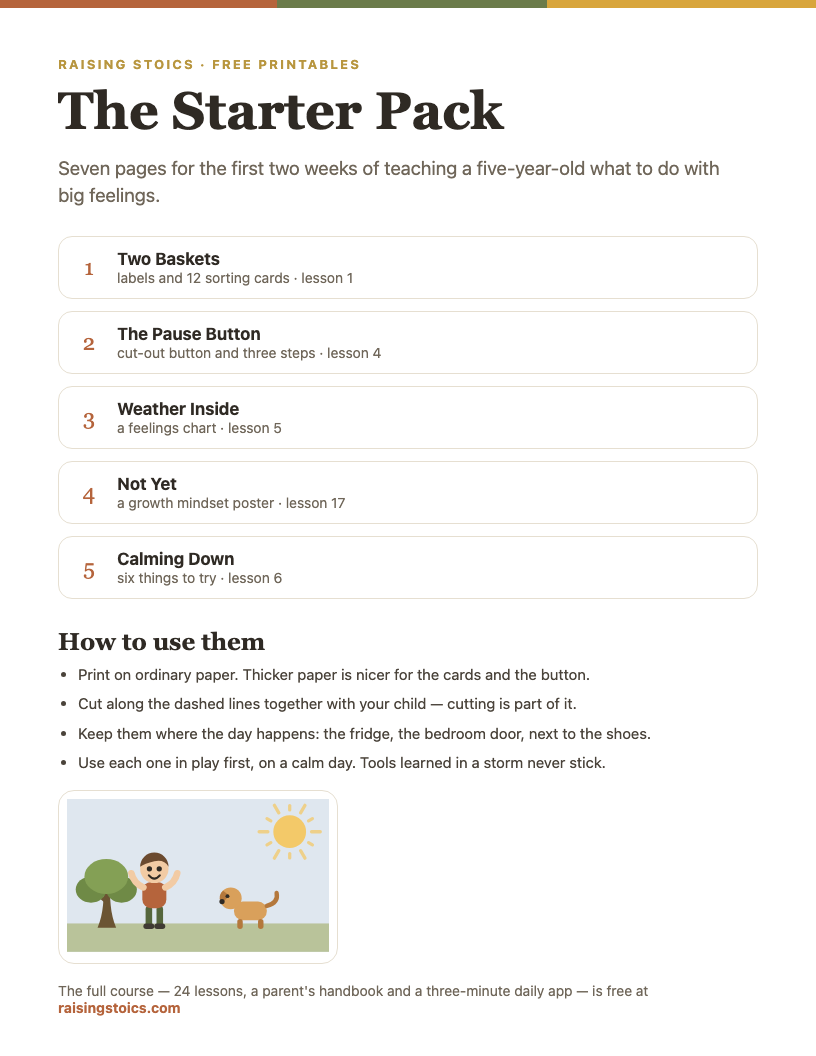
The Big Feelings Starter Pack
Nine pages for the first two weeks: a sorting game, a pause button, a feelings chart and a calm-down poster.
Download the free PDF See all 9 pages
Part of a free 9-page starter pack. Sign in with a code from your email — no password.
Big Life Journal and Generation Mindful: are printable kits enough?
They're both excellent at what they do, and both are all over Pinterest for good reason.
Big Life Journal makes growth-mindset journals by age, plus printable kits — one has around 50 worksheets for ages 5–11 — and sends free weekly printables. Generation Mindful is known for its Time-In ToolKit and calming-corner products; a full calming corner bundle with a plush toy and books is about $159 (as of September 2026).
Strengths: beautiful, ready-to-use materials that make a feeling visible and give a child something to hold.
Limits: a kit is a set of tools, not a sequence. The posters go up, and then it's on the parent to know which one to use when, and how to practice it on a calm day so it works on a hard one. Without that practice, most calm-down posters become wallpaper within a month.
What about books about Stoicism for kids?
There are more than you'd think. Stoicism for Kids collects 50 short original stories on resilience, patience and self-control. Ryan Holiday's illustrated The Boy Who Would Be King tells how the young Marcus Aurelius learned from his teacher. The Little Stoics series is aimed at the very youngest readers.
Strengths: stories are how five-year-olds take in ideas, and these ones carry real ones — what you control, how to face fear, how to stay fair.
Limits: a story is one evening. Turning "what's in my control" into something a child actually does when the tower falls takes repetition — a game, a phrase, a small practice every day. Books are the spark; they aren't the practice. We use picture books throughout our own course for exactly that reason, and we'd happily recommend these alongside it.
Are calm and mindfulness apps for kids a good option?
Some are lovely. Headspace and Calm both have children's content, Moshi is known for sleep stories and calming audio, and Sesame Workshop's Breathe, Think, Do is a free, gentle app for little ones.
Strengths: easy, soothing, and genuinely useful at bedtime or in the car.
Limits: the child uses them alone, and at four to seven the skill we're after — noticing a feeling rising and choosing what to do — is learned with an adult, in real situations, not only from audio. Apps are also, by design, something to come back to, which is the opposite of what many parents want from a screen.
Should we just rely on what the school or kindergarten does?
It's worth knowing what they use. Many schools run social emotional learning programs such as Second Step, or approaches like Conscious Discipline, and a good teacher does this work every day.
Strengths: consistency across a whole class, and trained adults.
Limits: school SEL is designed for groups, and a child's hardest moments usually happen at home — at bedtime, with siblings, when a game is lost. Home practice that uses the same ideas makes the school version stick. It doesn't compete with it.
So what is Raising Stoics, and how is it different?
We built Raising Stoics because none of the above did the whole job for our own five-year-old. It is a twelve-week home course for children aged 5–6: 24 lessons of twenty minutes that you run together, twice a week, from a fully scripted handbook; one key phrase a week to use in ordinary life ("Stop. Breathe. Choose."); and a three-minute daily app for the child, with a mission in the morning and three questions in the evening, that ends by itself. The ideas come from the Stoics — what's in my control and what isn't, the pause between what happens and what I do, "not yet" — put into words and games a five-year-old can actually use.
What makes it different is the combination: a sequence rather than a library, practice with the child rather than a course for the parent, and a screen that points back to the adult rather than replacing one. Printables are part of the lessons, so each poster arrives with the game that makes it work. And it's free.
Where it falls short, honestly: it's new, so there are no years of reviews yet. It asks for real time — about forty minutes a week together, plus the daily phrase. And it's built for 5–6; younger toddlers are better served by the toddler-focused courses above.
Which one should we choose?
Match it to what's missing.
If you need to change how you respond, and your child is under four, a parent course like Big Little Feelings is a good fit. If you want a deep, ongoing library for every situation, Good Inside. If your child needs something to hold and look at, and you already have a plan, a kit from Big Life Journal or Generation Mindful. If you want to plant the ideas, the Stoic picture books. For calm at bedtime, an app.
If what's missing is a plan you do together with a five- or six-year-old, step by step, with the materials included — that's the gap Raising Stoics was made for. You can read three of the lessons in full before signing up, and you can mix: the book tonight, the lesson on Saturday, the poster on the fridge.
Three of the 24 lessons are open in full, so you can see how a lesson actually runs before deciding.
Read next
Scared of Halloween? Helping a Kid Who's Afraid of Costumes and Monsters
Why Halloween frightens so many 4–7 year olds, what to say instead of "it's not real", and how
Gratitude Activities for Kids
Gratitude activities that work for kids aged 4–7: the Stoic 'imagine it's gone' game, a drawing
The course
Two twenty-minute lessons a week. Between them, one key phrase you use in ordinary life, a…