 Raising
Kindergarten Readiness Checklist: Skills by Area, With a Printable
A kindergarten readiness checklist can help you see where your child is, as long as you treat it as a map and not a test. NAEYC's position is that children are ready for kindergarten when they reach the legal age to enroll, and the AAP says schools are responsible for meeting children at every level of readiness. Below is a checklist built on the CDC's milestones for age 5, grouped by area, with what each skill looks like in real life, how to practice it, and when a gap is worth a call to your pediatrician.

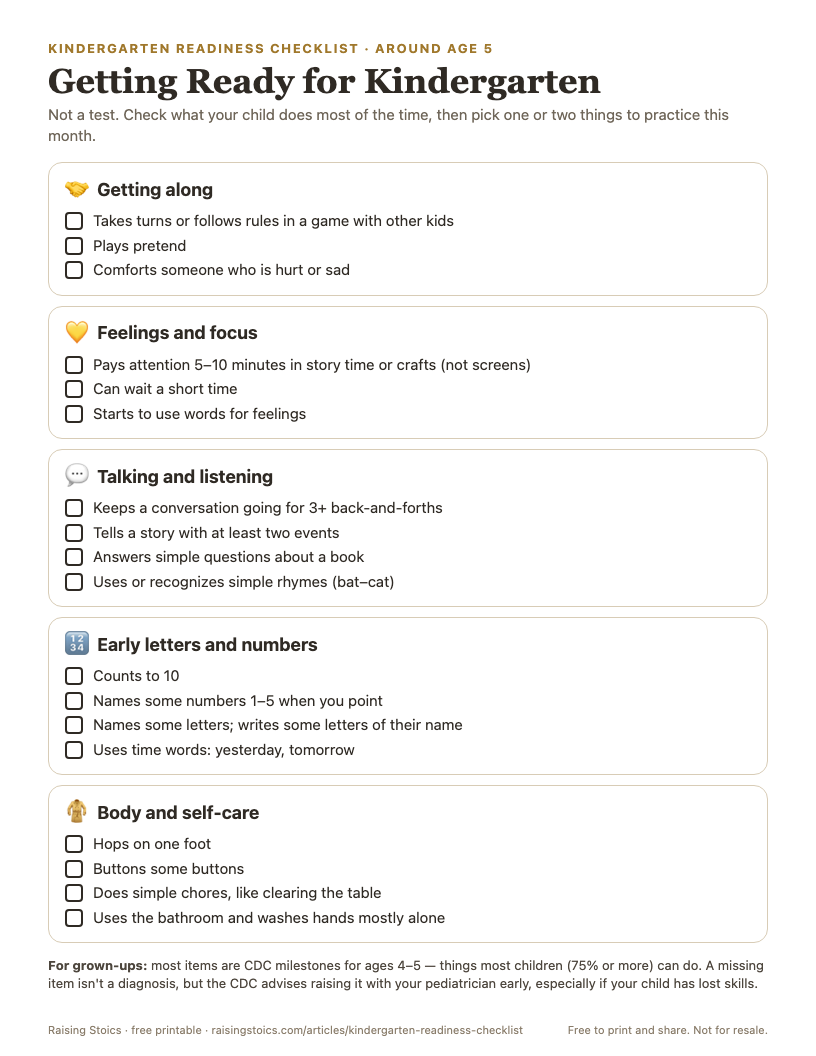
Free kindergarten readiness checklist (1 page)
One page of checkboxes grouped by area: getting along, feelings and focus, talking and listening, early letters and numbers, body and self-care. Adapted from the CDC's milestones, with a note on what to do if several boxes are empty. US Letter, prints fine on A4.
What "kindergarten readiness" actually means
The phrase sounds like a pass-or-fail test, but the major organizations in early childhood describe it differently.
The American Academy of Pediatrics describes school readiness as three things together: the readiness of the child, the school's readiness for children, and the ability of the family and community to support early development. It also says it's the responsibility of schools to meet the needs of all children at all levels of readiness.
The National Association for the Education of Young Children takes a similar position: children are ready to enter kindergarten when they reach the legal age of entry, and readiness doesn't arrive at the same time or in the same way for every child.
So the useful question isn't "Is my child ready?" but "What can I practice this year, and what should I tell the teacher?" A checklist helps with both.
The kindergarten readiness checklist, by area
These skills come from the CDC's developmental milestones for age 5, Plays pretend and comforts someone who is hurt or sad are CDC milestones for age 4. Waiting a short time, using words for feelings, and using the bathroom and washing hands are our own additions, not CDC milestones. CDC milestones are things most children, 75% or more, can do by that age. A missing item isn't proof that something is wrong. The CDC also says to talk with your child's doctor if a milestone isn't met, and not to wait.
Getting along: follows rules or takes turns in games with other children; plays pretend; comforts someone who is hurt or sad.
Feelings and focus: pays attention for 5 to 10 minutes during an activity like story time (screens don't count); can wait a short time; is starting to use words for feelings.
Talking and listening: keeps a conversation going for more than three back-and-forth exchanges; tells a story with at least two events; answers simple questions about a book after you read it; recognizes simple rhymes.
Early math and letters: counts to 10; names some numbers between 1 and 5 when you point to them; names some letters; writes some letters in their name; uses time words like "yesterday" and "tomorrow."
Body and self-care: hops on one foot; buttons some buttons; does simple chores like clearing the table; uses the bathroom and washes hands mostly on their own.
Social and emotional readiness: the part teachers notice first
Letters and numbers get most of the attention, but the social and emotional skills matter just as much for settling in. The AAP's guidance for parents lists being able to focus and pay attention, control impulses and emotions, take turns, and make friends.
These are also the skills that grow fastest with practice. A few ways to build them this year:
Play board games and card games with simple rules. Taking turns, losing, and waiting are all built in.
Practice short waits on purpose: "I'll help you as soon as I finish this," then keep the promise.
Name feelings out loud, yours and theirs. "You look frustrated. That puzzle piece won't fit."
Give your child a few minutes of focused activity every day, like a puzzle, a drawing, or a story, and gradually stretch it.
Arrange time with other children, especially some who will be in the same class.
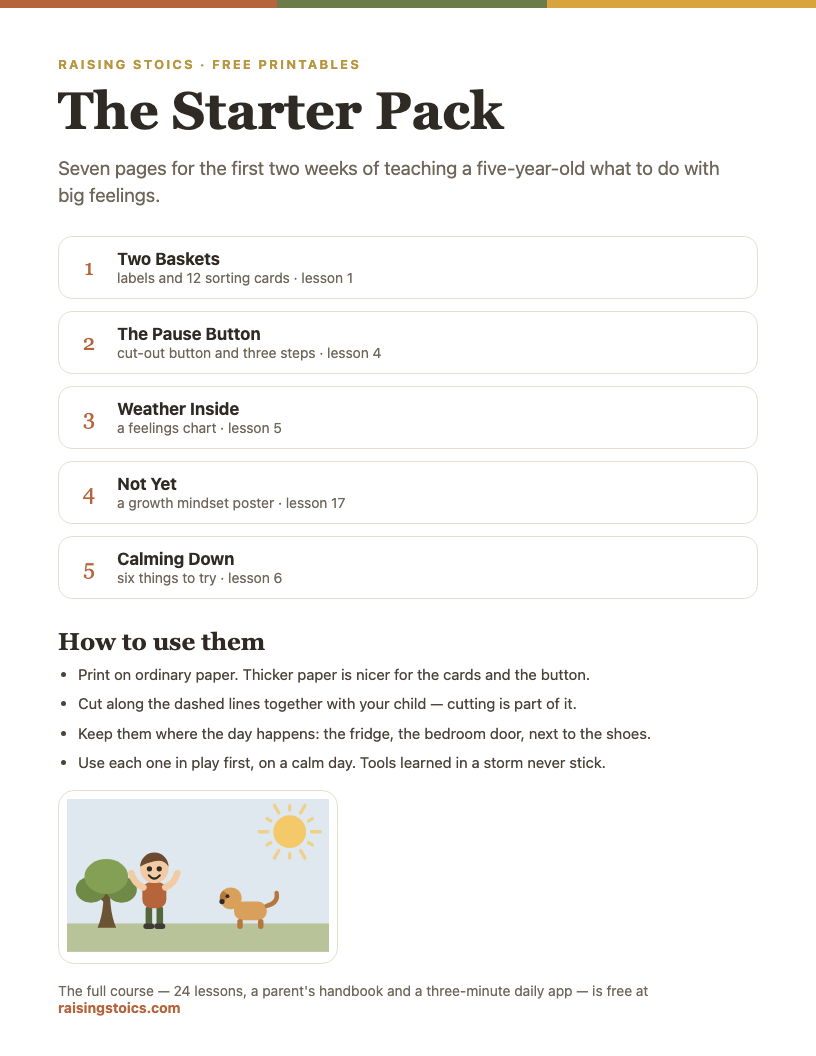
The Big Feelings Starter Pack
Nine pages for the first two weeks: a sorting game, a pause button, a feelings chart and a calm-down poster.
Download the free PDF See all 9 pages
Part of a free 9-page starter pack. Sign in with a code from your email — no password.
Early academic skills: helpful, not required
Kindergarten is where children are taught to read, write, and do math. A child doesn't need to arrive already reading.
What helps most is familiarity: hearing a lot of books read aloud, playing with rhymes and letter sounds, counting real things, noticing numbers and letters around them. If your child can count to 10, recognize some letters, and try writing their name, they're in line with the CDC's age-5 milestones.
The simplest daily habit with the biggest reach is reading aloud and talking about the book: "What do you think happens next?" "Why is she sad?" That one activity builds vocabulary, attention, early literacy, and the ability to think about other people's feelings at the same time. For what's typical at each age, see when do kids learn to read.
Kindergarten readiness assessments and screenings
Many states and districts give a kindergarten readiness assessment or screening at the start of the year, or during kindergarten registration. These usually look at a mix of early literacy, early math, language, motor, and social-emotional skills.
The AAP says these tools should guide teaching and extra support, not keep children out. Practices vary by state, so ask your district. The AAP notes that readiness tests are far from perfect and that some children who do poorly on them do just fine in school, and NAEYC has long opposed using readiness tests to keep children out of kindergarten.
If your district does a screening, ask what it's for and what happens with the results. It can be a useful conversation starter with the teacher.
Age cutoffs and the question of waiting a year
Most states set a birthday cutoff for kindergarten entry, and many require children to turn 5 on or before a date around September 1. The exact date varies by state, some leave it to districts, and states do change their laws, so check your state and district directly.
Some families of children with summer or fall birthdays consider waiting a year, sometimes called redshirting. A 2013 study using national data (Bassok and Reardon) estimated that about 4% to 5.5% of children delay kindergarten, depending on how delay is defined. Research on long-term benefits is mixed: one well-known review (Deming and Dynarski, 2008) found little evidence that being older than classmates has lasting positive effects on adult outcomes, while a Danish study found that starting a year later reduced inattention and hyperactivity at age 7. Danish children start school later than American children, so that finding doesn't transfer directly.
The AAP cautions that delaying school can keep some children out of the best learning environment for them, and notes that the academic disadvantage of being among the youngest tends to fade within the first few years of school. If you're unsure, talk with your child's preschool teacher and pediatrician, who know your child.
When to talk to your pediatrician
A checklist is not a diagnosis. Each CDC milestone is one that up to one in four children hasn't reached yet at that age, so a missing item is common and not a diagnosis. The CDC's advice is still to raise it with your pediatrician early; a short conversation costs nothing.
Talk to your pediatrician if several items in one area are missing, if your child has lost skills they used to have, or if you're worried for any reason. The CDC's guidance for parents is simple: you know your child best, and you don't need to wait. Your pediatrician can do a developmental screening, and if needed, if your child is 3 or older, your local school district must evaluate them for free under the federal Child Find rules to see whether they qualify for special education services. For children under 3, contact your state's early intervention program.
It's also worth telling your child's new teacher what you've noticed. Teachers adjust for children at many different levels every year.
FAQ
Is my child ready for kindergarten?
If your child is old enough to enroll in your state, they can start: schools are expected to meet children where they are. If you have developmental concerns, don't wait for school to find out. Use a checklist to find skills to practice and things to share with the teacher, and talk to your pediatrician if several skills in one area are missing.
Is there a kindergarten readiness quiz?
Online quizzes can be a starting point, but many aren't based on research. The CDC's free Milestone Tracker app and its age-5 milestone checklist are a more reliable tool, because the milestones were updated in 2022 by a group of experts using the available evidence.
What is a kindergarten readiness assessment?
It's a screening some states and districts give at registration or early in kindergarten, covering skills like early literacy, math, language, motor, and social-emotional development. In most places it's used to plan teaching and spot children who may need support, not to decide whether a child can enroll. Ask your district what theirs is for.
How do I get my child ready for kindergarten?
Read aloud every day and talk about the books. Play games with turns and simple rules. Practice short waits, naming feelings, and a few minutes of focused activity. Build self-care: bathroom, handwashing, coats, and shoes. In the last few weeks, visit the school if you can, and talk about what a day will look like.
What are kindergarten readiness skills?
They're the social, emotional, language, early academic, and physical skills that help a child settle into kindergarten. They include taking turns, following simple directions, paying attention for short stretches, handling frustration, using words for needs, and basic self-care. Early letters and numbers help, but kindergarten is where children are taught to read and do math.
Kindergarten Homeschool Curriculum: 14 Programs Compared
Kindergarten homeschool curriculum compared: prices, subjects, daily time, and faith stance of 14 programs, checked on publishers' sites, plus how to choose.
Read next →Raising Stoics is a 12-week program for ages 5–6 on the social-emotional side of readiness: waiting, handling frustration, trying something hard, and naming feelings. It doesn't teach letters or numbers and isn't a screening.