 Raising
Chore Chart for Kids Ages 4–7: Jobs by Age and a Free Printable
A chore chart for kids works best when it's short, has pictures, and is about helping the family rather than earning points. At 4 to 7, children can do a surprising amount around the house, and many of them want to. This guide covers which jobs fit this age, how to set up a chart your child will actually use, what to do about rewards and allowance, and a free printable weekly chart.

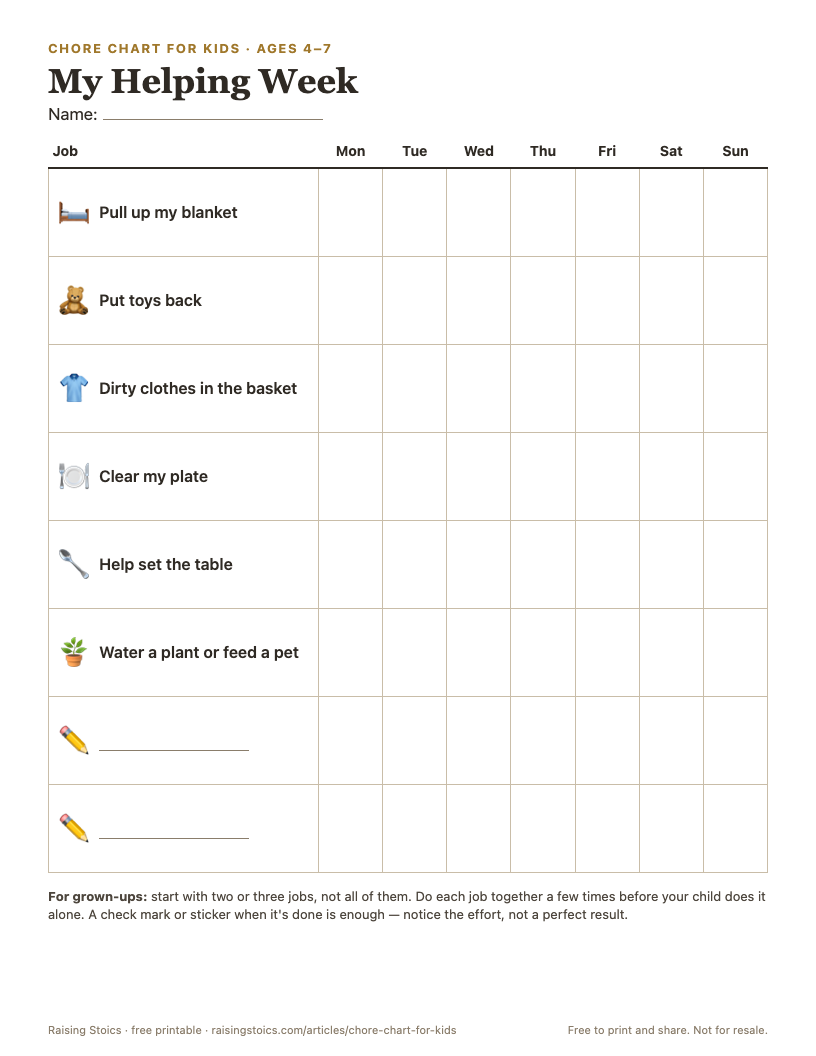
Free printable chore chart for kids (1 page)
A weekly chart with six picture jobs for ages 4–7, two blank rows for your own, and a box for each day. Pictures mean a child who can't read yet can still use it. US Letter, prints fine on A4.
Why chores matter at 4–7
Young children often want to help. The CDC lists "likes to be a helper" among its milestones for age 4, and "does simple chores at home, like matching socks or clearing the table after eating" for age 5. Chores at this age are less about getting the house clean and more about a child seeing themselves as someone who contributes.
There's some research behind this, with limits. A US study following nearly 10,000 children (White, DeBoer, and Scharf, 2019) found that children whose parents reported more frequent chores in kindergarten rated themselves more competent socially, academically, and in life satisfaction by third grade, and had better math scores. The study shows an association, not cause and effect: families where children do chores may differ in many other ways.
You may also see claims that chores at age 3 or 4 are "the best predictor" of adult success. That claim is usually traced to an analysis from the University of Minnesota that, as far as we could find, was never published in a peer-reviewed journal, so we'd treat it with caution.
Age-appropriate chores for kids 4–7
The American Academy of Pediatrics lists chores for ages 5 to 7 that include making their own bed, setting and clearing the table, putting toys away, putting dirty clothes in a hamper, filling a pet's food dish, emptying wastebaskets, sweeping, sorting laundry, bringing in the mail, watering flowers, dusting, and washing plastic dishes in the sink.
The AAP's list starts at age 5. For 4-year-olds, here are simpler versions we suggest: put toys in a bin, carry their plate to the counter, put clothes in the basket, help feed a pet, match socks, wipe up a spill with a cloth.
A few practical notes. "Make the bed" at this age means pulling up the blanket. "Set the table" means napkins and spoons first, plates later. Anything with knives, hot surfaces, glass, or chemicals stays with adults, and stay nearby when pets are involved.
Start with two or three jobs, not ten. A short list a child can manage beats a long one that turns into nagging.
How to make a chore chart for kids
Use pictures. Many 4- and 5-year-olds can't read yet, and a picture of a toy bin or a plate tells them what to do without asking you.
Keep it to one week. A weekly grid with days across the top and jobs down the side is easy to understand and easy to restart every Monday.
Start with two or three jobs. Add more only when the first ones are routine.
Teach each job before it goes on the chart. Do it together a few times, then let your child do it while you watch, then let them do it alone. Skipping this step is a common reason charts fall apart.
Put it at your child's eye level, near where the jobs happen, often on the fridge.
Let your child mark it. A check, a stamp, or a sticker they put on themselves gives them ownership.
The free printable on this page follows all of these: six picture jobs, two blank rows, and a box for each day.
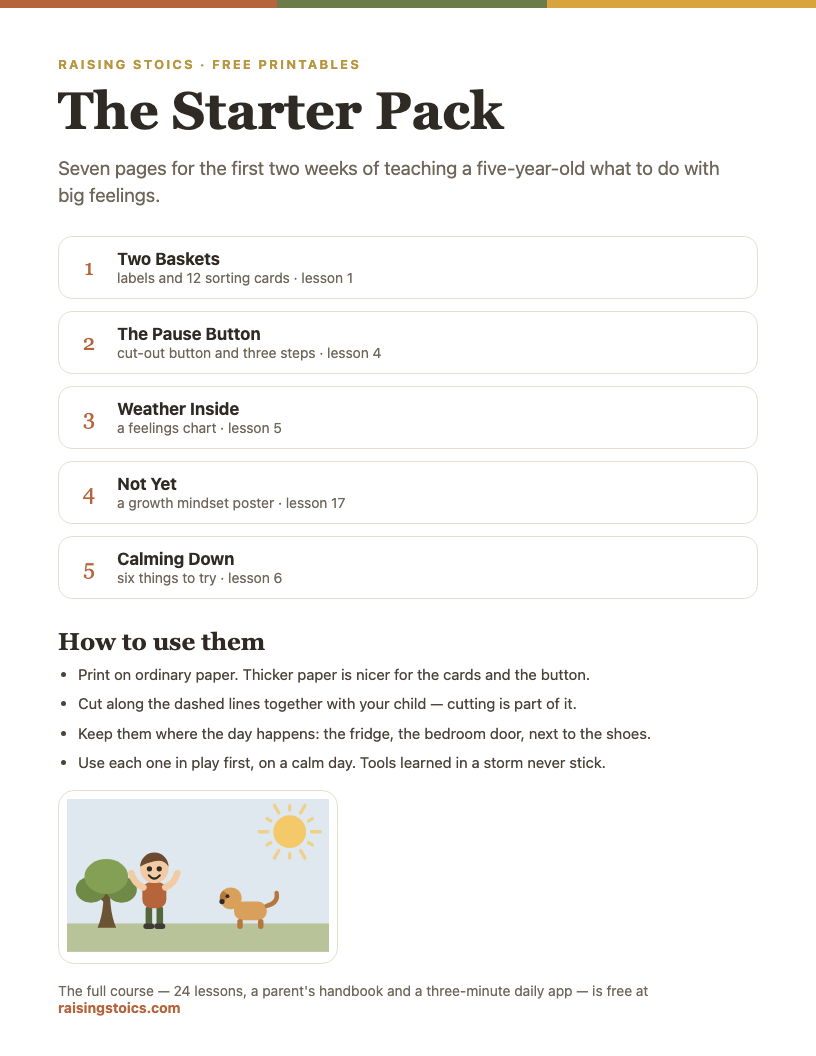
The Big Feelings Starter Pack
Nine pages for the first two weeks: a sorting game, a pause button, a feelings chart and a calm-down poster.
Download the free PDF See all 9 pages
Part of a free 9-page starter pack. Sign in with a code from your email — no password.
A sample chore routine for a 5-year-old
Chores stick best when they're attached to things that already happen every day. Here's one way a week might look for a five-year-old.
Morning: pull up the blanket on the bed, put pajamas under the pillow or in the hamper.
Before meals: carry napkins and spoons to the table.
After meals: carry their own plate and cup to the counter.
Before bed: put toys back in their bins, dirty clothes in the basket.
Once or twice a week: water a plant, help feed a pet, help sort clean laundry by matching socks.
That's only a few minutes a day, spread out, and most of it happens at moments when you're already there to help. As each job becomes automatic, you can hand over a bit more, like setting the whole table or sorting all the socks.
Chore charts and rewards: what to watch for
Stickers and checkmarks are fine as a way to see progress. Some parents find that every bit of help starts to feel like a transaction: "What do I get if I clear my plate?"
A few ways to keep the focus on contributing:
Separate family jobs from extra jobs. Family jobs, like clearing your plate and putting toys away, are things everyone does because they live here. Extra jobs, like helping wash the car, can come with something extra if you want.
Praise the effort and the help, not just the result: "You carried every plate. That really helped me."
Notice the help out loud in front of others sometimes. Children at this age care a lot about being seen as a helper.
If a sticker chart has become the whole point, it's fine to retire it once the jobs are habits. The goal is helping without the chart.
Should kids get paid for chores?
Families disagree on this, and there isn't one right answer. The AAP mentions allowances and stickers tied to completed chores as one option; other families keep family jobs unpaid. Either can work.
One common approach is a split: family jobs are unpaid, because everyone contributes to the home, and a small allowance or payment is tied to extra jobs, or given separately as a way to learn about money.
At 4 to 7, the money itself is mostly a learning tool. Children can start to understand that money is limited, that you can save for something, and that choices have trade-offs. A clear jar for saving and a few coins they can count are more useful than an app.
Whatever you choose, keep it simple and consistent. A system that changes every week is harder for a young child than any particular rule.
Chore charts for siblings of different ages
With more than one child, fairness quickly becomes the main topic. A few things make it easier.
Give each child their own row or their own chart. Comparing one long list across children invites "She has fewer jobs!"
Match jobs to ability, not to equal counts. A seven-year-old might set the whole table while a four-year-old puts out the napkins. Explain it simply: "You're each doing a job that's right for you."
Give older children a job that's clearly theirs and a bit grown-up, like watering the plants or feeding the pet. Being trusted with something real matters a lot at this age.
Let siblings do some jobs together, like clearing toys from the living room. Working side by side often goes better than separate jobs in separate rooms.
How to make chores fun for kids
Do them together. At this age, "Let's clean up together" works far better than "Go clean your room."
Make a game of it: race a song, see how many blocks go in the bin before the timer, sort socks into pairs like a memory game.
Give real tools in their size: a small broom, a spray bottle filled with plain water, never cleaning products, a cloth of their own.
Offer choices: "Do you want to feed the cat or water the plants?" Choosing gives a child a sense of control over the work.
Accept a child-level result, and let it be good enough for now. A bed that's pulled up crookedly is still a bed your child made, all by themselves. Redoing it in front of them can send the message that their help doesn't count.
When chores turn into a fight
Some days your child won't want to. That's normal at 4 to 7, and it's not a sign the chart has failed.
Keep the job, lower the size. "You don't have to put all of them away. Put the blue ones away, and I'll do the rest with you."
Link the job to what comes next, calmly: "When the toys are in the bin, we'll go to the park."
Avoid long lectures. A short, friendly reminder and then helping them start is usually enough.
If refusals are constant, check the list. It may be too long, too hard, or happening at a tired time of day. Moving a job from after school to the morning can change a lot. If your child melts down about chores almost every day, or has trouble following simple steps most children their age manage, mention it to your pediatrician.
FAQ
Are chores good for kids?
Chores can help children build skills, independence, and a sense of contributing to the family. A large US study found that kindergartners who did chores more often rated themselves more competent and had better math scores in third grade, though that shows an association, not proof that chores caused it.
How many chores should a 5-year-old have?
Two or three regular jobs is a good start for most 5-year-olds, such as putting toys away, clearing their plate, and putting clothes in the hamper. Add more only once those are routine. A short list your child actually does is better than a long one that leads to nagging.
How much should you pay kids for chores?
There's no standard amount. Some families give a small weekly allowance not tied to chores and pay only for extra jobs; others don't pay for chores at all. At 4 to 7, small amounts are enough, because the goal is learning to count, save, and choose, not earning.
What chores can a 4-year-old do?
A 4-year-old can put toys in a bin, carry their own plate to the counter, put dirty clothes in a basket, help feed a pet, match socks, and wipe up small spills. Teach each job together first, and expect a child-sized result.
Should chore charts have rewards?
Simple rewards like stickers or checkmarks help young children see their progress. Keep them small, praise the help itself, and consider phasing the chart out once jobs become habits, so helping doesn't depend on a reward.
How to Teach Kids Responsibility: Ownership, Not Obedience
How to teach kids responsibility at ages 5 and 6: why it isn't the same as doing what you're told, and a short chores list that fits small hands.
Read next →Raising Stoics is a 12-week program for ages 5–6. Week 8 is about fairness and helping: "I play fair" and "I can help."