Feelings Wheel Printable for Kids: A Simple Emotion Wheel for 4–7
This feelings wheel printable is made for young children, not adults. The famous feelings wheel has more than seventy words — far too many for a five-year-old. Ours has six core feelings with faces, twelve more exact words around them, and a coloring version with a spinner you can make together.

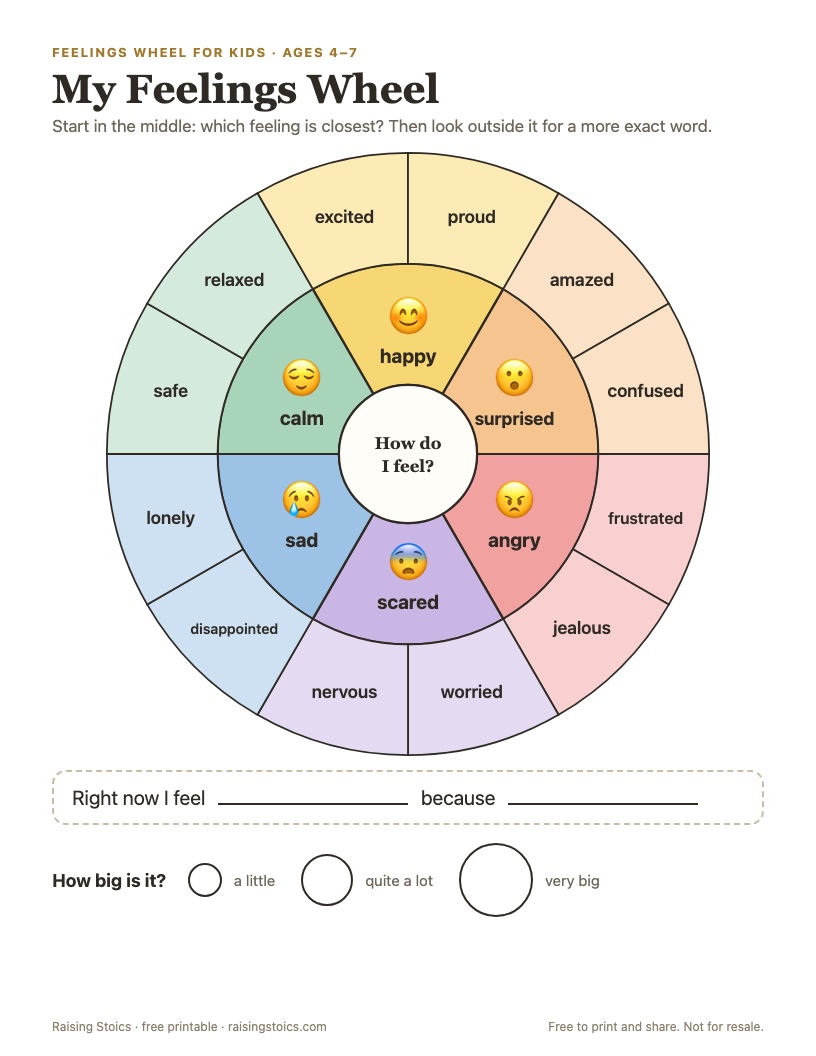
Free feelings wheel printable (2 pages)
Page 1: a colored feelings wheel with a "Right now I feel… because…" line and a "how big is it?" scale. Page 2: the same wheel to color in, a spinner arrow to cut out, and four tips for grown-ups. US Letter, prints fine on A4.
What is a feelings wheel?
A feelings wheel is a circle of emotion words arranged in rings: a few broad feelings in the middle and more specific ones further out. You start at the center — "I feel angry" — and move outward to find the exact word — "actually, I feel frustrated."
The best-known version was published by therapist Gloria Willcox in 1982 as The Feeling Wheel, to help adults put words to what they felt. It has six core feelings and dozens of more specific ones. A different and older idea, psychologist Robert Plutchik's wheel of emotions from 1980, arranges eight basic emotions by intensity and is more of a theory than a tool.
What both do well is show that feelings come in families. Frustrated, jealous and annoyed are all relatives of angry; worried and nervous are relatives of scared. For a child, seeing that a big messy feeling has a name — and a family — is often a relief in itself.
Why a feelings wheel for kids needs to be simpler
The adult feelings wheel is a brilliant tool for a teenager or a grown-up in therapy. For a four- to seven-year-old, it's mostly wallpaper.
Young children can't yet read most of the words, and even read aloud, a wheel with seventy options is overwhelming. Research on emotion knowledge suggests children build their feeling vocabulary gradually: basic words like happy, sad, angry and scared first, then more precise ones like frustrated, disappointed and proud through the early school years.
So a feelings wheel for kids should do three things. Use faces or pictures for the core feelings, so a child who can't read can still point. Keep the outer ring small — two words per feeling is plenty to start. And choose the words that actually come up at this age: frustrated, disappointed, worried, jealous and proud appear in a five-year-old's week far more often than "inadequate" or "apathetic."
That's how our printable is built: six core feelings with faces, twelve outer words, and nothing else competing for attention.
Why does naming feelings help young children?
Because a feeling with a name is easier to manage than one without.
Research on emotion knowledge — children's ability to recognize, understand and name feelings — has found consistent links with getting along better with other children and having somewhat fewer behavior problems. The links are modest and don't prove that naming alone causes the change, but they've been found across many studies.
There are practical reasons, too. A child who can say "I'm frustrated" can tell you what's wrong instead of showing you by throwing the puzzle. A parent who knows the feeling can help much more precisely: frustration needs a different response from disappointment or worry. And over time, catching a feeling early, while it's still small, is what lets a child use a calming tool before the storm arrives.
In adults, simply putting a feeling into words has been shown to take a little of the edge off it. Whether the same happens in a five-year-old in the middle of a meltdown is less clear — which is why the wheel is for calm moments, and the naming during a storm should be short.
Our study brief on naming feelings goes through the research and its limits.
Weather Inside feelings chart
Six kinds of weather to point to, plus “Right now I feel… because…”.
Download the free PDF See all 9 pages
Part of a free 9-page starter pack. Sign in with a code from your email — no password.
How to use a feelings wheel with kids
A feelings wheel works best as a short daily habit, not an emergency tool.
Put it somewhere you pass every day: the fridge, the bedroom door, next to where coats and shoes go. At the same moment each day — after school, at dinner, at bedtime — do a thirty-second check-in.
Go first. Point to your own feeling and say one sentence: "I'm a bit worried because Grandpa is sick." Children learn feeling words mostly by hearing adults use them about themselves.
Then invite, don't quiz. "Where are you on the wheel right now?" If they point to the middle ring, that's enough. If they seem ready, ask: "Is it more like frustrated, or more like jealous?"
Add "how big?" A little angry and very angry need different help. The size circles on the printable make this easy to show.
Finish with "because", if they want to. "Right now I feel ___ because ___" turns a feeling into something you can talk about.
Keep it light and short. The goal is not a report; it's making every feeling ordinary enough to name.
Feelings wheel activities for kids
Once the wheel is familiar, a few games make it more than a poster.
Spin and tell. Spin the arrow on the coloring version. Whoever spins tells about a time they felt that feeling. Grown-ups play too.
Feelings charades. One person picks a word from the wheel and acts it out with face and body; everyone else points to it on the wheel. It trains reading other people's faces, and it's usually very funny.
Story check. While reading a picture book, pause and ask: "Where is the bear on the wheel right now?" Book characters are a safe way to talk about big feelings.
Color your feelings. On the blank wheel, let your child choose a color for each feeling. Talk about their choices: why is scared purple? There are no wrong answers.
Feelings of the week. Choose one outer word each week — frustrated, proud, disappointed — and try to spot it in real life, in yourselves and in others. By the end of the term, those twelve words will be part of your family's vocabulary.
How to make a feelings wheel together at home
If you'd rather make your own, it takes about twenty minutes and a paper plate.
Draw two circles on the plate — a small one in the middle and a larger ring around it — and divide it into six slices, like a pizza. In each inner slice, your child draws a face for one feeling: happy, sad, angry, scared, surprised, calm. Write the word underneath.
For the outer ring, ask your child: "What's another word for when you're angry — like when your tower falls down?" Write down whatever they say, even if it isn't a "proper" feeling word. Grumpy, cross and furious all count. Add one or two of your own if they're stuck.
Let them color each family in its own color. Then cut an arrow from card and attach it to the middle with a paper fastener.
A homemade wheel has one big advantage over any printable: the words are theirs. Children use tools they helped make. And the conversation while you make it — "When were you last surprised?" — is often worth more than the wheel itself.
Which feelings are on our wheel, and why these?
The six core feelings are happy, surprised, angry, scared, sad and calm. The first five are close to the basic emotions most researchers agree young children recognize early. We added calm because children need a name for the feeling they're heading toward, not only the ones they're caught in.
The twelve outer words were chosen because they come up constantly between four and seven. Excited and proud sit next to happy. Amazed and confused sit next to surprised. Frustrated and jealous belong with angry — frustration is behind a large share of five-year-old meltdowns. Worried and nervous belong with scared. Disappointed and lonely belong with sad; disappointment is the feeling behind many "it's not fair!" storms. Safe and relaxed belong with calm.
If your child uses a word that isn't on the wheel — cross, grumpy, silly, left out — write it in. A wheel with their own words on it is better than ours.
Using a feelings wheel in a preschool or kindergarten classroom
A feelings wheel fits naturally into morning circle.
Put a large copy on the wall at children's eye level. At the start of the day, each child points to where they are, or places a clothespin with their name on the wheel. The teacher names what she sees without asking everyone to explain: "Lots of sleepy and excited faces today."
Use it for stories. When reading to the group, pause once and ask where a character is on the wheel. Children often find it easier to talk about a character's feelings than their own.
Use it for conflicts, afterwards. When two children have argued, the wheel can help each say what they felt, once everyone has calmed down: "I was frustrated because you took the blocks."
Keep a small copy in the calm corner, so a child who goes there can point to the feeling that brought them.
And send one home. When families use the same words as the classroom, children practice twice as often. Our free SEL curriculum for preschool and kindergarten builds a feelings check-in into its circle times.
Feelings wheel or feelings chart: which should I use?
Either works, and they do slightly different jobs.
A simple feelings chart with five or six faces is the easiest place to start, especially for four-year-olds. It answers one question: which feeling is this?
A feelings wheel adds a second step: once you know the family, which exact word fits? That makes it a good next step for five- to seven-year-olds who already use the basic words and are ready for frustrated, disappointed and proud.
Some families use both: the chart for a quick daily check-in, the wheel for the conversation afterwards. Our guide to feelings charts for kids explains how to use a chart well, and the free starter pack includes a simple weather-style feelings chart.
FAQ
Is there a free feelings wheel printable for kids?
Yes — the two-page feelings wheel printable on this page is free to print and share for home or classroom use. Page one is a colored wheel with six core feelings and twelve more exact words, plus a "how big is it?" scale. Page two is a coloring version with a cut-out spinner and tips for grown-ups.
What age is a feelings wheel for?
A simple feelings wheel with faces and a small number of words suits children from about four to seven. Younger children do better with a chart of four or five faces. From about eight, children can use a fuller wheel with more words, and teenagers and adults often use the classic wheel with seventy or more.
How many emotions are on a feelings wheel?
It depends on the wheel. The classic Feeling Wheel by Gloria Willcox has six core feelings and more than seventy words in total. Wheels for children are much smaller. Ours has six core feelings and twelve more specific ones — eighteen words — which is plenty for four- to seven-year-olds.
Who created the feelings wheel?
The widely used Feeling Wheel was created by therapist Gloria Willcox and published in 1982 in the Transactional Analysis Journal. A different model, the wheel of emotions, was developed by psychologist Robert Plutchik in 1980. Many printable wheels today, including ours, are simplified adaptations for particular ages.
Can a feelings wheel help with tantrums?
Indirectly. In the middle of a tantrum, a child can't use a wheel, so just stay close and name the feeling in a few words. The wheel helps before and after: daily practice gives a child words like frustrated and disappointed, and a child who can say "I'm frustrated" has an alternative to throwing things. Over months, that tends to make storms shorter.
Naming the weather inside is lesson 5 of the course — the first step before calming down.
What the research says
Read next
How to Teach Kids Responsibility
How to teach kids responsibility at 5 and 6: why it isn't the same as doing what you're told, a
How to Encourage Kids to Share (Without Forcing It)
How to encourage kids to share at 4–6: why forced sharing backfires, how turn-taking and timers
Why Is My 5-Year-Old So Angry? Anger Management for Kids 4–7
Why is my 5-year-old so angry and aggressive? What anger is telling you, anger management for k