 Raising
How to Talk to Kids About Death: Gentle, Plain Words That Help
A goldfish floats at the top of the tank, or a phone call brings news about Grandma, and suddenly you need words you never practiced. Knowing how to talk to kids about death doesn't take a script. It takes short, honest answers, said gently, and a willingness to say them again.

What do 4- to 7-year-olds understand about death?
Often less than adults, and more than many adults expect. Researchers often break the idea of death into a few parts:
Irreversibility. Dead things don't come back to life.
Nonfunctionality. When something dies, its body stops working. It doesn't eat, breathe, feel cold, or feel hurt anymore.
Universality. Every living thing dies at some point, including people we love.
A classic review of research on children's understanding of death concluded that most children in the studies came to understand all three between about 5 and 7. That's an average across many children, not a deadline, and individual children vary.
Some later researchers also include another part: causality, understanding what actually makes a body stop working, such as a serious illness or an accident. Young children may fill this gap with their own ideas, including magical ones: that a bad thought, an angry word, or something they did caused the death.
So a 4-year-old may hear "Grandpa died" and ask, the next day, when he's coming back. That isn't denial or not listening. They may not yet have the idea that dead means forever. A 6- or 7-year-old is more likely to understand that it's permanent, and may then start to worry about who else could die.
How to talk to kids about death: start with plain words
Short answer: use the real words, "died" and "dead," and explain them in terms of the body.
For example: "Grandpa died. That means his body stopped working. His heart stopped beating, and he can't breathe, eat, or feel anything anymore. He isn't hurting. He won't come back, and we're going to miss him very much."
That may sound blunt to an adult. To a young child, it's clear, and clear is comforting. A study of 90 children ages 4 to 8 found that those who understood death as a biological event tended to be less afraid of death, even after accounting for age and general anxiety. It's one correlational study, so it can't show that explaining death reduces fear, but it fits with the common advice to use clear, concrete words.
Some other points that help:
- Tell them soon, yourself, somewhere quiet. Children often notice that something is wrong before anyone tells them.
- Keep the first explanation short, then stop and let them ask.
- It's fine to say "I don't know."
- It's fine to cry in front of them. "I'm crying because I'm sad that Grandpa died. I'll be okay."
If your family has a faith tradition, you can share your beliefs about what happens after death too. Share it alongside the plain facts about the body: that it has stopped working and won't come back.
Words to avoid: "went to sleep" and other gentle-sounding phrases
Adults reach for softer phrases to protect children. Taken literally, which is how many young children take words, some of them can confuse or frighten.
"He went to sleep." A child may become afraid of going to sleep, or of someone else not waking up.
"We lost her." Lost things can be found. A child may wonder why nobody is looking.
"He went away" or "She's on a long trip." These suggest a return. A child may wait, or feel abandoned.
"He was sick, so he died." True, but a child who gets a cold next week may worry. Add: "He had a very, very serious sickness. Most sicknesses, like colds, get better."
None of this means you've done harm if you've already used one of these phrases. You can simply add the plain version: "When I said Grandma went to sleep, I meant she died. Sleeping is different. When you sleep, your body keeps working, and you wake up."
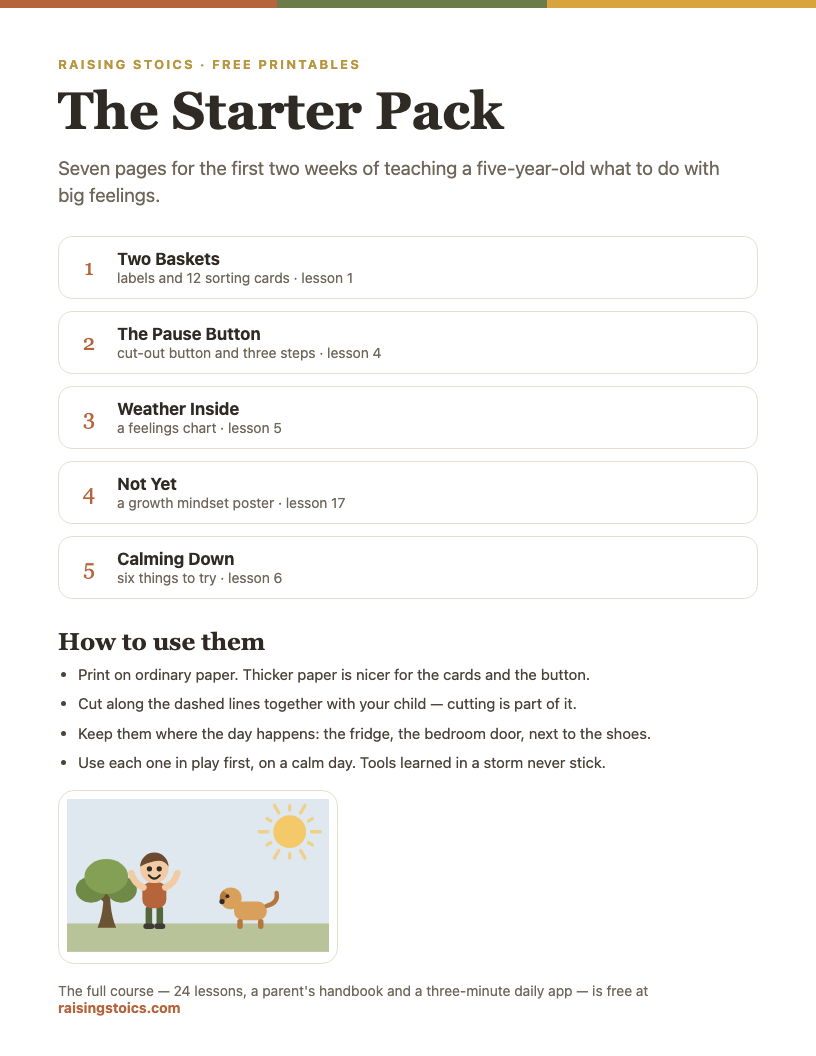
The Big Feelings Starter Pack
Nine pages for the first two weeks: a sorting game, a pause button, a feelings chart and a calm-down poster.
Download the free PDF See all 9 pages
Part of a free 9-page starter pack. Sign in with a code from your email — no password.
How to explain death to a 4-year-old
With a 4-year-old, keep it short, concrete, and connected to things they can see.
You might use the body: "When someone dies, their body stops working. They can't move or eat or talk anymore, and they don't feel anything, not even hurt."
Expect the same questions again and again. "When is Grandpa coming back?" may come up for weeks. Answer the same way each time, calmly: "Grandpa died. He can't come back. I miss him too." The repetition isn't a sign that you explained it badly. It's often how children this age work an idea through.
Expect feelings in short bursts. A 4-year-old may cry hard and then ask for a snack a minute later. That doesn't mean they don't care; feelings at this age often come and go quickly.
Explaining death to a 5-year-old (and a 6- or 7-year-old)
Many 5- to 7-year-olds are starting to understand that death is permanent and that it happens to everyone. That understanding often brings new questions, and some of them may be hard to hear.
"Will you die?" Answer honestly and reassure about the near future: "Everyone dies one day. I expect to live for a very, very long time, until you're grown up and maybe have grown-up children of your own."
"Will I die?" "Almost certainly not for a very, very long time. Most people live until they're very old." If you or your child is seriously ill, ask your doctor or a counselor how to answer these questions honestly.
"Who would take care of me?" This is often the real worry behind the first two. Name actual people: "If anything ever happened to me, Dad and Aunt Rosa would take care of you."
"Was it my fault?" Some children quietly believe it was, because they were angry, misbehaved, or once wished someone would go away. Say it directly even if they don't ask: "Nothing you did or said or thought made Grandpa die."
Older children in this range may want details: what happens to the body, what a casket or cremation is, what the doctors did. Simple, accurate facts are usually easier for them than mystery.
When a pet dies
For many children, a pet's death is their first experience of death, and it deserves to be treated as a real loss.
Tell the truth. Saying a dog "ran away" or quietly replacing a goldfish can backfire if the child finds out, and it misses a chance to learn about death with a loss that's sad but more manageable than losing a person. "Biscuit died. His body was very old and tired, and it stopped working."
If the pet is going to be euthanized, avoid "put to sleep." You can say: "The vet is going to help Biscuit die so that he doesn't hurt anymore. He'll die peacefully."
Let your child take part in saying goodbye if they want to: a small burial, a drawing, or a story about the funniest thing the pet did.
Wait before getting a new pet. A child may need time to understand that a new pet is a new friend, not a replacement who makes the sadness stop.
When a grandparent dies
The death of a grandparent is one of the most common losses for young children, and it usually comes with something else: a parent who is grieving too.
If there's time, prepare them. When a grandparent is seriously ill, a child may handle the death better if they know it might be coming: "Grandma is very, very sick. The doctors are trying to help, but her body might stop working." If it feels right, a visit, a phone call, or a card can be part of saying goodbye.
Keep routines going. Meals, bedtime, and school give a child something steady.
Let them see your grief, and know that you're okay. "I'm sad, and I'm crying, and that's okay. I'm still taking care of you."
Keep the person present. Look at photos, tell stories, cook their favorite recipe.
Should children go to the funeral?
Short answer: often it helps to let them choose, after you've explained what will happen.
Some children find a funeral or memorial less frightening than what they imagine when they're left at home.
If they want to come, prepare them in detail. Where it will be, what people will do, and that people may cry. If there will be a casket, whether it will be open and what the person's body will look like: "Grandpa's body will be lying still, with his eyes closed. He won't move, because his body has stopped working."
Ask an adult your child knows well to stay with them and take them outside if they need a break.
If they don't want to go, don't force it. They can say goodbye in another way, such as drawing a picture to put in the casket, lighting a candle at home with an adult, or visiting the grave later together.
Questions they repeat, and play that looks strange
Young children often come back to death at unexpected moments: in the car, in the bath, at bedtime, weeks after you thought the subject was closed. "Is Grandpa still dead?" "Where is he now?" "Can we dig him up?"
Answering again is part of how a child makes sense of it. Keep your answers consistent and calm. It's okay to say, "That's a big question. Let me think, and we'll talk about it at dinner." Then remember to bring it up.
You may also see death in play: toys that die and get buried, a game of funerals, a child lying still and saying "I'm dead." This can be unsettling to watch, but for many children, play is a way to try out an idea that's too big to talk about.
Bedtime fears can come too, especially if a child has started to think about death happening to them or to you. Many of the ideas in our guide for kids scared of Halloween, like talking about the fear in daylight and keeping bedtime predictable, help here too.
Helping with the big feelings that come with grief
Grief in young children doesn't always look like sadness. It can look like anger, clinginess, silliness, trouble sleeping, or a return to younger behavior for a while.
Help them name the feeling. In our program, the lesson Weather Inside teaches children to describe what's going on inside them: "Is it stormy in there? Rainy? Foggy?" Some children find it easier to say "it's rainy inside" than "I'm sad."
Tell them feelings come and go. Another lesson, The Wave, teaches that big feelings rise, peak, and pass. For a grieving child, that can be a relief: the sad feeling will come back sometimes, and it will also pass, and it's okay to play and laugh in between.
Books can help a child see their feelings in a story; our list of feelings books for children is a place to start. For more everyday ways to handle hard moments, see our guide to coping skills for kids.
When to get help
Grief is not a problem to be fixed, and most children, given honest answers and steady care, gradually find their way through it.
It's worth talking to your pediatrician if, after the first weeks:
- sleep, eating, or toileting problems continue or get worse;
- your child seems withdrawn, frightened, or angry most of the time, not just at moments;
- they won't separate from you at all, or refuse school;
- they talk a lot about wanting to die or wanting to be with the person who died;
- their play is full of distress and doesn't change over time.
If your child talks about wanting to die or about hurting themselves, contact your pediatrician or a mental health professional the same day, rather than waiting to see if it passes. If you think they are in immediate danger, call or text 988 or call 911. Your pediatrician can help you think it through and, if needed, refer you to a counselor who works with grieving children.
Get support for yourself too. It's easier to stay steady for a grieving child when someone is also looking after you.
What parents ask
Paraphrased from questions parents often post on Reddit, Mumsnet, BabyCenter, and other parenting forums.
“Our dog is very sick and may not get better. Do we tell our 5-year-old before the dog dies?”
Short answer: when there's time, a child may handle a death better if they know it may be coming. Use plain words: "Biscuit is very sick. The vet is helping, but his body might stop working." Let your child say goodbye in their own way, such as a drawing or extra cuddles. If the vet will help the dog die, avoid saying "put to sleep."
“My 5-year-old asked whether kids can die too. How do I answer?”
Short answer: use plain, honest words, and explain what happened in simple terms, such as a very, very serious sickness or a bad accident. Reassure them that most sicknesses, like colds, get better, and that most people live until they're very old. Expect the question to come back, and answer the same way each time. If you're grieving too, it's okay to cry with them. If sleep or eating problems continue, your child seems withdrawn or frightened most of the time, or they talk about wanting to die, contact your pediatrician. If they talk about wanting to die or hurting themselves, do it the same day, and call or text 988 or call 911 if you think they're in immediate danger.
“Since Grandpa died, my 6-year-old is scared I'll die too and won't let me out of their sight.”
Short answer: this worry is common once a child understands that death is permanent. Answer honestly and reassure them about the near future: "I expect to live for a very, very long time." Name the people who would take care of them, and keep routines steady. If they won't separate from you at all, or refuse school, talk to your pediatrician.
“Is it okay to tell my child Grandma is in heaven?”
Short answer: if that's part of your family's faith, you can share it. Many parents share their beliefs alongside the plain facts about the body: Grandma's body stopped working, she won't come back, and she can't feel hurt. Young children often take words literally, so you may need to explain that she can't visit or call from there.
FAQ
How to explain death to a child?
Explain death to a child in plain words: "died" means the body has stopped working, and the person or animal won't come back and can't feel hurt. Keep it short, let them ask questions, and answer again when they repeat them. Avoid phrases like "went to sleep," and reassure them that nothing they did caused it.
Should I tell my child how someone died?
Usually, yes, in simple and honest terms suited to their age. "She had a very serious sickness in her heart" or "He was in a car crash, and his body was too badly hurt to keep working." Children often hear pieces from others, and a calm explanation from you may be less frightening than gaps they fill in themselves.
Is it normal for a child not to seem sad after a death?
Yes, that's common. Young children often grieve in short bursts: a question or a few tears, then back to play. They may also show it later or in other ways, such as clinginess, irritability, or trouble sleeping. It doesn't mean they didn't care. Keep the door open by mentioning the person naturally and answering questions when they come.
Should I let my child see the body of a pet that died?
If they want to, it can help. Seeing that the pet is still and not breathing can make the idea of death clearer than words alone. Tell them first what they'll see, stay with them, and let them touch or not as they choose. If they'd rather not, a goodbye drawing or a small burial works too.
Coping Skills for Kids: 12 Strategies to Try at Ages 4–7
Coping skills for kids ages 4–7: a list of 12 strategies, how to teach them on calm days, how to use them in hard moments, and free printable cards.
Read next →Naming a feeling and riding it out are lessons 5 and 6 of the program, Weather Inside and The Wave.