 Raising
Elf on the Shelf Ideas: 5-Minute Setups by Week, for Ages 4–8
It's 10:40 p.m., the dishes are done, and somebody still has to move the elf. These Elf on the Shelf ideas are written for that moment: each one takes about five minutes with things you already have at home. They're sorted by week, from a gentle arrival to a cozy goodbye, and they're aimed at children ages 4–8. Further down you'll find ideas where the elf shows kindness, patience, and calm, and an honest section for parents who don't want an elf at all, or who are tired of theirs.

What is Elf on the Shelf?
The Elf on the Shelf started as a picture book, *The Elf on the Shelf: A Christmas Tradition*, by Carol Aebersold and her daughter Chanda Bell, published in 2005. It comes in a box with a small elf doll. The family names the elf, and the story says it's a "Scout Elf" sent by Santa.
According to the company's own beginner's guide, the tradition has a few rules:
- Don't touch the elf, or it loses its magic.
- Scout Elves can't talk, but they're good listeners, so children can tell them things.
- The elf flies to the North Pole each night and lands in a new spot in the house by morning.
- It goes back to the North Pole on Christmas Eve.
In the book, the elf reports the day to Santa. That's the part some families love and some find uncomfortable; more on that below.
Everything else, including the funny scenes you see online, is up to each family. The official rules don't say the elf has to do something clever every night. "The elf sat somewhere new" is the whole requirement.
Before you start: three habits that make easy Elf on the Shelf ideas work
Plan one week at a time. On Sunday, pick seven ideas from the lists below and write them on a sticky note inside a kitchen cabinet. At 10:40 p.m. you won't have to think.
Keep a "lazy night" list. Some nights the elf will simply sit on a different shelf. That's fine. Some 4- and 5-year-olds are delighted just to find it. You can also add a short note: "Long flight. Resting today."
No cleanup in the morning. Flour snow, spilled cereal, and toilet paper across the hallway look great in photos, but they turn into a mess before school. Every idea in this list puts things back in five minutes or less.
Week 1 Elf on the Shelf ideas: a gentle arrival
The first week is about the elf settling in. Keep the scenes small and friendly.
1. Arrival with luggage. The elf sits next to a matchbox or tiny gift box with a paper tag: "Packed light. Brought only my hat." 2. Counting the fruit. The elf sits in the fruit bowl with a note: "There are 4 oranges. I counted twice." 3. Story time. Line up three stuffed animals on the couch and open a picture book in front of them. The elf sits on the book, "reading." 4. Lost in a sleeve. Tuck the elf into the sleeve of a hanging coat so only the hat peeks out. 5. A sock sleeping bag. The elf sleeps in a clean sock in the sock drawer, with a tissue for a pillow. 6. Fishing in the sink. Tie a short string to a pencil, tape a paper fish to the end, and let the elf "fish" over the edge of a dry sink. 7. A map of the house. Draw a very simple map with an X on the kitchen table. Breakfast is waiting under the X.
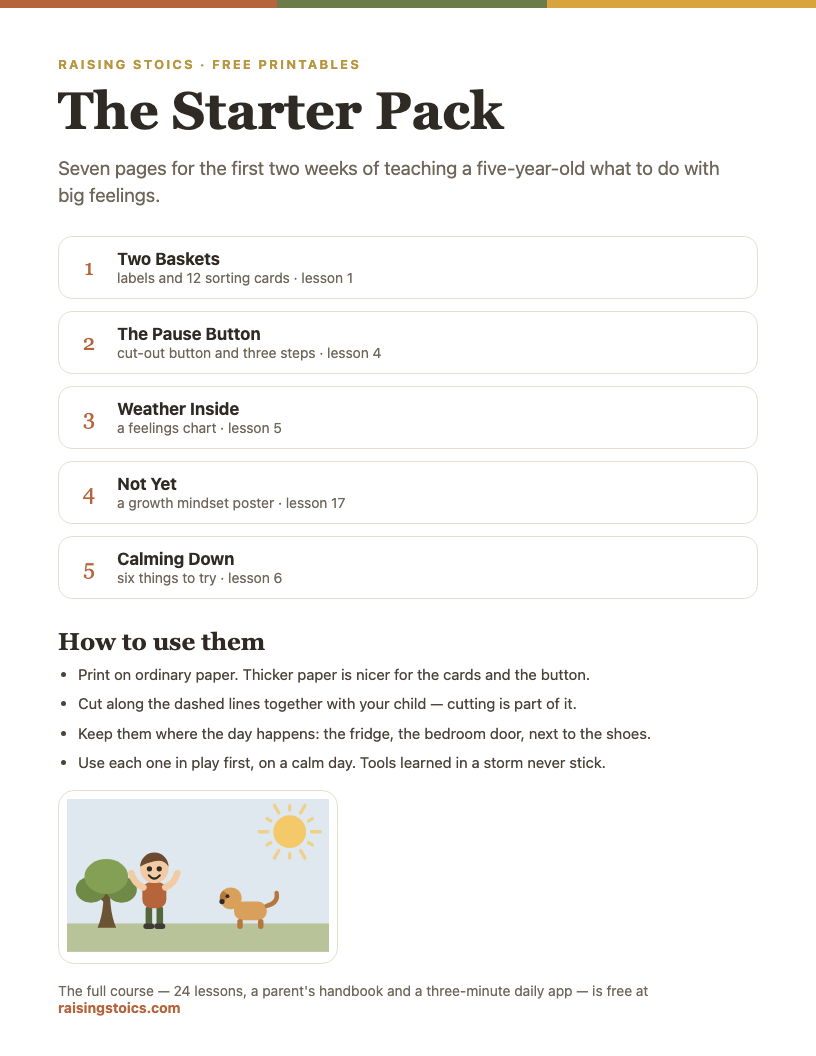
The Big Feelings Starter Pack
Nine pages for the first two weeks: a sorting game, a pause button, a feelings chart and a calm-down poster.
Download the free PDF See all 9 pages
Part of a free 9-page starter pack. Sign in with a code from your email — no password.
Week 2: silly elf ideas for kids 4–8
By week two, children start looking for the joke. These ideas lean on things being in the wrong place.
1. New hat. The elf wears a measuring cup or a bottle cap as a hat, with a note: "New hat. Thoughts?" 2. Bad parking. The elf sits in a toy car parked crooked across two "spaces" drawn on paper, with a tiny parking ticket. 3. Fridge check. The elf sits on a fridge door shelf wearing a paper scarf: "Checking if it's colder than the North Pole. It isn't." 4. Spoon band. Stand four spoons in a mug and give the elf a straw to "conduct" them. 5. A tea party. The elf hosts two action figures with bottle-cap cups. There's an empty seat with your child's name on a folded card. 6. Paper airplane. Fold a plane, sit the elf on top, and rest it on the highest bookshelf, as if it just landed. 7. A snowball from home. The elf holds a cotton ball: "Brought you a North Pole snowball. It melted less than I expected."
Week 3: elf ideas that give your child something to do
In week three, the elf can invite your child to act, not just to look. A small, clear action your child can do right now, with a choice between a few options, may work better than a big task like "be good today."
1. Pick a card. The elf holds three folded cards: "Draw me a picture," "Tell me a joke at breakfast," and "Build me a chair out of blocks." Your child picks one. 2. Elf ruler. The elf leaves a paper strip as long as the elf: "How many of me tall are you?" Measuring takes two minutes and some giggling. 3. A card for someone. The elf sits next to a blank folded card and three crayons: "Grandma needs a tree, a star, or a snowman. You choose." 4. Cup tower. Three paper cups and a note: "I tried to build a tower. Can you build a taller one?" 5. Name the animals. The elf sits with the stuffed animals: "I don't know their names. Can you introduce us?" 6. A secret word. A note says: "Today's secret word is 'pickle.' Whisper it to a grown-up at dinner." 7. Sort the socks. The elf sits on a pile of clean socks: "I can't find the pairs. Help?"
Keep the elf's request small enough to finish before breakfast. If your child doesn't want to do it, that's fine; the elf will try something else tomorrow.
Week 4: calm, cozy elf ideas before Christmas Eve
The last week before Christmas is often the busiest and the most tired. These ideas slow things down.
1. Blanket and book. The elf sits wrapped in a napkin next to a picture book: "Story tonight?" 2. Light counting. The elf sits at a window with a rolled-paper telescope: "Counting the lights on our street. Help me finish tonight?" 3. My favorite things. The elf holds a list titled "Best parts of December," with three empty lines. Your child tells you what to write. 4. Cookie jar nap. The elf naps in an empty cookie jar, with a note: "Just resting near the cookies. Didn't eat any. Probably." 5. Thank-you drawing. The elf leaves a drawing of your family: "Thank you for having me." 6. Countdown chain. The elf hangs from a paper chain, one link for each day left until Christmas.
The Christmas Eve goodbye. Many families end with a short letter from the elf. Make it specific: "I saw you help your brother put on his boots. I saw you wait for your turn on the swing." Keep the goodbye warm and brief, and say the elf will be back next year, if your family plans to keep the tradition.
Elf on the Shelf ideas that show kindness, patience, and calm
The elf can do more than be funny. Some families use it to show a small skill, the way a puppet does in a preschool class. The elf doesn't lecture. It just does the thing, and your child sees it.
Kindness. The elf leaves a paper heart and a note: "This is for someone who needs a smile. Who should get it: your sister, your teacher, or the mail carrier?" Your child delivers it. Our guide on how to teach kids kindness explains why noticing someone else comes before being nice. In our program, the lesson "Stepping In" is about helping each other.
Patience. The elf sits next to a cookie on a plate, with a note: "I'm waiting until after dinner. It's hard. I'm counting to 10 while I wait." Waiting out loud like this is the idea behind "Boss of My Want," our lesson on "I want it now." More ideas are in how to teach kids patience.
Calm. The elf sits cross-legged with a cotton ball "cloud": "When I'm upset, I stop and take three slow breaths before I do anything." That's the gap between what happens and what we do, and it's the subject of The Pause Button, a lesson you can try with your child. For more ideas, see calm-down strategies.
Feelings. The elf holds three paper cards: a sun, a cloud, and a storm cloud. "What's the weather inside you today?" Naming a feeling may help a child step back from it.
Mistakes. The cup tower from week three has fallen over. The elf's note says: "Not yet. Trying again tonight." Then, the next morning, the tower is standing. That's Not Yet, a lesson about mistakes being practice.
Is Elf on the Shelf supposed to be bad? Watching vs. noticing
It's a common question, and the answer depends on how your family uses the elf. On its homepage, the company describes Scout Elves as "always nice and never naughty." The trouble starts when the elf turns into a threat: "The elf is watching, so you'd better behave," or "The elf will tell Santa."
Many parents use the elf this way on a hard evening. Others find the idea of a doll that reports to Santa uncomfortable, and the company's own site acknowledges that "reporting to Santa" can feel uncomfortable when it's framed as constant monitoring.
A different approach is to make the elf notice, not judge. It writes down kind and brave moments, not mistakes. It never takes anything away. Its notes say "I saw" instead of "I'll tell."
And one practical rule: nothing your child gets should depend on whether a grown-up remembered to move the elf. If the elf didn't move, the elf "was tired" or "liked that spot." It's never because your child did something wrong.
If you don't want an elf, or you're tired of yours
Not every family wants an elf, and that's a reasonable choice. Some parents don't like the idea of a doll that reports to Santa. Some simply don't have the energy for 24 nights of scenes. Some started with excitement and, by December 12, dread the evening routine.
If you're skipping it, your child may still hear about elves at school. You can say: "Different families have different Christmas traditions. Ours is the gingerbread house," or whatever yours is. Some children accept that easily, especially if they get a tradition of their own.
If you're tired of it, you have options:
- Fewer nights. The elf visits only on weekends, or only on the 12 days before Christmas.
- A lazy elf. The elf simply moves from shelf to shelf. Some children are just as happy.
- A kindness elf. The elf doesn't report to anyone. It just leaves one small idea for a kind act each morning.
- An early goodbye. The elf leaves a warm letter saying it's needed at the North Pole this year.
If your child starts asking whether the elf, or Santa, is real, our guide is Santa real? has ideas for answering kindly and following their lead.
FAQ
When did Elf on the Shelf start?
The Elf on the Shelf began as a picture book published in 2005 by Carol Aebersold and her daughter Chanda Bell. The company behind it says the idea began with Aebersold's own family many Christmases earlier. Before 2005 there was no Elf on the Shelf product, though elves in Christmas stories are much older. The book and the elf are now sold together in one box.
When does Elf on the Shelf start?
The company says most Scout Elves return in a week-long window at the end of November, and some arrive as late as the second week of December. There's no wrong date. Some parents start on December 1, so the elf's visit lines up with an Advent calendar and there are fewer nights to plan.
When does Elf on the Shelf leave?
According to the official rules, the elf goes back to the North Pole on Christmas Eve. Many families mark the goodbye with a short letter from the elf on Christmas morning or the night before. If your child is sad, it may help to say the elf will be back next year, if you plan to continue, and to keep the goodbye letter somewhere they can find it.
Is the Elf on the Shelf real?
The Elf on the Shelf is a toy and a story, made by a company and first published as a book in 2005. For a child, it's part of the same make-believe as Santa. If your child asks you directly, find out first what they're really asking: "What do you think?" Some want reassurance; others want the truth. Our guide is Santa real? covers that conversation.
How do you introduce Elf on the Shelf?
Read the book together on the first evening, then let your child name the elf. The next morning, put the elf somewhere easy to find, at your child's eye level, with a short note that says hello. Explain the one rule that matters most to the story: don't touch the elf. Keep the first week simple, so neither you nor your child feels pressure.
Podcasts for Kids: Story, Science, and Bedtime Shows for Ages 4–8
Podcasts for kids ages 4–8, sorted by type: stories, science, calm and sleep, history, and comedy, with who makes each show and how to use them in the car.
Read next →The Pause Button and Not Yet, two lessons the elf can act out, are lessons 4 and 17 of the program, along with Stepping In and Boss of My Want.