 Raising
Secular Homeschool Curriculum for K–2: Programs, Prices, Time
Finding a secular homeschool curriculum takes more checking than it should, because many of the best-known programs are Christian, and "faith-neutral" can mean different things. This guide covers programs for the early grades, kindergarten through second grade: first those that describe themselves as secular or as not taking a faith position, in the publishers' own words, then subject programs secular families often pair with them. We checked each one on its official site in October 2026: price, format, grades, and time per day where the publisher states it.

What makes a homeschool curriculum secular?
A secular curriculum doesn't teach from a religious point of view. In practice, parents usually look at three things.
Science: does it teach the scientific consensus, including the age of the Earth and evolution, as science? History: are religions described as part of history and culture, rather than as the frame for the whole story? Language arts and character: are values taught through literature and discussion, rather than through scripture?
Publishers use different words for this. Some say "secular," some say "faith-neutral," some say they "do not espouse or oppose any faith." A faith-neutral program may simply avoid the topic, which some families prefer and others don't. Reading the publisher's own description, and then a sample week of science and history, is the most reliable check.
All-subject secular homeschool curriculum
These cover most subjects in one package. Prices are as shown on each publisher's site in October 2026; several were sale prices.
Oak Meadow: "secular, book-based, nature-based," Waldorf-inspired, Pre-K to 12th grade. The kindergarten package is $449.35. Oak Meadow estimates 3 to 4 hours a day in the early grades, and also runs an optional accredited distance school.
BookShark: literature-based and open-and-go; it "does not espouse or oppose any faith." Level A, for ages 5 to 7, was $958.67 for all subjects on sale at the time of checking. Schedules run 36 weeks of four days.
Time4Learning: "a complete, secular online homeschool curriculum," with grade levels through 12th grade, $39.95 a month per grade. It estimates 30 to 60 minutes a day online for kindergarten through second grade.
Blossom and Root: "Creative, Nature-Based, Secular Homeschooling," inspired by Charlotte Mason and Waldorf. Level 0, for kindergarten, is a $67 PDF.
Torchlight: "a distinctively secular approach with Humanist underpinnings," literature-based, Pre-K to 5th grade. Level K is a $32 PDF for 36 weeks; books are bought separately, and there's no math.
Build Your Library: a "Secular Literature Based Homeschool Curriculum," Charlotte Mason-inspired, K to 12. Level 0 is a $29.95 PDF for 30 weeks; books are separate, and math isn't included.
Secular homeschool curriculum by subject
Many secular families combine an all-subject spine with separate math or science, or build the whole year from single subjects.
Science: Pandia Press publishes REAL Science Odyssey, described as "Secular & Facts-Based." Level 1 titles were $43.99 to $52.99.
Math: Beast Academy, from Art of Problem Solving, is comic-style math for ages 6 to 13, with an online version at about $99 a year. Math Mammoth sells worktexts and says a year costs "less than $50." We didn't see either describe itself as secular or faith-based; check samples if that matters to you.
History: Pandia Press also publishes History Odyssey, and the literature-based spines above include history.
Writing: Brave Writer's Jot It Down, for ages 5 to 7, is a project-based writing and language program sold as a PDF; we didn't find a faith statement for it.
For reading, most phonics programs don't involve faith at all; the choice there is more about method than worldview.
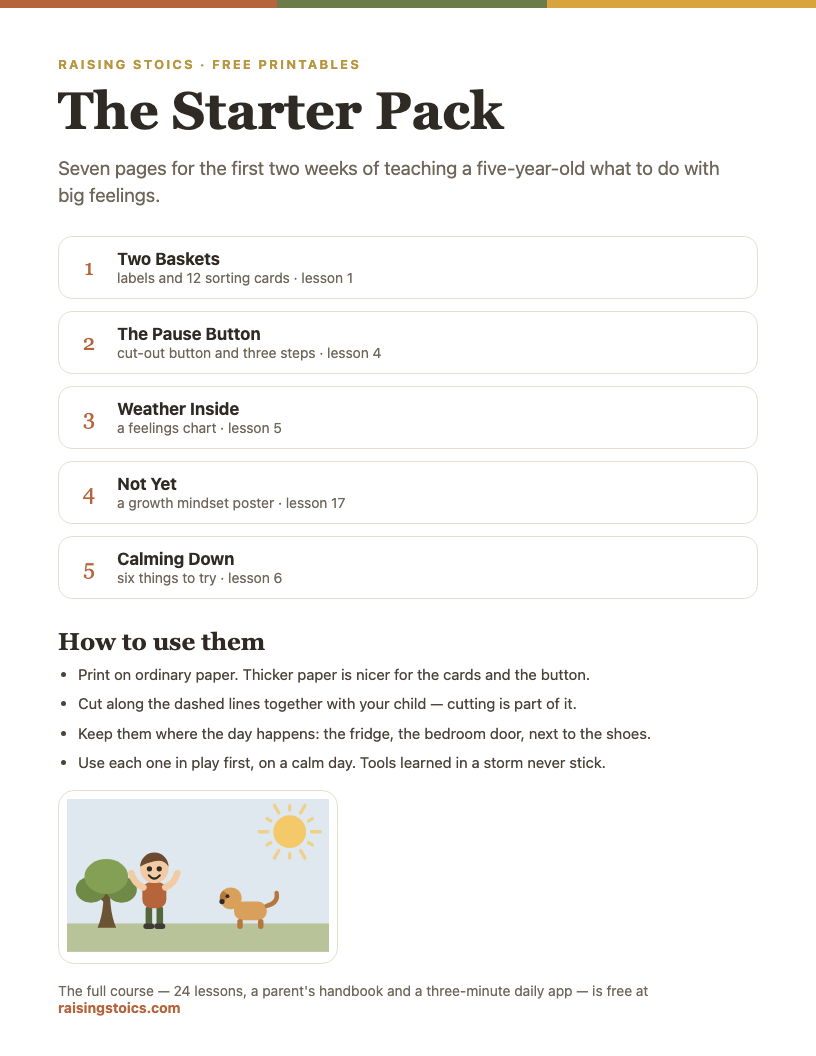
The Big Feelings Starter Pack
Nine pages for the first two weeks: a sorting game, a pause button, a feelings chart and a calm-down poster.
Download the free PDF See all 9 pages
Part of a free 9-page starter pack. Sign in with a code from your email — no password.
Secular vs. faith-neutral: the difference that matters
"Secular" and "faith-neutral" are often used as if they mean the same thing, but parents tend to care about one specific difference.
A program that calls itself secular usually teaches science as science, including evolution, and treats religion as a subject of history and culture. A faith-neutral program may avoid the topics where families disagree, so it suits both religious and non-religious families, but it may say less about evolution or the history of religions. Check a sample to see.
Neither is wrong. If you want a program you can use alongside your own faith teaching, faith-neutral may be exactly right. If you want science and history that don't step around the questions, look for the word "secular" and check a sample unit on the Earth's history or on early civilizations.
How much does a secular homeschool curriculum cost?
From under $50 to more than $900 a year for the early grades, based on the programs above.
At the low end are PDF programs where you buy or borrow the books yourself: Build Your Library Level 0 at $29.95, Torchlight Level K at $32, Blossom and Root Level 0 at $67. Add a math program, often under $100.
In the middle are print programs like Oak Meadow's kindergarten package at $449.35, and online subscriptions like Time4Learning at $39.95 a month, which comes to about $360 for a nine-month school year.
At the top are complete literature-based packages with every book included, such as BookShark Level A at $958.67 on sale.
The library changes the math a lot. Literature-based programs that list their books separately can cost far less if most of the books are on your library's shelves.
How much time a day does secular homeschooling take in K–2?
It depends a lot on the program. Time4Learning estimates 30 to 60 minutes a day online for kindergarten through second grade. Oak Meadow estimates 3 to 4 hours a day in the early grades, including hands-on and outdoor work. Several of the literature-based programs above don't give a number, but their daily plans usually include a read-aloud, a short reading or phonics lesson, math, and one other subject.
These are the publishers' figures. Some families find that focused work in the early grades fits into a morning, with the rest of the day for play, reading, outings, and projects.
What secular curricula leave to you: feelings, patience, and getting along
Secular programs often do character through literature and discussion: Torchlight uses stories to "build character," BookShark mentions "strong character and empathy," and Oak Meadow mentions empathy and social responsibility. We didn't find a separate social-emotional strand for the early grades on the pages we checked.
For a five- or six-year-old, that part of the day is often the loudest: anger when something doesn't work, fear of trying, not being able to wait, losing a game. Some families handle it as it comes. Others add a short, planned lesson once or twice a week.
If you want it to be secular too, look for programs built on psychology or philosophy rather than on scripture. Raising Stoics, the site you're on, makes one option: a 12-week at-home program for ages 5 to 6 built on ideas from Stoic philosophy, with two 20-minute lessons a week and no religious content. It's new and hasn't been evaluated in a study.
How to choose a secular homeschool curriculum
Start with how you want to teach, then check worldview.
Do you want everything in one package or to build your own? All-subject programs save planning time; single subjects let you match each one to your child.
How much of your time is available? Online programs need the least during lessons; literature-based programs need the most reading aloud.
What's your budget for books? PDF programs are cheap, but the book list can add up unless your library has it.
How does your child learn best? Nature-based programs suit children who need to be outside, literature-based programs suit children who love being read to, and online programs suit children who like games and independence.
Then read the publisher's own faith statement and look at a sample unit on science and history. That takes ten minutes and answers the question better than any label.
FAQ
What is secular homeschooling?
Secular homeschooling means teaching at home without a religious framework: science is taught as science, and religion appears as part of history and culture, not as the basis of the curriculum. Families choose it for many reasons, including families of faith who prefer to teach religion separately.
What does secular homeschool curriculum mean?
A secular homeschool curriculum is one whose publisher doesn't teach from a religious point of view. Some publishers use the word "secular" directly; others say they are faith-neutral or don't take a position on faith. Check the publisher's own statement and a sample science unit to see which kind it is.
Is Time4Learning secular?
Yes. Time4Learning describes itself as "a complete, secular online homeschool curriculum." It runs through 12th grade and was $39.95 a month per grade at the time of checking.
Is BookShark secular?
BookShark describes itself as a program that "does not espouse or oppose any faith," which is faith-neutral rather than explicitly secular. It's literature-based and open-and-go.
Can you homeschool secularly if you're religious?
Yes. Many religious families use a secular or faith-neutral curriculum for academic subjects and teach their faith separately, at home or in their community. The curriculum choice is about how science, history, and character are taught, not about the family's own beliefs.
Kindergarten Homeschool Curriculum: 14 Programs Compared
Kindergarten homeschool curriculum compared: prices, subjects, daily time, and faith stance of 14 programs, checked on publishers' sites, plus how to choose.
Read next →Raising Stoics is a secular 12-week program for ages 5 to 6 on feelings, patience, and not giving up: two 20-minute lessons a week, alongside any curriculum.