 Raising
How to Make Slime: 4 Easy Recipes for Kids Ages 4–8
Slime is one of those projects children ask for again and again. If you're wondering how to make slime at home with a 4- to 8-year-old, you need fewer ingredients than the videos suggest, and you can skip borax powder entirely. Below are four recipes with exact amounts: a classic glue slime, a fluffy version, a slime without glue, and a two-ingredient oobleck for younger kids. The amounts are common home recipes, not tested safety limits. After the recipes: what Poison Control says about borax and contact lens solution, simple table rules, and what to do when a batch doesn't work.

How to make slime: which recipe to start with
Short answer: Start with the recipe that matches your child's age and your patience for cleanup. Each recipe here takes about 10 to 15 minutes to make and uses ingredients from a grocery or drugstore.
- 1. Classic glue slime: ages 6–8. Glue plus contact lens solution. Stretchy, pulls apart.
- 2. Fluffy slime: ages 6–8. Glue, shaving cream, and contact lens solution. Soft and squishy.
- 3. Cornstarch and dish soap: ages 6–8, with an adult at the table. No glue, no activator. Smooth, like soft dough.
- 4. Oobleck: ages 4–8. Cornstarch and water. Hard when squeezed, runny when released.
Before you start, set out a tray or baking sheet, old clothes or an apron (slime and food coloring can stain), measuring cups and spoons, and a container with a lid. Measure carefully: too much activator turns slime rubbery, and too little leaves it runny.
The ages are our suggestion, not a rule. For younger children, the adult does the pouring and the child does the stirring and squishing. Many 6- to 8-year-olds can measure with help.
Slime recipe 1: Classic glue slime with contact lens solution
This is the slime most children picture: glossy and stretchy. It answers "how to make slime with glue" and "how to make slime activator" at once, because the activator is store-bought contact lens solution.
You need: - ½ cup (4 oz) white or clear school glue (PVA glue) - ¼ cup water - ½ teaspoon baking soda - 1 tablespoon contact lens solution (saline), plus a little more as needed - Food coloring or washable paint, a few drops (optional)
Check the label first. Many contact lens solutions list boric acid or sodium borate among their ingredients, and those are what set the glue. Check the label before you buy.
Steps: 1. Pour the glue and water into a bowl and stir until smooth. 2. Add a few drops of color and stir again. 3. Sprinkle in the baking soda and stir well. 4. Add 1 tablespoon of contact lens solution and stir. Within a minute, the mixture starts pulling away from the sides of the bowl. 5. When it forms a blob, take it out and knead it with your hands for 2 to 3 minutes. It may be sticky at first and get smoother as you knead. 6. Still very sticky after 2 to 3 minutes of kneading? Add contact lens solution ½ teaspoon at a time. Go slowly: it's easy to add more and impossible to take it out.
This recipe is borax-free in the sense that it doesn't use borax powder. It still uses a borate activator, so the safety rules below apply to it, too.
Slime recipe 2: How to make fluffy slime
Fluffy slime is the same glue slime with shaving cream folded in. It feels light and soft, and it's the one many children want to squish for an hour.
You need: - ½ cup white school glue - 1 to 2 cups plain white foaming shaving cream - ½ teaspoon baking soda - 1 tablespoon contact lens solution with boric acid or sodium borate, plus more as needed - Food coloring, a few drops (optional)
Steps: 1. Put the glue in a large bowl. Add 1 cup of shaving cream and fold it in gently with a spatula. 2. Add color, then the baking soda, and stir. 3. Add 1 tablespoon of contact lens solution and stir until the mixture comes together. 4. Knead it with your hands. Add more solution ½ teaspoon at a time if it stays sticky. 5. For an even puffier slime, fold in up to 1 more cup of shaving cream before adding the solution.
Fluffy slime deflates over a day or two as the air escapes. That's normal, not a mistake. You can knead in a little fresh shaving cream to puff it up again.
Shaving cream isn't food and may irritate skin or eyes, so keep it away from faces and wash hands afterward.
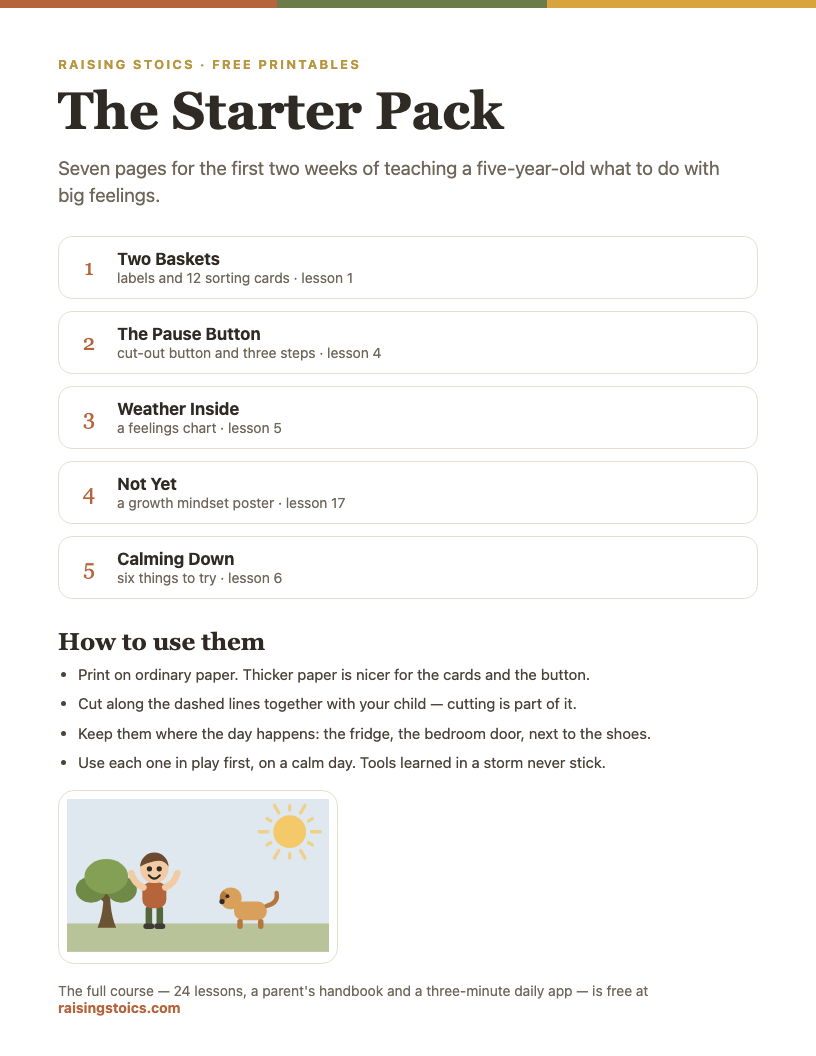
The Big Feelings Starter Pack
Nine pages for the first two weeks: a sorting game, a pause button, a feelings chart and a calm-down poster.
Download the free PDF See all 9 pages
Part of a free 9-page starter pack. Sign in with a code from your email — no password.
Slime recipe 3: How to make slime without glue (cornstarch and dish soap)
Short answer: Mix ½ cup of cornstarch with ¼ cup of dish soap and knead. That's it: no glue and no activator.
This is the simplest answer to "how to make slime without glue" and also to "how to make slime without activator," two of the most searched slime questions. The result is closer to a soft, smooth dough than to a stretchy glue slime, but it squishes, molds, and slowly oozes, which is what most young children want.
You need: - ½ cup cornstarch, plus extra for adjusting - ¼ cup liquid dish soap - Food coloring, 1 or 2 drops (optional; many dish soaps are already colored)
Steps: 1. Pour the cornstarch into a bowl and add the dish soap. 2. Stir with a spoon until it looks lumpy, then switch to hands. 3. Knead for 2 to 3 minutes. If it sticks to fingers, add cornstarch 1 tablespoon at a time. If it crumbles, add a teaspoon of dish soap.
This recipe is for ages 6–8, with an adult at the table. It's made of household products, not food. Dish soap can dry out or irritate skin, so rinse hands well afterward and skip this recipe if your child's skin is sensitive. Poison Control lists detergents among the slime ingredients that can be toxic at high levels.
Slime recipe 4 for younger kids: two-ingredient oobleck
Oobleck isn't quite slime, but for children ages 4–8, and especially the youngest, it may be even better. It's made from cornstarch and water, two things you probably have in the kitchen. Squeeze a handful and it feels solid. Open your hand and it melts through your fingers.
You need: - 1 cup cornstarch - ½ cup water - Food coloring, a few drops (optional) - A shallow tray or a baking dish
Steps: 1. Put the cornstarch in the tray. 2. Mix a few drops of food coloring into the water. 3. Pour the water in slowly while your child stirs with a spoon or their fingers. 4. Aim for a mix that feels hard when you tap it and runny when you tilt the tray. Too runny: add cornstarch by the tablespoon. Too stiff: add water by the teaspoon.
Try together: punch it quickly, then press a finger in slowly, and ask why it acted differently. Or hide a bath toy inside and rescue it with a spoon.
Oobleck is made from kitchen ingredients, but it isn't a snack. When you're done, let it dry and scrape it into the trash rather than rinsing it down the sink, which can clog the drain.
Is slime safe? What Poison Control says about borax
Short answer: Poison Control says commercial slime labeled nontoxic is unlikely to cause problems. Homemade slime with high levels of borax, glue, or detergent can be toxic, so supervise, wash hands, and don't let anyone eat it.
The National Capital Poison Center, which runs Poison Control's guide to homemade slime, explains that borax, boric acid, and sodium borate are all activators that link the glue's long molecules together. Boron is the part of borax that can cause harm. According to Poison Control:
- On the skin, slime can cause redness, itching, and dermatitis. Burns and blisters are possible with high borax concentrations or long contact.
- Swallowed slime can cause stomachache, nausea, vomiting, and diarrhea, and depending on the amount, there is a risk of intestinal blockage.
Poison Control doesn't give a safe amount of borax for slime, and we don't either. Instead, it suggests using alternatives to borax, such as cornstarch, dish soap, or baking soda plus contact lens solution. Recipes 1 to 4 above follow that advice: none of them uses borax powder. Poison Control gives no amounts, so our proportions are common home recipes, not tested safe limits.
If your child swallows slime, Poison Control says to wipe out their mouth with a damp cloth and give them something to drink. If a rash develops, remove the slime, wash the skin with soap and water, and pat it dry. Call Poison Help at 1-800-222-1222 for advice. The American Academy of Pediatrics (AAP) adds, on HealthyChildren.org: if a child is unconscious, not breathing, or having convulsions or seizures after a poison exposure, call 911.
How to make slime without borax: contact lens solution, glue, and labels
Many recipes online still call for borax powder dissolved in water. Here's what the sources say about the common ingredients.
Borax powder. It's a laundry booster, sold next to detergent. HealthyChildren.org advises keeping cleaning and laundry products in their original packaging, in locked cabinets, out of children's sight and reach. Borax is sold as a laundry booster, so that advice applies to it, too. Recipes 1 and 2 work without it.
Contact lens solution. Poison Control lists baking soda plus contact lens solution as an alternative to borax. Many contact lens solutions list boric acid or sodium borate, which is what sets the glue, so check the label. The same rules about supervision, washing hands, and not eating slime still apply.
School glue. Most children's school glue is a PVA glue, the polymer Poison Control describes as the base of slime. Use a glue sold for children and check the label.
Store-bought slime. Poison Control notes that commercial slimes labeled nontoxic are unlikely to cause problems. The U.S. Consumer Product Safety Commission (CPSC) hasn't published slime-specific advice on borax that we could find, but it has recalled at least one slime product: in December 2023, it recalled Prextex slime eggs (recall 24-737) for exceeding federal limits on lead and phthalates. Before you buy, you can search the product name at cpsc.gov/Recalls.
Slime rules for kids: setting up the table
Agree on a few rules before the first squish. Rules 1 to 6 follow Poison Control's prevention tips; the details in parentheses are our own.
1. A grown-up supervises. (We'd say: at the table, not in the next room.) 2. Slime is not food. Say it plainly before you start, especially if you used food coloring and the slime looks like candy. 3. Hands get washed before and after. Clean hands keep dirt out of the slime, and washing afterward keeps the slime off faces and snacks. 4. Slime stays on the tray. A smooth, clean surface is easier to clean and keeps slime out of carpets and hair. (If it gets there anyway, see the FAQ below.) 5. Stop if it stings. Poison Control advises stopping slime play if the skin gets red, irritated, or starts to burn. If your child's skin is broken or irritated, ask your pediatrician before slime play. 6. The lid goes on. Store slime in an airtight container, away from heat. (We'd add: out of reach of younger siblings.)
When the slime doesn't work: patience and "Not Yet"
Slime fails a lot. It comes out as soup, or as a rubber brick, or it glues itself to every finger. For a 5-year-old who watched a perfect slime video, that may feel like a disaster.
Most fixes are simple:
- Too runny: It needs more activator or more kneading. Knead for 2 to 3 minutes, then add contact lens solution ½ teaspoon at a time.
- Rubbery and snaps: There's too much activator. Knead in a teaspoon of warm water or a pump of hand lotion, slowly.
- Oobleck is soup: Add cornstarch by the tablespoon.
- Cornstarch slime crumbles: Add dish soap by the teaspoon.
The bigger lesson is what happens between the failure and the fix. A few things that help:
Name it before you fix it. "You're really frustrated. You wanted it stretchy and it's soup." Naming a feeling can make it easier for many children to wait it out.
Use "not yet." In our program, lesson 17, "Not Yet," is about a simple idea: a mistake is practice, not a verdict. "It's not slime yet" is more accurate than "it didn't work," and it points toward the next step.
Let them choose the next step. Offer three options: "Add a little more solution, knead for one more minute, or take a break and come back?" A choice may give a frustrated child something to do with the feeling.
Point out the wait afterward. "You kneaded for three whole minutes, and it changed." Kneading slime is a small, real practice in patience. Our guide on how to teach kids patience has more ways to build it, and our coping skills for kids cover what to do when the frustration gets big.
How long slime lasts and how to store it
Glue slime kept in an airtight container at room temperature often stays playable for a week or more, though it picks up dust and lint. Cornstarch slime and oobleck dry out much faster, often within a day. Close the lid right after play, keep the container away from heat, as Poison Control advises, and label it if you have more than one child. Throw slime away if it's dirty, smells off, or has changed color in spots.
Slime is a good fit for a rainy afternoon. For more ideas like it, see our list of rainy day activities for kids, sorted by how long each one takes.
FAQ
How do you get slime out of clothes?
Scrape off as much slime as you can with a spoon or a dull knife. Then soak the spot in white vinegar for a few minutes, which often helps loosen glue slime, and work it with an old toothbrush. Rinse with warm water, treat with a little dish soap or stain remover, and wash as usual. Check the spot before drying: heat can set what's left.
How do you get slime out of hair?
Don't pull. Work a generous amount of hair conditioner or a little cooking oil into the slimy section, wait a few minutes, and comb it out gently with a wide-tooth comb, starting from the ends. Then shampoo as usual. For a young child, a distraction helps: an audiobook or a song while you work. Often, no cutting is needed.
How do you get slime out of carpet?
Pick off as much as you can by hand, or let the slime dry and scrape it. Then blot the spot with a mix of white vinegar and warm water, roughly half and half, and scrub gently with a soft brush. Blot with clean water and a towel afterward. Test the vinegar on a hidden spot first, since some carpets react to it.
How do you make slime less sticky?
Sticky slime often needs more kneading or a little more activator. Knead it for 2 to 3 minutes first. If it's still sticky, add contact lens solution ½ teaspoon at a time, kneading between each addition. Rubbing a few drops of solution on your hands before kneading also helps. For cornstarch slime, add a tablespoon of cornstarch instead.
How do you make slime stretchy?
Stretchy slime has just enough activator, not too much. If yours snaps or tears, knead in a pump of hand lotion or a teaspoon of warm water. Stretch it slowly rather than pulling fast, since glue slime tears under sudden force. Next time, add the activator in smaller amounts.
Rainy Day Activities for Kids: 24 Screen-Free Ideas at Home
Rainy day activities for kids ages 4–8: 24 screen-free ideas at home, sorted into active, quiet, creative, and kitchen, with the time and supplies for each.
Read next →Not Yet is lesson 17 of the program, and it's open in full: a lesson for 5- and 6-year-olds about trying again when something doesn't work the first time.