Scared of Halloween? Helping a Kid Who's Afraid of Costumes and Monsters
Every October, a lot of four- to seven-year-olds who love the idea of Halloween fall apart at the first skeleton on a porch. That isn't a sign something is wrong. It's what a mind at this age does with a month designed to be scary on purpose.
Why are so many young kids scared of Halloween?
Because at four to six, the line between pretend and real is still being drawn, and Halloween smudges it on purpose.
A child this age knows, in some sense, that a costume has a person inside. What they can't yet do reliably is hold on to that knowledge while their eyes are telling them something else. A familiar neighbor with a rubber face and a strange voice is, for a few seconds, genuinely not the neighbor.
Imagination is also growing faster than the ability to check it. That's the same development that gives you elaborate pretend play and monsters under the bed, and in October the world briefly supplies the monsters.
Should I tell them it's not real?
You can, but on its own it rarely helps, because they usually already know. The fear isn't a factual mistake you can correct.
"It's not real" also has a hidden second message: the feeling is silly. A child who hears that learns to stop telling you they're scared, not to stop being scared.
What works better is to accept the feeling first and then offer a way to check it. "That mask looks really scary. Want to look at it with me from here?" The feeling is allowed, and now there's something to do with it.
What's the best thing to do in the moment?
Get close, get low, and slow everything down.
Pick them up or crouch beside them. Say one short thing, once: "I'm right here." Then step back to a distance where they can breathe. Don't insist on walking past the scary thing "because it's nothing" — the moment of being made to face it is exactly what gets remembered.
When they've settled, a simple routine helps: stop, one slow breath out, and then choose together what happens next. Cross the street, try the next house, or go home. All three are acceptable answers.
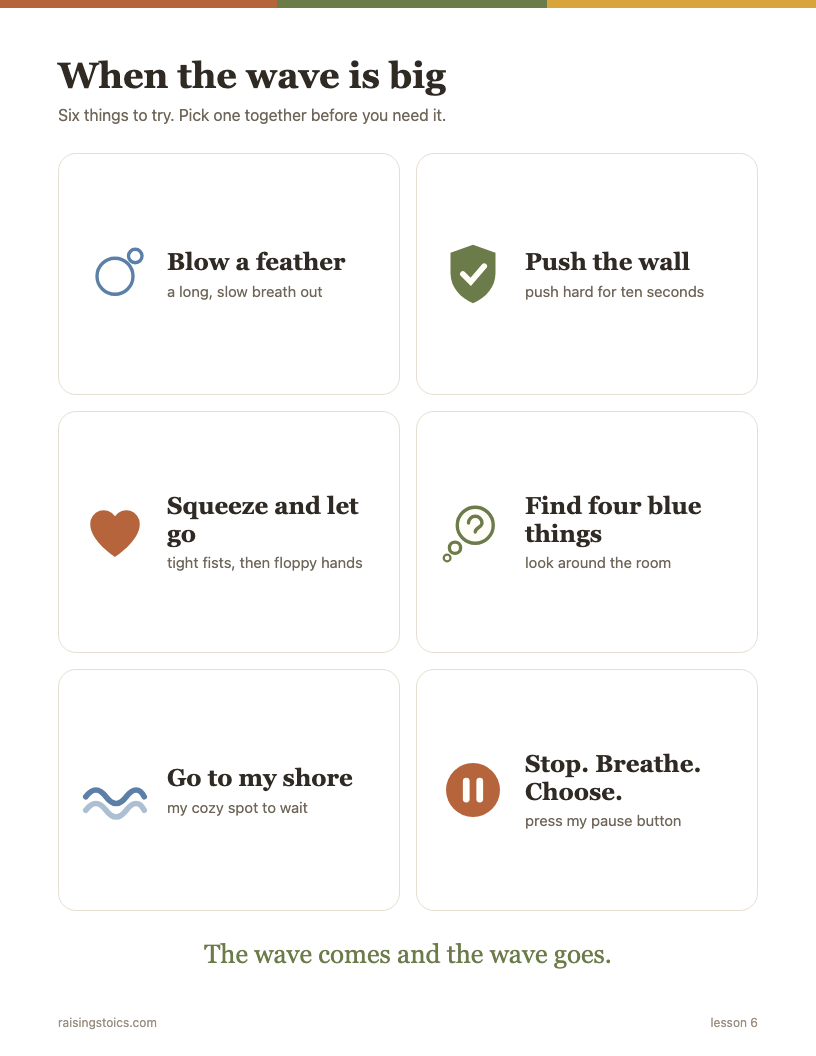
Six ways to calm down
A fridge poster: blow a feather, push the wall, find four blue things.
Download the free PDF See all 9 pages
Part of a free 9-page starter pack. Sign in with a code from your email — no password.
How do I help them be brave without pushing them?
Change what brave means. For a five-year-old, brave usually means not being scared, which makes it impossible for a scared child to be brave.
A more useful definition: brave is when you're scared and you do the thing anyway — or a small piece of it. Say it out loud together: "I'm scared, and I'm going." Let them decide how big the piece is.
Then make it a ladder rather than a leap. Looking at costumes in a catalog. Touching one in the store. Watching a sibling try one on. Wearing a hat from it. Opening the door to trick-or-treaters with you. Each step is theirs to choose, and they can stop on any of them. Jumping to the top step in one go usually makes the fear bigger, and the ladder has to start again.
Can I prepare them before the day?
Yes, and this does more than anything you do on the night itself.
Surprise is where most Halloween fear comes from, so take the surprise out. Look at pictures of decorations together and talk about who made them and how. Visit the costume aisle on an ordinary afternoon and let them handle the masks — feel the rubber, look inside, put one on a stuffed toy. Walk past the neighborhood's biggest display in daylight.
You can also play detective. A detective doesn't argue with a fear; they go and check what it actually is. The skeleton on the porch is plastic, the fog is from a machine, the witch's cackle comes from a speaker with a battery. Checking is something a child can do, which is more useful than being told there's nothing to worry about.
Should they wear a scary costume, or a cute one?
Whatever they choose, and it's worth letting them change their mind.
Many children find it easier to face scary things by becoming one. A child who is frightened of monsters and insists on being a monster is often doing something sensible: trying the fear on from the inside, where they're in charge of it.
The one practical rule is that they should be able to take the scary part off themselves. A mask they can't remove, or face paint they hate once it's on, turns a costume into another thing that's happening to them.
What if they want to go home halfway through trick-or-treating?
Go home, and treat it as a good decision rather than a failure.
Agree the exit plan before you leave: "If it gets too much, you say 'home' and we go, no questions." Knowing the door is open makes many children braver, because they're no longer trapped in a situation they can't leave.
Afterwards, name what they did do. "You went to four houses, and you rang the bell at the one with the pumpkin yourself." That's specific, it's true, and it's the piece they'll build on next year.
When is a fear of Halloween worth talking to a pediatrician about?
Most Halloween fear is ordinary, and it fades within days of the decorations coming down.
It's worth raising if the fear spreads well beyond Halloween — to leaving the house, to sleeping, to things that aren't scary in themselves — or if it lasts for weeks, or if it's stopping ordinary life in a way that's getting worse rather than better. The same is true for a child who seems frightened most of the time, not just in October.
Courage, the bravery ladder and checking a fear like a detective are lessons 9, 10 and 12 of the course.