 Raising
Mom Guilt: Why It Hits So Hard and How to Let It Go
Mom guilt tends to arrive late in the evening, after the kids are asleep and the day replays itself. It's one of the most common feelings in parenting, and dads feel it too. Here's how to tell useful guilt from the kind that just goes in circles, and what to do with each.

Mom guilt: why it hits so hard
Mom guilt rarely shows up when things are calm. It shows up at 9 p.m., after the kids are finally asleep, when you replay the moment you snapped about shoes, or the afternoon the tablet stayed on far longer than you meant it to.
Part of the reason it hits so hard is that the job never has a clear finish line. There's always one more thing you could have done: more patience, more vegetables, more reading, more play. Against a list like that, any ordinary day can look like a failure.
The other part is that you care. Guilt can be a signal that something matters to you. That's worth keeping. What usually isn't worth keeping is the replay that goes on for hours and ends with "I'm a bad mom," which tends to make the next day harder, not better.
This page is for any parent who recognizes that feeling. Dads, stepparents, grandparents, and anyone else raising a child can feel exactly the same thing.
What parent guilt sounds like
When parents describe it in online forums, the same moments come up again and again.
After yelling. A parent snapped at their 5-year-old once and the child still mentions it, weeks later. Another slammed a door during a long bath-time meltdown and then lay awake wondering whether that made them an awful parent.
When you're trying hard and still losing it. Some parents say they do everything they've read about, and still find themselves raising their voice by evening.
Screens and phones. Guilt about how much the kids watched, and just as often about how much the parent was looking at their own phone.
Not playing enough. One parent asked whether adults really have to play with their kids all day, and when that became the expectation. Several parents replied with relief that someone had said it out loud.
Work and time. Missing a school event, working late, needing time alone.
Moments like these are part of ordinary parenting. They're what an ordinary week with young children looks like, seen at the end of a long day.
Dad guilt is real too
Dad guilt gets talked about less, but it's there. Fathers describe the same replays: the shout at bedtime, the weekend spent half on the phone, the sense that they're not as patient as they'd hoped to be.
It can also look a little different. Some dads say they feel guilty for not knowing what to do in a hard moment, or for leaving most of the emotional work to their partner. Others feel guilty about working long hours and missing things.
Whatever the details, the tools on this page work the same way. Guilt is a feeling about something you did or didn't do. It's not a measure of what kind of parent you are.
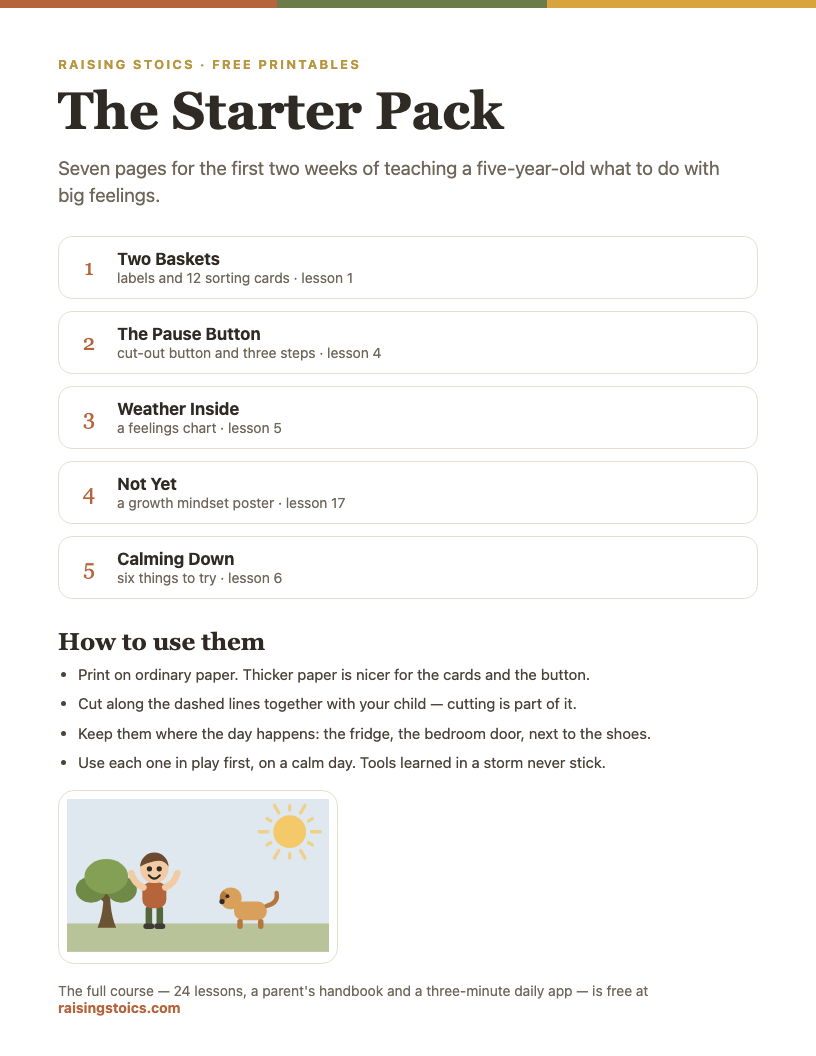
The Big Feelings Starter Pack
Nine pages for the first two weeks: a sorting game, a pause button, a feelings chart and a calm-down poster.
Download the free PDF See all 9 pages
Part of a free 9-page starter pack. Sign in with a code from your email — no password.
Guilt or shame: a useful difference
Many parents find it helps to separate two feelings that often arrive together.
Guilt says: *I did something I wish I hadn't.* It points at an action, which means it also points at a next step: apologize, repair, do it differently tomorrow.
Shame says: *I am bad.* It points at you as a person, and there's no next step in it, only a heavier feeling.
When the evening replay starts, it can help to ask which one is talking. "I yelled about the shoes" is guilt, and you can do something with it. "I'm a terrible mother" is shame, and it's worth gently setting down. You can take full responsibility for what happened without deciding that it defines you.
Two Baskets: what's up to you, and what isn't
The Stoic philosopher Epictetus began his handbook by dividing everything into two groups: what's up to us, and what isn't. That one idea is the foundation of our program, and children ages 5–6 learn it with two actual baskets.
It works on parent guilt, too. Picture two baskets at the end of the day.
Not up to you: your child's temperament, the meltdown that happened anyway, the rain that canceled the park, the work deadline, the fact that you were running on four hours of sleep, what other parents post online.
Up to you: how you speak to your child now, whether you come back and repair, what you'll try tomorrow, whether you go to bed at a reasonable hour tonight.
A lot of mom guilt is spent on the first basket: on things that were never fully yours to control. Moving those items over, out loud or on paper, doesn't excuse anything. It just puts your energy where it can actually change something.
The parent track starts with exactly this idea: a week on what's up to you, practiced alongside your child.
After you yell: repair instead of replay
Short answer: come back, own it briefly, and start again.
Most parents of young children raise their voice sometimes. Many experts suggest that what children need isn't a parent who never loses it, but a parent who comes back afterward. Once everyone has settled, get down to their eye level and say three short things: what you did, that it wasn't their fault, and that you're starting again. "I yelled. That was mine to fix, not yours. Let's try again."
Keep it short. A long, emotional apology may shift the focus to your feelings, so keep it short. Say it, mean it, and move on to something ordinary together.
Then do one thing differently next time, not ten. Our guide on how to stop yelling at your kids walks through the first-second pause and the repair in more detail.
If your child brings it up again days later, that's not proof the damage is lasting. Children often revisit things to make sense of them. Answer calmly: "Yes, I yelled that day. I didn't like it either. I'm working on it."
How to stop mom guilt from taking over the evening
Guilt that leads somewhere is useful. Guilt that circles for hours mostly isn't. A short end-of-day routine can help turn the first kind into action and let the second kind go.
Try three questions, in two minutes, once the kids are asleep:
What actually happened? One or two sentences, the way a neutral friend would describe it. Not "I ruined bedtime," but "I raised my voice when she wouldn't brush her teeth."
Which basket? What part was up to you, and what part wasn't? Tiredness, a hard day, and a stubborn 5-year-old all belong in the second basket.
What's one thing for tomorrow? One small, specific change. Brush teeth before the last story, not after. Put the phone in another room until bedtime.
Then stop. Close the notebook or put the phone down. The replay has done its job, and there's nothing more for it to do tonight.
If it helps to have a calming tool for the moment itself, many of the calm-down strategies we suggest for children (one slow breath out, a pause, naming the feeling) work just as well for adults.
Screens, work, and not playing enough
Some of the most persistent guilt isn't about one moment but about a whole pattern: too many screens, too many hours at work, not enough play.
It's worth looking at these honestly, but also at scale. A child doesn't need a parent who plays with them all day. In online discussions, a lot of parents recommend the opposite: letting children be a little bored and find their own play. A short stretch of real attention, with your phone put away, may count for more than hours of distracted half-play.
On screens, guilt often helps less than a simple family rule you can keep. On work, it may help to notice what is and isn't in your basket. You may not be able to change your hours, but you can choose how you spend the first ten minutes when you walk in the door.
And if your guilt is really saying "I want more time with my kids," that's useful information. It's not an accusation; it's something you value.
What to say to yourself instead
The voice in your head after a hard day can be harsher than anything you'd say to a friend. Try swapping a few lines.
Instead of "I'm a terrible mom," try "I had a hard moment. I can repair it."
Instead of "I've ruined them," try "Children learn from how we come back, too. I'll make sure they see that."
Instead of "Everyone else manages," try "I only see other people's best moments. They don't see my best ones either."
Instead of "I should be doing more," try "What's one thing that's actually up to me tomorrow?"
These aren't magic words, and they won't erase the feeling. They just move your attention from judging yourself to the next step, which is where a parent can actually do something. The parent track has a whole week on this idea: your mistakes are practice, not a verdict.
When it's more than guilt: signs to talk to a doctor
Ordinary mom guilt comes and goes. It's attached to specific moments, and it eases with sleep, repair, and a better day. Sometimes, though, guilt is part of something bigger that deserves real help.
After having a baby, constant guilt and feelings of worthlessness can be signs of perinatal depression, which includes depression during pregnancy and after birth. According to the National Institute of Mental Health, other signs can include a persistently sad, anxious, or "empty" mood most of the day for at least two weeks, trouble sleeping even when the baby sleeps, loss of interest in things you used to enjoy, and persistent doubts about being able to care for the baby. Their page on perinatal depression lists the signs in full and says that anyone with these symptoms should see a health care provider. Fathers and other parents can struggle after a new baby, too.
Depression and burnout can also come later, with a child of any age. It may be worth talking to your doctor if you feel numb, hopeless, or exhausted most days; if guilt never lifts, even on good days; if you've stopped enjoying almost everything; or if your anger is frightening you or your child.
This page isn't medical advice, and only a professional can tell what's going on. Asking for help is not a failure. If you ever have thoughts of harming yourself or your child, get help right away. In the US, call or text 988 (the 988 Suicide & Crisis Lifeline), or call 911 if anyone is in immediate danger.
FAQ
Is mom guilt normal?
Yes, feeling guilty sometimes is very common among parents of young children, and many dads feel it too. It often shows up after yelling, long screen days, or time away at work. Ordinary guilt is tied to specific moments and eases with rest and repair. Guilt that never lifts, or comes with hopelessness, is worth mentioning to a doctor.
Why do I feel guilty all the time as a mom?
Often because the list of things a parent could be doing has no end, so any ordinary day can look like falling short. Comparisons online, tiredness, and little time to yourself can make it worse. Separating what's up to you from what isn't helps many parents. If the guilt is constant and heavy, talk to a doctor about it.
How do I deal with working mom guilt?
Start with what's actually in your control. You may not be able to change your hours, but you can protect a short stretch of real attention each day, with your phone put away, such as the first ten minutes home or the bedtime story. Warm, focused time may matter more to a child than total hours. Talking openly with your partner about sharing the load also helps.
Does mom guilt ever go away?
For most parents, it doesn't vanish completely, but it can become quieter and more useful: a quick signal to repair or adjust rather than an hours-long replay. Practicing a short evening routine, repairing after hard moments, and getting enough sleep all help. If guilt gets heavier over time instead of lighter, that's a good reason to talk to a doctor.
Calming Strategies for Kids: Calm-Down Tools That Actually Work
Calming strategies for kids ages 4–7: why telling a child to calm down fails, what to do during a meltdown, and the calm-down tools worth rehearsing.
Read next →While children learn "Two Baskets" and "The Pause Button" in the program, parents practice the same ideas in a short weekly track of their own.