 Raising
After-School Restraint Collapse: Why Kids Fall Apart at Home
The teacher says your child had a great day, and then they fall apart in the car or the moment you walk in the door. Parents call it after-school restraint collapse, and it's one of the most common questions on parenting forums in the US and Europe. Here's why it may happen in children ages 4–7, and what helps in that first hour home.

Why your child has an after-school restraint collapse
Short answer: a school day asks a young child to hold a lot in: follow rules, wait their turn, sit still, and manage noise and feelings in front of other people. Home is where it's safe to let go, so the feelings often come out there, with you.
"After-school restraint collapse" is a phrase from parenting educators, not a medical diagnosis. It describes a pattern: crying, shouting, refusing, or melting down over something small soon after pickup. Hunger, tiredness, and the switch from one place to another may all add to it. Some children show it mostly early in kindergarten or a new school year; others have a harder time after long or busy days.
It can feel personal when the worst of the day lands on you. Often it means the opposite: your child feels safe enough at home to stop holding it together.
What parents argue about
On parenting forums, the collapse itself is widely recognized. Parents agree less about what to do with it.
Questions or quiet. Some parents want to hear about the day right away, to catch problems early. Others say questions at pickup are exactly what tips a tired child over, and they wait until dinner or bedtime.
Consequences at home. Some parents add a consequence at home when the teacher reports trouble at school. Others say the school has already dealt with it, and a second punishment hours later only makes evenings harder.
Normal or worth checking. When the meltdowns are big, some parents push for an evaluation early. Others point first to sleep, food, and how demanding the day was.
What to do today
1. Feed them before anything else. A snack in the car or at the door, with no questions attached. Say: "Snack first. You can tell me about your day later, or not at all." 2. Give them a quiet stretch with no demands. No chores, no homework, no quiz about the day. Say: "You worked hard today. Now you get to rest." 3. Spend a little one-on-one time, phone away. Parents on forums often suggest a short stretch of one-on-one play, phone away. Say: "I missed you. Want to play something, just us?"
Over the week, look at bedtime too. An earlier bedtime on school nights helps many families; see how much sleep a 5-year-old needs.
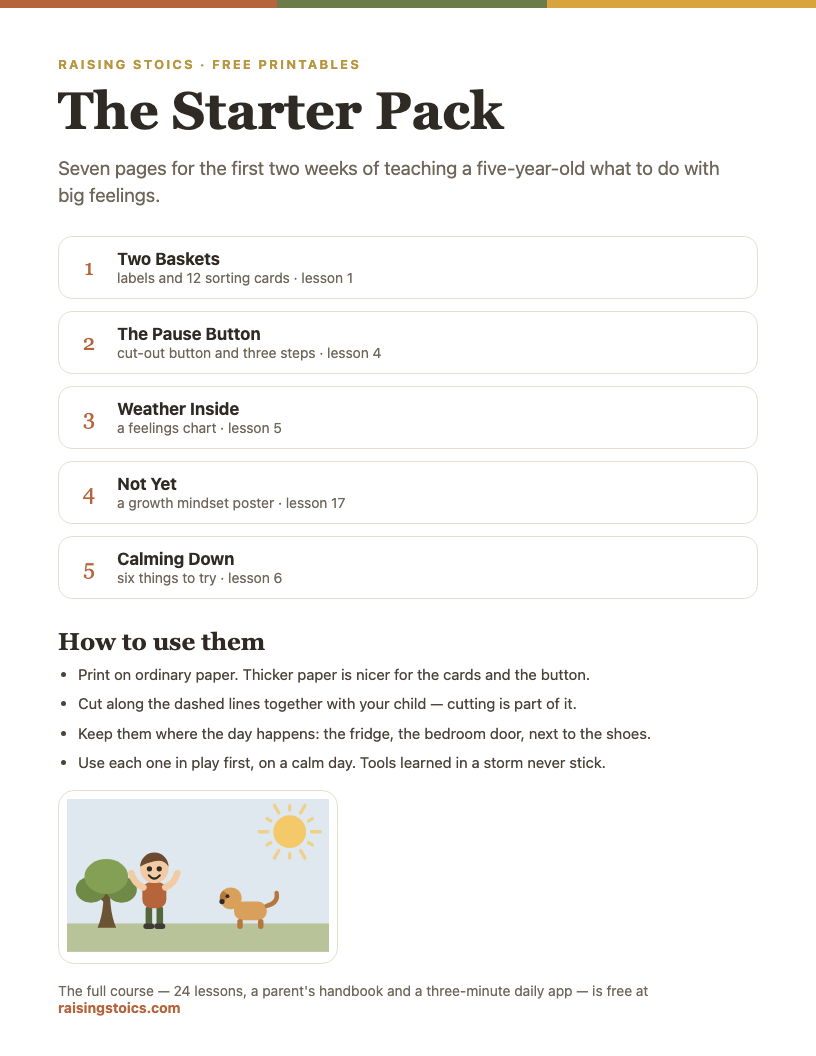
The Big Feelings Starter Pack
Nine pages for the first two weeks: a sorting game, a pause button, a feelings chart and a calm-down poster.
Download the free PDF See all 9 pages
Part of a free 9-page starter pack. Sign in with a code from your email — no password.
What to say in the moment
When the meltdown comes anyway, keep your words short and your voice low.
- "You held on all day. It's okay to let it out here."
- "I'm right here. I'm not going anywhere."
- "We'll talk later. Right now, let's just breathe."
Skip the lecture and the questions about what went wrong. If things get thrown, calmly move the things or move your child. When they've settled, point out what happened: "That was a big wave. It came, and now it's going." For more tools, see our calm-down strategies and the guide to tantrums at 4 to 6.
When to talk to your pediatrician
Mention it at a checkup if the meltdowns are frequent and severe, keep going as the school year goes on, or show up in more than one setting, such as at school as well as at home. Also mention it if your child seems unhappy about school much of the time, sleeps poorly, or isn't eating well. Your pediatrician can help look at sleep and anything else that may be making the day harder.
In the program
In our program, this is the lesson "The Wave": a big feeling always passes. Children practice the phrase "The wave comes and the wave goes," so they can recognize a feeling while it's happening instead of only afterward. Your child's app adds three minutes a day: a small mission in the morning and three short questions in the evening, which some families turn into a calm after-school ritual. See the program for all 24 lessons, or read more answers to questions parents often ask.
What parents ask
Paraphrased from questions parents often post on Reddit, Mumsnet, BabyCenter, and other parenting forums.
“My kindergartner is an angel at school, then screams at their little brother the minute they get home. What do I do?”
Short answer: the collapse often lands on whoever is closest, and a younger sibling is an easy target. For the first stretch after pickup, it may help to give your child some space of their own: a snack and a quiet spot away from the sibling. If anyone gets hit, keep everyone safe first and talk later. Our page on sibling rivalry has more on what to say.
“Is it too much to sign my 5-year-old up for activities right after school?”
Short answer: it depends on the child, but for some children an activity straight after a full school day may add to the evening meltdowns. Many parents keep weekdays light early in the school year and add an activity once evenings are calmer. Watch how your child does on activity days compared with quiet ones, and adjust from there.
“Would an earlier bedtime really help with after-school meltdowns?”
Short answer: for some children it may. Tiredness often adds to the collapse, and a tired 5-year-old may look wound up rather than sleepy. Work back from the time your child has to get up, and keep bedtime about the same on school nights. Our guide on what time a 5-year-old should go to bed has example bedtimes by wake-up time.
“Should I take away screen time when they melt down after school?”
Short answer: parents on forums disagree about consequences. Some add one at home when the day goes badly; others say school has already been hard and a second consequence only makes evenings worse. Many agree that food, quiet, and a little time together can come first, since hunger and tiredness may add to the meltdown. Some families also keep screens off right after pickup, because turning a show off can set off a second meltdown. See child meltdown when screen time ends.
FAQ
Is after-school restraint collapse normal?
Yes, it's common, especially in kindergarten and at the start of a school year. Many parents on forums describe the same pattern: a good report from the teacher and a meltdown at home. It's worth a closer look if the meltdowns are severe, keep going, or come with problems at school too.
How long does after-school restraint collapse last?
It varies from child to child. For many children it's most intense early in a new school year and eases as the routine becomes familiar, though it may come back after long days, busy weeks, or school breaks. If it isn't easing as the year goes on, talk with your child's teacher and your pediatrician.
Should I ask my child about their day right after school?
Usually it works better to wait. Right after pickup, many children have nothing left for questions. Offer a snack and some quiet first, and ask later in the evening. Specific, light questions, like "Who did you sit with at lunch?" or "What made you laugh today?" often get more than "How was your day?"
Do older kids have after-school meltdowns too?
They can. The phrase is most often used about young children starting school, but older kids, and adults, can come home drained and short-tempered after a long day of holding it together. The same basics help at any age: food, rest, a little time to themselves, and questions later.
Kindergarten Behavior Problems: When the Teacher Calls Every Day
Kindergarten behavior problems, frowny faces, and daily calls from the teacher. Why they may happen, what parents disagree on, and three steps to take today.
Read next →The lesson "The Wave" helps your child notice a big feeling rising and wait for it to pass.