 Raising
Why Does My Child Hit Me? What to Do When a 5-Year-Old Hits
It stings in more ways than one: your child is upset, and the first thing they do is hit you. If you've typed "why does my child hit me" into a search bar, you're not alone; hitting is one of the most common worries parents of 4- to 7-year-olds bring to parenting forums. Here's what may be behind it, and what to do.

Why does my child hit me when they're upset?
Short answer: many young children hit because a big feeling arrives faster than their ability to stop and put it into words. They often hit the person they feel safest with, which is usually you.
At ages 4–7, the skills that help a child pause before acting are still developing. Anger, frustration, or hearing "no" can turn into action before a child has had time to think. Some children are also testing what happens: does hitting end the limit, get attention, or make you back off? It doesn't mean your child doesn't love you, or that you've done something wrong. It is a sign that they need a clear limit and a better plan for their hands.
What parents argue about
On parenting forums, this is one of the sharpest splits.
Gentle or firm. Some parents lead with connection: stay close, name the feeling, help the child calm down. Others say that's too soft for hitting and want an immediate, clear consequence every time. Many replies land in between: calm and firm at once.
During or after. Some parents say a child in a meltdown can't take in a consequence, so the talk waits. Others say the response to hitting has to be immediate to mean anything.
Spanking. A few parents still suggest it. Others push back hard, pointing out that hitting a child to stop hitting sends a mixed message. Pediatric guidance, including from the American Academy of Pediatrics, advises against spanking.
What gets the most agreement: stop the hitting right away, in a calm, boring, same-every-time way, and talk about it later.
What to do today
1. Decide your response now, and use it every time. Gently block their hands, or step out of reach, and say one sentence. Say: "I won't let you hit me. I'm moving away until your hands are calm." 2. Give their hands a job. At a calm time, show what hands can do when they're mad: squeeze fists, push against a wall, stomp their feet. Say: "When you're mad, you can push the wall as hard as you want." 3. Practice when no one is upset. Act out a small problem with a stuffed animal and try the new plan. Say: "Let's pretend Bear is really mad. What can his hands do instead?"
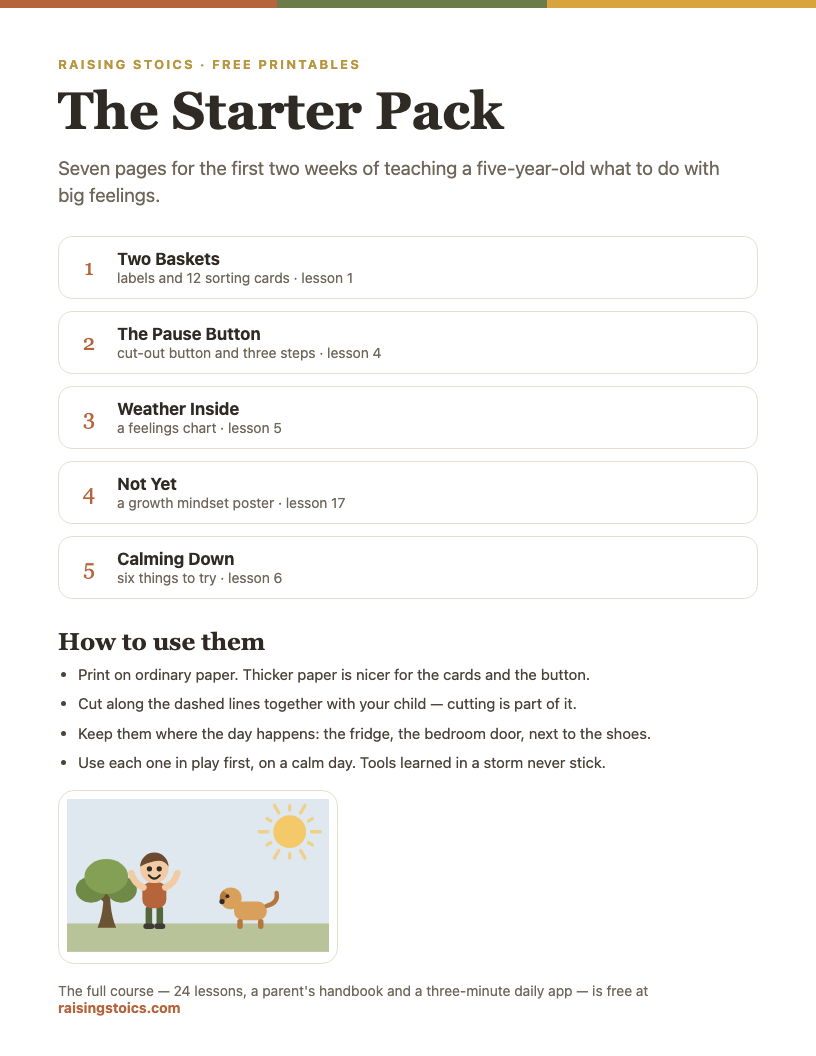
The Big Feelings Starter Pack
Nine pages for the first two weeks: a sorting game, a pause button, a feelings chart and a calm-down poster.
Download the free PDF See all 9 pages
Part of a free 9-page starter pack. Sign in with a code from your email — no password.
What to do in the moment
Keep it short and boring. A long explanation while you're being hit teaches less than a clear limit.
- Protect yourself: catch the hand, step back, or put a cushion between you.
- Say it once: "I won't let you hit."
- Stay nearby and calm until the storm passes.
- Later, name it: "You were really angry when I said no to the park."
Don't expect a heartfelt apology in the moment, and skip "How would you like it?" For many 4- and 5-year-olds, that question doesn't land yet. Our guides to the angry child and 5-year-old tantrums cover the bigger picture.
After the hit: when your child says "sorry" just to end it
Once everyone has calmed down, many parents ask for an apology and get a quick, flat "sorry" that seems to mean "Can we be done now?" That doesn't make the apology pointless. It may just be missing the part that helps the other person.
A 2016 study with 64 children ages 6 and 7 looked at this with block towers. After someone knocked a child's tower over, children shared more with that person after an apology than after no apology, whether the apology was offered freely or only after prompting. But in the lab, the only response that made children feel better was restitution: an offer to make up for the damage. It was one small study, not a study of families, and the children in the study were a little older than many children who hit. Still, it suggests that "sorry" may help mend the relationship, while fixing something may help with the hurt.
So instead of an instant "Say sorry!":
1. Wait until everyone is calm. A child who is still upset may find it hard to mean it. Say: "We'll make it right when your body is calm." 2. Show the three steps. Say what you did, say how it was for them, then fix it. Say: "Sorry is something you do. What happened?" Help with the words if needed: "I hit you. It hurt." 3. Offer three ways to fix it, and let your child choose. Help clean up what got knocked over, offer something of theirs, like a drawing or a turn with a toy, or ask, "What would help?" 4. Don't turn the apology into a punishment. Skip "Say it like you mean it" and extra lectures. The goal is repair. If your child isn't ready, come back to it later that day. 5. Apologize too when you yell. Use the same three steps: "I yelled at you. That was scary. What would help?" Our page on how to stop yelling at your kids covers repair after you lose your temper.
When to talk to your pediatrician
Talk to your pediatrician if hitting is frequent or getting worse, if someone is getting hurt, if it also happens at school or with other children, or if it keeps going despite a calm, consistent plan. Also mention it if it started after a big change or something upsetting. They can help look at what's going on and point you to support.
In the program
In our program, this is the lesson "The Dragon Inside": noticing anger before it takes over. Children learn to say "My dragon woke up" when anger starts, which puts words between the feeling and their hands. The next lesson, "The Pause Button," adds three steps: stop, breathe, choose. Your child's app practices both with a short daily mission. See the program, or read more answers to questions parents often ask.
What parents ask
Paraphrased from questions parents often post on Reddit, Mumsnet, BabyCenter, and other parenting forums.
“My 4-year-old keeps hitting kids at school when someone takes their toy. What now?”
Short answer: treat the meeting as teamwork. Ask when it happens, where, and what comes just before it, and agree on the same short words at home and at school, such as "I won't let you hit." At home, practice what hands can do instead when someone grabs a toy. If hitting is frequent or getting worse, talk to your pediatrician. See kindergarten behavior problems.
“Is it okay to hold my child's arms to stop them from hitting me?”
Short answer: many parents gently block or catch a hand, or step out of reach, to keep everyone safe. The goal is protection, not punishment, so keep it brief, calm, and quiet, and let go once your child is calmer. Holding a child's arms is different from blocking a hand, so avoid it when you're angry, and never hold your child down. If you often need to hold your child to keep people safe, talk to your pediatrician about getting more support.
“My child hits their little brother every time they don't get their way. How do I stop it?”
Short answer: take care of the child who was hit first, out loud, then respond to the hitting calmly and the same way every time. Later, when everyone is calm, practice what to do instead: use words, walk away, or get a grown-up. Our page on sibling rivalry covers when to step in and how kids can make up.
“Should I tell my 5-year-old to hit back if another kid hits them?”
Short answer: parents on forums disagree about this. Many replies lean toward a simple plan: say "Stop!" in a loud voice, move away, tell a teacher, and tell you at home. If it keeps happening, keep notes and talk to the school. Practicing the words at home, with a stuffed animal, may make them easier to use in the moment.
FAQ
Is it normal for a 5-year-old to be hitting?
It's common, especially when a 5-year-old is angry, tired, or has just heard "no." Many children this age still act before they think. What matters is the direction over time: with a calm, consistent response and practice, hitting may become less frequent. If it's frequent, severe, or happening everywhere, talk to your pediatrician.
Why does my child only hit me and not other people?
Children often save their biggest feelings for the person they feel safest with. That doesn't make hitting okay, but it usually isn't about how they feel about you. Hold the same limit every time, give them words for the feeling, and practice a plan for their hands when everyone is calm.
Should I hit my child back to show how it feels?
No. Hitting back shows the very thing you're trying to stop, and a young child may learn that bigger people are allowed to hit. Protect yourself, move out of reach, and keep the limit calm and clear. Once everyone has calmed down, practice together what their hands can do instead.
What consequence works for a child who hits?
The most useful consequence is usually immediate and connected to what happened: the game stops, or you move away. Long punishments later in the day are hard for a young child to link to the hitting. Afterward, when everyone is calm, practice what to do next time, so the consequence comes with a plan.
Kindergarten Behavior Problems: When the Teacher Calls Every Day
Kindergarten behavior problems, frowny faces, and daily calls from the teacher. Why they may happen, what parents disagree on, and three steps to take today.
Read next →The lesson "The Dragon Inside" teaches children to notice anger waking up before it reaches their hands.