 Raising
Child Can't Handle Losing? Why Games End in Tears and What Helps
The board goes flying, the cards hit the floor, or the game ends in tears. If your child can't handle losing, you're in good company: it's a question parents of 4- to 7-year-olds often ask on parenting forums. Losing well is a skill, and it can be practiced like any other.

Why your child can't handle losing
Short answer: for many young children, winning and losing still feel like news about themselves, not about the game. Losing may feel like being bad at something, and the feeling arrives faster than the words to manage it.
At ages 4–7, children are still learning to hold two ideas at once: "I lost" and "I'm still okay." Some children feel disappointment more intensely than others, and a tired or hungry child may find it harder at the end of the day. Searches like "sore loser kids" make it sound like a type of child. It's more useful to see a skill your child hasn't finished learning yet: losing, feeling bad about it, and staying in the game.
What parents argue about
Let them win, or play fair? On parenting forums, some parents let a young child win most of the time to keep the peace, especially at 4. Others say always winning makes losing harder later, and play by the rules from the start.
Keep playing, or stop? Some parents insist that a child finish the game they started. Others say forcing a crying child to keep playing doesn't teach anything, and pause the game instead.
What gets the most agreement: having a hard time losing is very common at this age, a calm pause works better than a lecture, and children copy how the adults around them lose.
What to do today
1. Play a cooperative game first. In games where everyone wins or loses together against the board, there's no one to be angry at. Say: "Today we're a team. Let's beat the game together." 2. Lose out loud yourself. When you lose, name the feeling and recover in front of them. Say: "Oh, I lost. I'm disappointed. Good game, that was a sneaky move." 3. Agree on an end-of-game ritual before you start. A handshake or a high five after every game, whoever wins. Say: "Win or lose, we shake hands at the end."
When competitive games come back, start with short ones and games of luck, where nobody's skill is on the line.
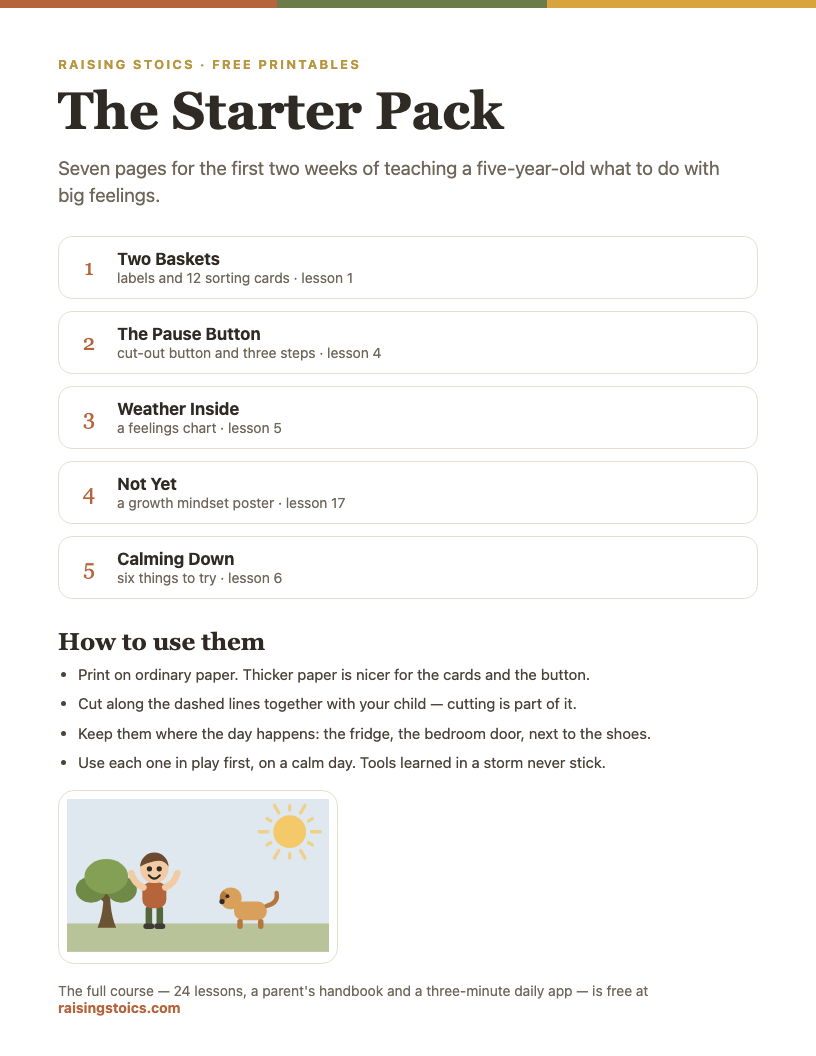
The Big Feelings Starter Pack
Nine pages for the first two weeks: a sorting game, a pause button, a feelings chart and a calm-down poster.
Download the free PDF See all 9 pages
Part of a free 9-page starter pack. Sign in with a code from your email — no password.
What to say in the moment
When the tears or the flying pieces come:
- "Losing feels terrible. I get it."
- "We're pausing the game. We can try again later."
- "Pieces stay on the table. If they fly, the game is done for today."
Save the talk for the next day, when everyone's calm: "Yesterday the game ended badly. What could you do next time you feel that mad?" For more on strong reactions, see why a 5-year-old gets so angry and our guide to building resilience in children.
When to talk to your pediatrician
Mention it if losing leads to meltdowns that are frequent and severe, if your child hurts other people or themselves, or if the same intensity shows up in more than one setting, like school, sports, and home, and isn't easing over time. A pediatrician can help sort out whether something else is making frustration harder to handle.
In the program
In our program, this is the lesson "Fair Play": fair means the same rules for everyone. Children practice the phrase "I play fair," including when they're losing. A later lesson, "Not Yet," adds that a mistake is practice, not a verdict. Your child's app keeps it going with a three-minute daily mission. See the program, or read more answers to questions parents often ask.
What parents ask
Paraphrased from questions parents often post on Reddit, Mumsnet, BabyCenter, and other parenting forums.
“My 5-year-old throws the game board when they lose. Do we just stop having game night?”
Short answer: not necessarily. Agree on the rule before you start: pieces stay on the table, and if they fly, the game is done for today. Then follow through calmly, without a lecture. Many parents switch to cooperative games for a while and bring competitive ones back slowly, starting with short games of luck.
“My kid quits anything the second it gets hard, not just games. How do I help?”
Short answer: for many young children, quitting is a way to avoid the feeling of not being good at something yet. Try breaking the hard part into smaller steps, praising the effort rather than the result, and adding "yet" to "I can't." Taking a break and coming back later is fine. Our guide to building resilience in children has more ideas.
“My kindergartner wasn't picked for something at school and is crushed. What do I say?”
Short answer: listen first and name the feeling before trying to fix it: "You really wanted that. It hurts not to be picked." Skip "It doesn't matter," which may leave a child feeling unheard. Later, when they're calm, you can talk about what they enjoyed and what they might try next time. Disappointment shared with a calm adult is often easier to carry.
“Is it okay to stop competitive games for a while?”
Short answer: yes, many parents do exactly that. Cooperative games, where everyone wins or loses together against the board, let a child practice playing without anyone to be angry at. When competitive games come back, start with short ones and games of luck, agree on a handshake at the end, and lose calmly yourself so they can see how it's done.
FAQ
Should I let my child win at games?
Sometimes, especially when a 4-year-old is learning a new game, but not every time. Losing in small, safe ways at home is how children practice it. Mixing in cooperative games and games of pure luck lets them lose without feeling judged, and gives you chances to show how you handle losing yourself.
At what age do kids learn to lose gracefully?
There's no fixed age, and it varies a lot from child to child. Many children find losing easier as they get older and have more practice, but plenty of adults still feel the sting. Regular low-stakes practice at home, and seeing the adults around them lose calmly, tend to matter more than age alone.
Why does my child cheat at games?
At ages 4–6, cheating may be less about deceiving and more about avoiding the feeling of losing. Some young children also see rules as flexible. Calmly restate the rule, play the turn again, and praise fair play when you see it. If cheating ends every game, try a cooperative game for a while.
Are team sports good for a child who hates losing?
They can be, if the setting is low pressure. A coach who praises effort, short games, and no focus on scores can help a child practice losing alongside friends. If every game ends in tears, it's fine to pause and try again later, or to choose an activity without winners for a season.
Teaching Empathy to Children: Empathy Activities for Ages 4–7
Empathy activities for kids ages 4–7: at age 5, empathy is largely perspective-taking, and it can be practiced with stories, one good question, and three moves.
Read next →The lesson "Fair Play" helps children keep the same rules for everyone, even when they're losing.