 Raising
When Your Child Hits, Lies, or Whines: Answers for Ages 4–7
When your child does something that leaves you stuck, you're rarely the only one. These answers come from questions parents often ask on Reddit, BabyCenter, Mumsnet, and other parenting forums, in the words parents actually use. Each page explains why it may happen, where parents disagree, and what to do today.

When your child falls apart after school
Fine at school, a meltdown the moment they're home: parents call it after-school restraint collapse. Why it may happen, and what helps in the first hour after pickup. After-school restraint collapse
When your child can't handle losing
Board games that end in tears or flying pieces are common at ages 4–7. How to practice losing at home, and whether to let them win. Child can't handle losing
When your child hits you
Many young children hit when a feeling moves faster than their words, often the person they feel safest with. A calm, same-every-time response and a plan for their hands. Why does my child hit me?
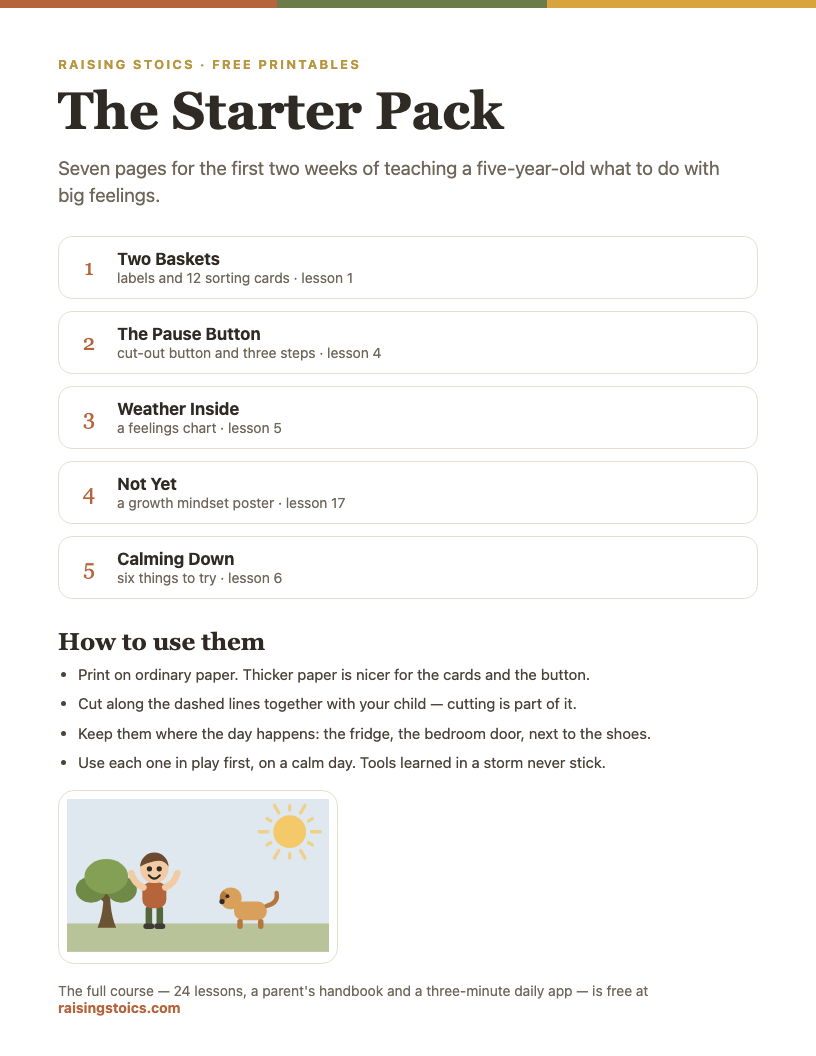
The Big Feelings Starter Pack
Nine pages for the first two weeks: a sorting game, a pause button, a feelings chart and a calm-down poster.
Download the free PDF See all 9 pages
Part of a free 9-page starter pack. Sign in with a code from your email — no password.
When your child says "I hate you"
Usually it means "I'm really angry right now." What to say back, and how to give them better words. Child says "I hate you"
When your child lies
Saying things that aren't true is common at this age and is often about avoiding trouble. How to make the truth the easy road. Why do kids lie?
When your child whines
Whining is often tiredness, hunger, or a habit that has worked before. One calm phrase and a plan for answering it. Whining child
When your child copies bad behavior from TV
What parents say about PAW Patrol, Bluey, Peppa Pig, and other shows, why young children copy, and how to talk about it. Kids copying behavior from TV
When your child is afraid of the dark
Bedtime fears and nightmares often come with a growing imagination. A calm plan for tonight, and when nightmares often start. Child afraid of the dark
When nobody plays with your child
Friendships at ages 4–7 are new and shift quickly. How to find out what's really happening, and three small steps to help. My child has no friends at school
When your child won't turn off the tablet
Why the end of screen time is so hard, and a three-step plan that lets the device do the stopping. Child meltdown when screen time ends
When your child has tantrums, gets angry, or won't listen
Three of the biggest questions already have longer guides: 5-year-old tantrums, what to do with an angry child, and how to make kids listen without yelling.
…and when you yell
Many parents lose their temper sometimes, and many forum threads are about exactly that. Our page on how to stop yelling at your kids is about the pause before you raise your voice, and how to repair afterward.
What parents ask
Paraphrased from questions parents often post on Reddit, Mumsnet, BabyCenter, and other parenting forums.
“My 5-year-old argues about every single rule and says it isn't fair. Is this a phase?”
Short answer: arguing and testing limits are common at this age, and they often ease when the rules stay predictable. Say the rule once, follow through calmly, and skip the debate in the moment. Offering two choices you're fine with may give a child some control without reopening the rule. Our guide on how to make kids listen without yelling covers calm follow-through.
“My kid is sweet with everyone else and saves the worst behavior for me. Why?”
Short answer: many children let their hardest feelings out with the person they feel safest with. That doesn't make hitting, whining, or rudeness okay, but it often isn't a sign that something is wrong between you. Keep the same calm limit every time, and look at when the hard moments happen: tiredness, hunger, and the end of the school day often play a part. See after-school restraint collapse.
“Gentle parenting or firm consequences? Everyone online says something different.”
Short answer: parents on forums disagree sharply, and many land in between: calm and firm at the same time. In practice that may mean stopping unsafe behavior right away, in the same boring way every time, and talking about the feeling later, once everyone has calmed down. Each page in this series has a section on what parents argue about, so you can see both sides.
“Do sticker charts actually work for a 5-year-old, or do they backfire?”
Short answer: they work for some children and not for others. A chart may help most when it targets one specific habit, notices good moments, and is easy to earn. Many parents say that taking stickers away, or mixing rewards with punishments, turns the chart into a fight. If a chart stops working, it's fine to drop it. Our page on kindergarten behavior problems covers charts at school.
FAQ
Where do these questions come from?
They come from questions parents of 4- to 7-year-olds often ask on parenting forums: Reddit communities such as r/Parenting, r/Mommit, and r/GentleParenting, BabyCenter, What to Expect, Quora, Mumsnet, and others. We paraphrase what parents ask, where they disagree, and which advice gets the most agreement. We don't quote posts or name anyone.
Are these behaviors normal at ages 4–7?
Most of them are common at this age. Hitting, whining, saying things that aren't true, and big meltdowns often reflect skills that are still developing, like pausing before acting and naming feelings. Each page explains what may be behind the behavior and includes a section on when to talk to your pediatrician.
When should I worry about my child's behavior?
Talk to your pediatrician when a behavior is frequent, severe, lasting, or happening in more than one setting, such as at home and at school. Also reach out if someone is getting hurt, or if your child seems unhappy most of the time. Each page has its own guidance.
After-School Restraint Collapse: Why Kids Fall Apart at Home
After-school restraint collapse is why kids hold it together at school and fall apart at home. Why it happens, and what helps in the first hour after pickup.
Read next →Most answers link to a lesson in the program, where children practice the skill behind the behavior with you.