 Raising
Kindergarten Behavior Problems: When the Teacher Calls Every Day
The teacher calls again, or the folder comes home with another frowny face. Kindergarten behavior problems are one of the most common worries parents of 5- and 6-year-olds bring to parenting forums. Here's why they may happen, what parents disagree about, and what you can do starting today.

Why your child is having kindergarten behavior problems
Short answer: kindergarten asks a lot of a 5-year-old at once: sitting, waiting, following group directions, and handling noise and other children for a whole day. Some children aren't ready for all of that on the same day, and it often shows as behavior.
Parents on forums describe a common pattern: the child does fine during structured lessons and gets in trouble at recess and lunch. Unstructured time has fewer rules, more noise, and more chances to bump into other children, and that may be hardest for a child who is still learning to stop and think first. Tiredness, hunger, a new classroom, and the start of a school year may add to it. Some children settle as the routine becomes familiar, though others need more help.
What parents argue about
ADHD or the class. On parenting forums, some parents say a school that calls every day is a sign to get an evaluation for ADHD or another difference early, and that an evaluation is not a label. Others say the real cause in their case was the class: a poor fit with the teacher, a crowded room, or a long day, and that a change there helped.
Punishing at home. Some parents add a consequence at home for trouble at school. Others say the school has already dealt with it, and a second punishment hours later only makes evenings harder and doesn't change tomorrow.
Charts and rewards. Some parents use small rewards for a good day, one setting at a time. Others find that a daily frowny face, or taking everything away after one, stops working fast and leaves the child feeling bad about themselves.
What to do today
1. Ask the teacher for specifics. When, where, and what happened just before: recess, lunch, carpet time, transitions. Treat the teacher as a partner, and keep short notes. Say: "Thank you for telling me. Can you help me see when it usually happens, so we can work on the same thing?" 2. Plan for the hardest part of the day together. If it's recess or lunch, agree on one thing your child can do there: find a set friend, play one game they know, or go to a grown-up when they feel stuck. Say: "At recess, you can play tag, swing, or find Ms. Lee. Which one first?" 3. Talk about tomorrow, not the punishment. Skip a second consequence at home. Say: "School was hard today. Let's figure out one thing that could help tomorrow."
If your child falls apart at home after a hard day, start with food and rest. See after-school restraint collapse.
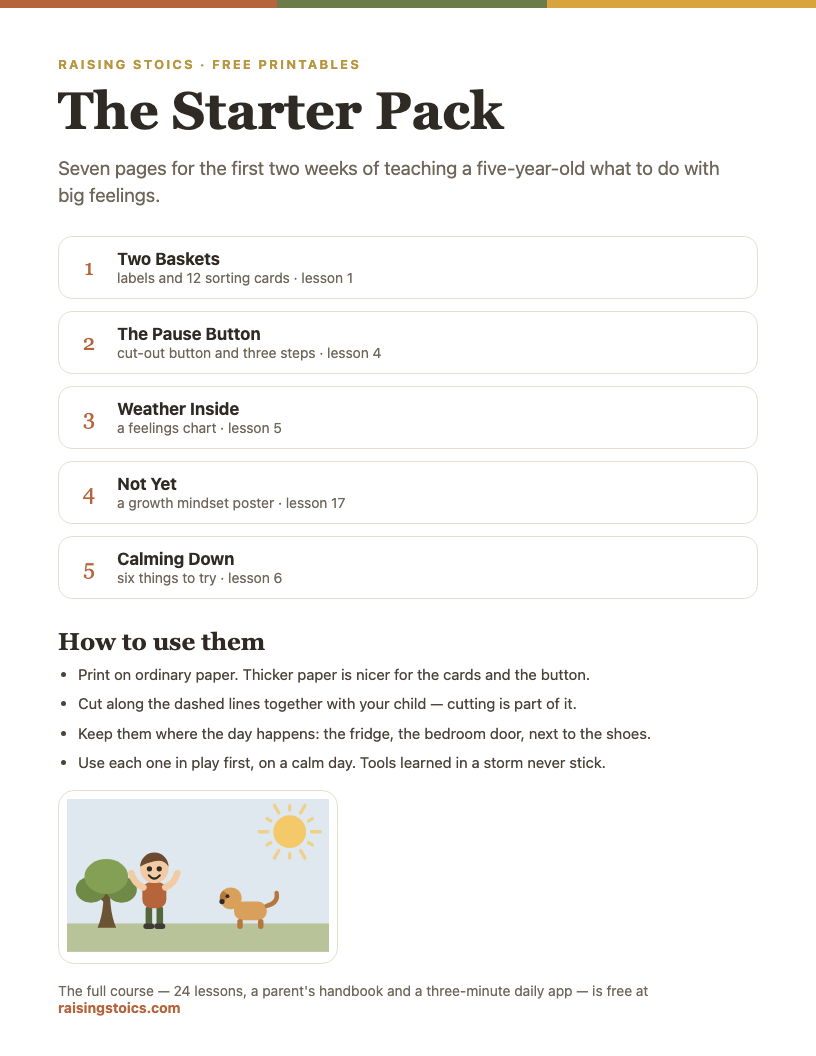
The Big Feelings Starter Pack
Nine pages for the first two weeks: a sorting game, a pause button, a feelings chart and a calm-down poster.
Download the free PDF See all 9 pages
Part of a free 9-page starter pack. Sign in with a code from your email — no password.
What to say instead
When the behavior chart comes home with a frowny face, try to keep your reaction small.
- Instead of "Why did you do that?" try: "Tell me what happened at lunch."
- Instead of "You'll lose your tablet" try: "What could you do next time someone takes your spot?"
- Instead of "You're always in trouble" try: "You had a hard day. Tomorrow is a new day."
If they can tell you what happened before the trouble, you've learned something useful. If they can't, that's normal at 5; ask the teacher instead.
When to talk to your pediatrician
Talk to your pediatrician if the behavior is frequent, severe, lasting, or happening in more than one setting, such as at school and at home or with other caregivers. Also bring it up if your child seems unhappy about school most of the time, sleeps poorly, or isn't eating well. Your pediatrician can check sleep, hearing, and other things that may be making school harder, and talk with you about whether an evaluation makes sense. If your child talks about hurting themselves, contact your pediatrician right away. If they're in danger, call 911 or call or text 988.
In the program
In our program for children ages 5–6, the matching lesson is "The Pause Button" (the gap between what happens and what I do). Children practice the routine "Stop. Breathe. Choose." at home while everyone is calm, so it's there when someone takes their spot in line. The lesson is open in full, no sign-up needed. Your child's app adds a small mission in the morning and a few short questions in the evening. For readiness skills, see the kindergarten readiness checklist, and for other everyday struggles, more answers to questions parents often ask.
What parents ask
Paraphrased from questions parents often post on Reddit, Mumsnet, BabyCenter, and other parenting forums.
“The school is talking about suspending my 5-year-old. What should I ask for?”
Short answer: ask for a meeting, and come with questions: what happens, when, what comes just before it, and what support the school has tried. You can also ask, in writing, whether an evaluation would help; some parents on forums say asking early doesn't put a label on a child. Talk to your pediatrician too, especially if behavior is also a concern at home.
“My kindergartner can't sit still or follow directions. Is it ADHD or just being 5?”
Short answer: only a professional can answer that, and many 5-year-olds have trouble sitting still. It's worth raising with your pediatrician if the behavior is frequent, lasting, and shows up in more than one setting, such as at school and at home. Ask the teacher what they see, and keep short notes before the appointment. Pediatricians often check sleep and hearing too.
“My child gets a frowny face every day and now calls themselves 'the bad kid.' How do I help?”
Short answer: separate the behavior from your child: "You had a hard day. You're not a bad kid." Ask the teacher whether you can work on one goal together and notice the good moments, not only the bad ones. At home, point out times your child stopped and thought first. If they seem unhappy about school most of the time, talk to your pediatrician.
“My kindergartner said a really bad word at school and the teacher called me. How do I handle it?”
Short answer: stay calm, since a big reaction may make the word more interesting. Ask where they heard it, explain simply that it's a word that hurts people and isn't used at school or at home, and give them another word to use when they're upset. Then let the teacher know you've talked about it.
FAQ
Is it normal for a kindergartener to get in trouble at school?
Yes, some trouble is common, especially early in the year. Kindergarten is many children's first full day of group rules, and learning to wait, share, and follow directions takes practice. It's worth a closer look if the reports come most days, are serious, keep going as the year goes on, or match what you see at home.
Should I punish my child at home for bad behavior at school?
Usually it works better not to add a second punishment. The school has already responded, and by evening a 5-year-old may not connect the two. Talk briefly about what happened, ask what could help tomorrow, and stay in touch with the teacher. If the school asks you to back up a plan, follow the same plan at home.
What should I do if my kindergartener has trouble at recess?
Ask the teacher what usually happens and when. Then give your child a short plan for recess: a game they know, a friend to look for, and a grown-up to go to when they feel stuck. Some parents ask the school whether their child can have a small job at recess or lunch, which gives the time more structure.
Do behavior charts work in kindergarten?
They work for some children and not for others. A chart that focuses on one specific behavior and notices good moments may help. A chart that shows a frowny face most days may leave a child discouraged. If your child's chart is mostly bad news, ask the teacher whether you can work on one goal together.
After-School Restraint Collapse: Why Kids Fall Apart at Home
After-school restraint collapse is why kids hold it together at school and fall apart at home. Why it happens, and what helps in the first hour after pickup.
Read next →The lesson "The Pause Button" gives your child a three-step routine for the moment between what happens and what they do.