 Raising
My Child Has No Friends at School: What Helps When No One Plays
"Nobody plays with me." If you've heard that and started to think "my child has no friends at school," you're asking one of the most common questions on parenting forums, from kindergarten through second grade. At ages 4–7, friendships are new and shifting, and they often shift quickly.

"My child has no friends at school": why it happens
Short answer: at ages 4–7, friendships form and fall apart quickly, and a child who says "nobody plays with me" may be describing one hard recess, not every day. Some children also need more time, or a little help, to join a game that's already going.
Joining in is a real skill: watching a game, finding a role, and asking at the right moment. Cautious children may hang back, and very eager children may rush in. A new class, a new school, or a group that already knew each other from preschool can make the start slower. Some children are doing better at school than they describe at home, so it helps to find out more before deciding what it means.
What parents argue about
Step in or wait. On parenting forums, some parents talk to the teacher or other parents early. Others wait and watch, since many friendship problems at this age pass on their own.
Is it bullying? Some parents use the word only for repeated, deliberate cruelty and treat sudden fallings-out as normal. Others say young children can be deliberately unkind, and the school's response matters either way.
Avoid or include. Parents disagree about telling a child to stay away from a classmate who's unkind. Many agree that a child can say no to playing but shouldn't shut others out of the group.
What gets the most agreement: keep inviting, start small, and keep notes if a pattern continues.
What to do today
1. Ask for a name. Instead of asking "Who are your friends?" ask who they'd like to play with. Say: "Who's someone in your class you'd like to have over?" 2. Set up one small playdate. One child, a park or your home, a short visit, an activity ready. Say: "Let's invite Sam to the park on Saturday. What should we bring?" 3. Practice joining a game. Role-play at home with blocks or toys: watch first, then offer to add something. Say: "I'm building a tower. What could you say to join in?"
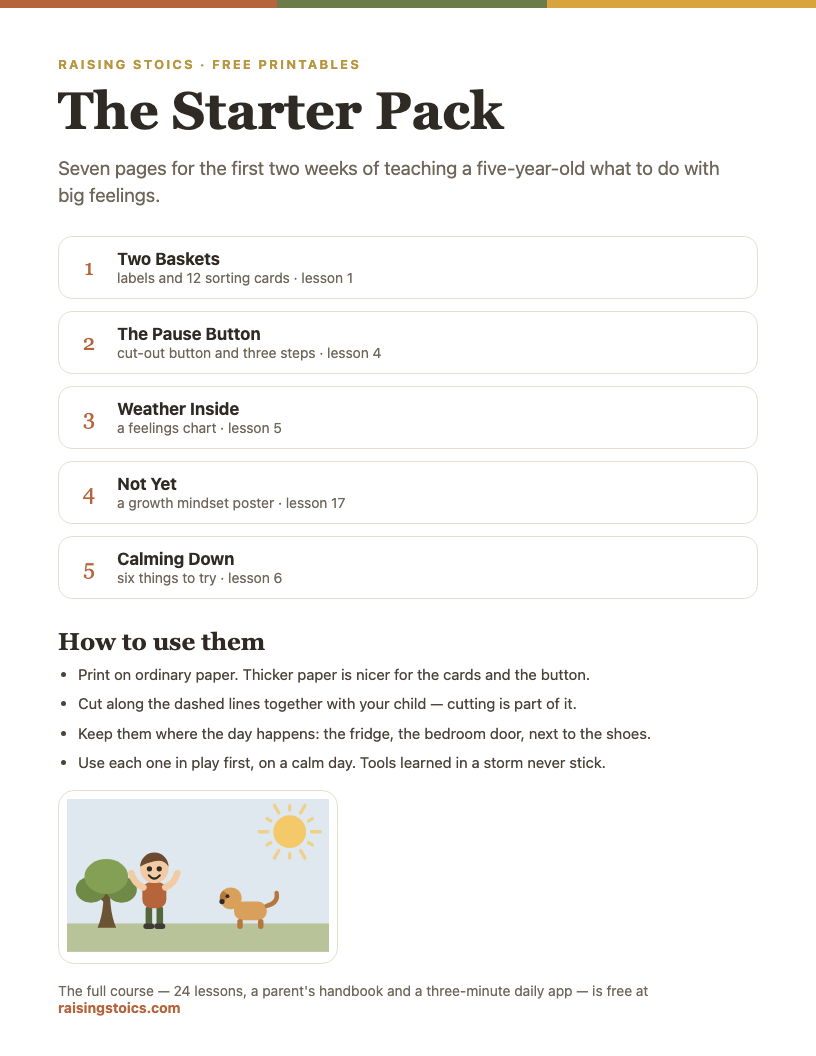
The Big Feelings Starter Pack
Nine pages for the first two weeks: a sorting game, a pause button, a feelings chart and a calm-down poster.
Download the free PDF See all 9 pages
Part of a free 9-page starter pack. Sign in with a code from your email — no password.
What to say instead
Instead of "I'm sure that's not true" or "Just go up and ask," try:
- "That sounds lonely. Tell me about recess today."
- "Who did you sit near at lunch?"
- "What were the other kids playing? What part could you play?"
Listen first, then ask how school looks from their side. Many children open up more in the car or at bedtime than right after pickup. For a cautious child, our guide to building confidence in shy children has more ideas, and how to teach kids kindness covers being a good friend.
When to talk to your pediatrician
Start with the teacher, who sees recess and can tell you whether your child plays with others. Talk to your pediatrician if your child seems sad or anxious much of the time, doesn't want to go to school, has trouble with play and conversation in more than one setting, or shows changes in sleep or appetite. If your child is being hurt or targeted repeatedly, keep notes and ask the school for a meeting.
In the program
In our program, this is the lesson "Stepping In": we're here to help each other. Children practice the phrase "I can help": sit with someone who's having a bad time, ask what's wrong, or get a grown-up. It turns friendship from waiting to be chosen into something your child can do: notice someone who's having a hard time. Our research summary on prosocial behavior covers the science of helping. Your child's app adds a short daily mission. See the program, or read more answers to questions parents often ask.
What parents ask
Paraphrased from questions parents often post on Reddit, Mumsnet, BabyCenter, and other parenting forums.
“No one ever invites my kindergartner to playdates or parties. Do I keep trying?”
Short answer: many parents on forums say yes: keep inviting, and start small. One child, a park, a short visit, and an activity ready often go better than a big party. Ask your child to name a classmate they like. Clubs or activities outside school can also help, because a shared interest gives children something easy to do together.
“One kid in my child's class decides who's allowed to play. What do I tell my child?”
Short answer: help your child name what's happening and plan what to do: "If someone says you can't play, you can find someone else, or ask a grown-up." Practice the words at home. Many parents agree that a child can say no to playing but shouldn't shut others out of a group, so if the pattern repeats, tell the teacher.
“Should I tell my child to stop playing with kids who are mean to them?”
Short answer: parents disagree. Some steer their child away from an unkind classmate; others worry it can spread into bigger group splits. A middle path is to help your child find kinder options, like inviting a different classmate over, while keeping notes if the meanness repeats. If your child is being targeted again and again, ask the school for a meeting.
“Every playdate at our house ends in a fight. What's going wrong?”
Short answer: sometimes it's the setup, not the children. Short visits with one friend and an activity ready may go better than open-ended free play. Before the friend arrives, let your child put away a few special toys they don't want to share. Stay nearby to coach turn-taking, and end while it's still going well. See how to teach kids sharing.
FAQ
Is it normal for a 5-year-old to have no friends?
It's common for a 5-year-old to go through stretches without a steady friend, especially in a new class. Friendships at this age are often short and change quickly. Check with the teacher about what they see at recess. If your child seems unhappy much of the time or avoids other children everywhere, mention it to your pediatrician.
How can I help my child make friends at school?
Start small. Ask your child to name one classmate they like, and invite that child for a short playdate with an activity ready. Practice joining a game at home with role-play. Clubs or activities outside school can help too, because shared interests give children something easy to talk about.
Should I talk to the teacher if my child has no friends?
Yes, it's usually a good first step. Teachers see recess and group work and can tell you whether your child plays with others, who they get along with, and whether anything is going wrong. Ask in a curious, not accusing, way, and ask what you can do at home to help.
What if my child says nobody likes them?
Take the feeling seriously, then gather details. Ask what happened today, who was there, and what they were playing. Often it's one hard moment, not every day. If it's repeated, or if your child is being teased or excluded on purpose, keep notes and talk with the teacher.
Kindergarten Behavior Problems: When the Teacher Calls Every Day
Kindergarten behavior problems, frowny faces, and daily calls from the teacher. Why they may happen, what parents disagree on, and three steps to take today.
Read next →The lesson "Stepping In" teaches children to notice someone who's having a hard time and help, a natural way to start a friendship.