Kindergarten Homeschool Curriculum: 14 Programs Compared
Choosing a kindergarten homeschool curriculum is mostly a question of fit: how much time you have, what you want to spend, whether you want faith in it, and how your child learns. We checked 14 well-known programs on their publishers' own sites in September 2026 and put the facts side by side: price, subjects, daily time, and how each one describes its worldview. At the end there's a note on the part most programs leave to you: feelings, patience, and what to do when something is hard.

What does a kindergarten homeschool curriculum need to cover?
Most programs for five- and six-year-olds cover the same core: early reading (letter sounds, blending, first words), early math (counting, number sense, shapes, simple adding and taking away), handwriting, and read-alouds. Many add science and nature study, a little history or geography, art, and music.
What's legally required depends on your state. Some states list subjects, some ask for records or an assessment, and some ask for very little. Compulsory school age also varies, from 5 to 8 depending on the state, so in some places a kindergarten year at home isn't formally regulated at all. Check your own state's homeschool law before you buy anything.
In practice, a kindergarten year at home doesn't need to look like school. A short reading lesson, a short math lesson, a lot of reading aloud, and time outside make a full day at this age.
How many hours a day does homeschool kindergarten take?
Usually less than a school day. Here's what publishers themselves estimate for their kindergarten levels.
Sonlight K: 1.5 to 2 hours for the child, 1 to 1.5 hours of parent time. Time4Learning: about 30 minutes to 1 hour a day for early learners. Blossom and Root Level 0: 1 to 2 hours a day, 4 to 5 days a week. Timberdoodle: parents report 1 to 3 hours a day, 4 to 5 days a week. Beyond the Page (ages 5–7): its minimums add up to roughly 2 hours 20 minutes to 3 hours 15 minutes a day.
These are the publishers' figures, not measurements, and they include reading aloud. Many families do less, especially at the start of the year. Several of the publishers above recommend short lessons rather than one long sitting.
All-in-one kindergarten homeschool curriculum or build your own?
An all-in-one program gives you every subject in one box with a daily schedule. It's the easier start: you open the guide and do today's page. The trade-off is price and less flexibility if one subject doesn't suit your child.
Building your own means picking one program for reading, one for math, and adding books and activities for the rest. It often costs less and lets you match each subject to your child. The trade-off is planning time, and it's easy to buy more than you'll use.
One common path is to start with an all-in-one program in the first year and switch to single subjects once you know what works. Another is to start with just reading and math and add the rest slowly. Both are reasonable at this age.
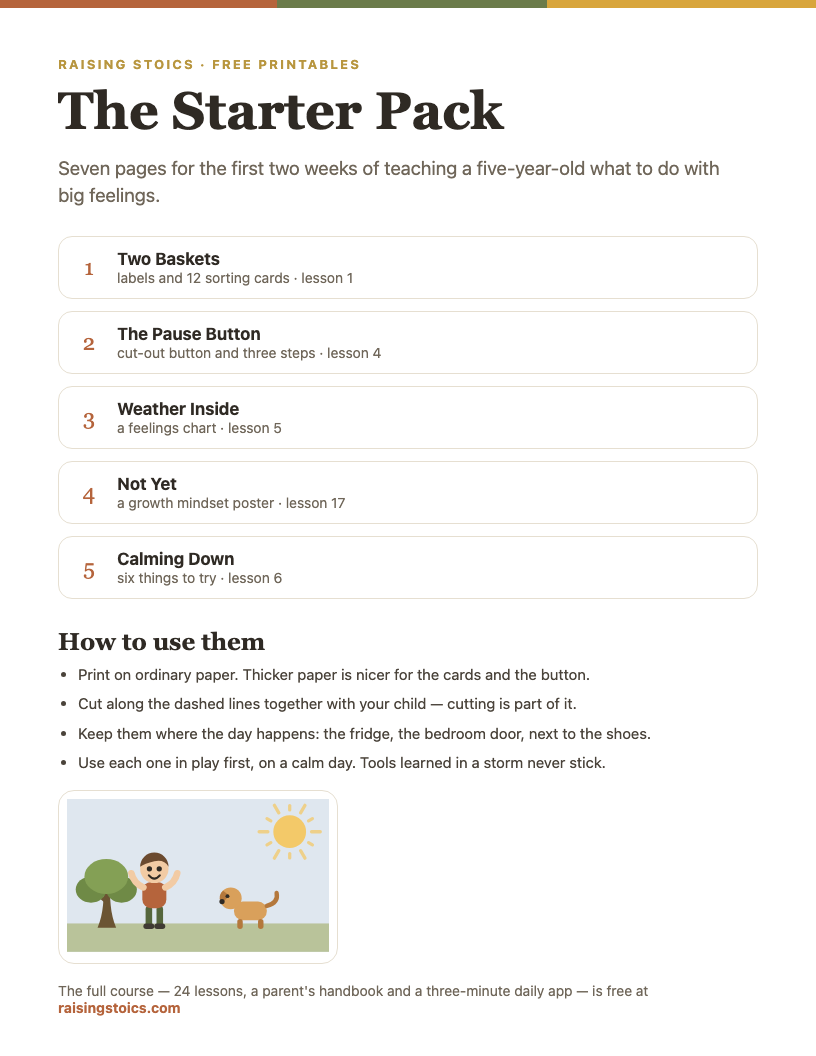
The Big Feelings Starter Pack
Nine pages for the first two weeks: a sorting game, a pause button, a feelings chart and a calm-down poster.
Download the free PDF See all 9 pages
Part of a free 9-page starter pack. Sign in with a code from your email — no password.
All-in-one programs: prices and what's included
Prices below are as shown on each publisher's site on September 30, 2026. Several were sale prices, so check the current price before you buy.
Timberdoodle Kindergarten Kit 2026–27: $487 (Basic), $731 to $761 (Complete), $964 to $994 (Elite). A physical kit with workbooks, games, and hands-on materials. Comes in a Classic edition with faith-based material and a Nonreligious edition. Includes an Emotional Intelligence subject.
Oak Meadow Kindergarten: $449.35 for the print package, or $315 for a digital version that can't be printed; some recommended books are extra. Waldorf-inspired, secular, nature-based, 36 weekly lessons.
BookShark Level A (ages 5–7, its kindergarten level): $880.25 for the all-subject package at 20% off. Literature-based, open-and-go, and it describes itself as neither espousing nor opposing any faith.
Beyond the Page (formerly Moving Beyond the Page), ages 5–7: $553 (science, social studies, and language arts) to $953 (all subjects plus reading), at 15% off. Literature-based and hands-on, secular, aimed at gifted and creative learners. It labels this level first grade, so it suits advanced kindergartners best.
Sonlight Kindergarten: $1,016 for the 4-day all-subjects package at 20% off. Literature-based, Christian. Sonlight also has a Pre-K package, currently $503.71.
Abeka K5: $157.60 to $785.30 for the child kit, depending on the parent materials. Traditional textbooks, taught from a biblical worldview in Abeka's words, 170 days of lesson plans, with a video option.
Time4Learning: $39.95 a month (PreK through 5th grade), online and self-paced, with automatic grading. Covers language arts, math, and science, with no social studies at this level. Not faith-based.
Single-subject and low-cost options
The Good and the Beautiful: Level K Language Arts $69.97, Math K $49.98, Handwriting K $12.99, or $132.94 for all three. Both the Level K Language Arts and Math K courses are also available as free PDFs. Open-and-go, with a general Christian worldview.
Torchlight Level K: $32 for the PDF, books bought separately. Literature, science, social studies, art, and character building, but no math. Secular, with Humanist underpinnings, as the publisher puts it.
Blossom and Root Level 0: $67 for the PDF. Language arts, nature study, science, art, and music, with math woven into the science. Strictly secular, inspired by Charlotte Mason and Waldorf.
Brave Writer Jot It Down (ages 5–7): $47 for the PDF. Writing and oral language only, project-based.
All About Reading: $119.95 for Pre-reading, $159.95 for Level 1, plus $25.95 for letter tiles. Scripted, multisensory reading lessons.
Math-U-See Primer: $205.63 for the set with blocks and a year of video access. Dimensions Math Grade K: $137.50 for the set with teacher's guides (out of stock at the time of checking).
Secular homeschool curriculum vs. faith-based: how programs describe themselves
It's worth reading how each publisher describes its own worldview, because "faith-neutral" and "secular" can mean different things.
Described as secular: Oak Meadow, Beyond the Page, Torchlight, and Blossom and Root. Time4Learning describes itself as free of religious content. BookShark says it does not espouse or oppose any faith. Brave Writer says all worldviews are honored.
Described as Christian: Sonlight, Abeka, and The Good and the Beautiful. The last one calls itself nondenominational, with a general Christian worldview and Bible principles such as gratitude, honesty, prayer, and kindness, rather than the doctrine of one church.
Timberdoodle sells both: a Classic kit with faith-based material and a Nonreligious kit; the publisher says the two differ only in history and social studies.
If worldview matters to you either way, look at sample pages, not just the label. Many publishers post free samples of their first weeks.
What most programs leave to you: feelings, patience, and frustration
Reading and math get a daily lesson in every all-in-one program above. The other thing a five-year-old is learning, often more loudly, gets much less space: what to do with anger, how to wait, how to try something scary, what to do when it doesn't work the first time.
Of the 14 programs we checked, two give it its own strand. Timberdoodle's kit includes an Emotional Intelligence subject with a feelings flipbook. Torchlight has a character-building thread with fables and stories about empathy. The Good and the Beautiful, Beyond the Page, and Abeka describe values or character woven through their other material. The rest don't mention it on the kindergarten pages we checked.
That doesn't mean a child learns nothing about feelings at home; they learn it all day, from how the adults around them handle hard moments. But if you want it to be taught on purpose, you'll probably have to add it yourself. At this age that can be small: a short lesson twice a week on one idea, such as what's in my control, pausing before acting, or trying again after a mistake; one phrase the family uses all week, and a few real moments to practice it.
A sample homeschool kindergarten schedule
A calm kindergarten day at home often looks something like this. Adjust freely; the order matters less than keeping each piece short.
Morning: reading lesson, 15 to 20 minutes. Break, snack, play. Math lesson, 15 to 20 minutes, ideally with objects to count and move. Outside time.
Afternoon: read-aloud, 20 to 30 minutes. Two afternoons a week, a short social-emotional lesson of about 20 minutes. That's the rhythm our own course uses; any short program works here. Once or twice a week, art, science, or a nature walk instead.
That's roughly one to two hours of focused time, which is in line with what the publishers above estimate for this age. If a lesson is going badly, stopping early and trying tomorrow usually works better than pushing through.
How to choose a kindergarten homeschool curriculum
Five questions narrow the list quickly.
What's your budget for the year? The programs above range from a free PDF to more than $1,000.
How much of your own time can you give each day? Open-and-go guides need little prep; build-your-own needs more planning. Online programs need less of your time during the lesson, but more screen time for your child.
Do you want faith in it, or none? Read the publisher's own description and the samples.
Is your child already reading? A child who knows their letter sounds may be ready for a first-grade level in reading and still be at kindergarten level in math. Programs that sell subjects separately handle this more easily.
How does your child learn best? Hands-on kits tend to suit children who need to move, literature-based programs suit children who love being read to, and short scripted lessons suit parents who want to know exactly what to say.
Whatever you choose, it's fine to change it. Kindergarten is a good year to find out what works for your family.
FAQ
Can you homeschool kindergarten?
Yes. Homeschooling is legal in all 50 states, and kindergarten is a common year to start. The rules differ by state: some require you to notify the district or keep records, and in some states a kindergarten year at home isn't formally regulated. Check your state's homeschool law before you begin.
What subjects are required for kindergarten homeschool?
That depends on your state. Some states list required subjects, such as reading, language arts, and math; others don't specify. Where subjects are listed, a typical kindergarten program covering early reading, early math, handwriting, and read-alouds, plus a little science and art, usually covers them. Check your state's law for the exact list.
How do I start homeschooling kindergarten?
Start by checking your state's homeschool law and doing whatever it asks, such as a notice of intent. Then pick a reading program and a math program, or one all-in-one curriculum, and begin with short lessons a few days a week. Add read-alouds every day. Build up to a fuller routine over the first month instead of starting at full speed.
What age do you start kindergarten homeschool?
Most families start kindergarten at 5, which matches school kindergarten, but at home you can follow your child. Some start a gentle version at 4, others wait until 6. Interest in letters and numbers and being able to sit with you for a short lesson are good signs.
Is homeschooling kindergarten hard?
The teaching itself is usually manageable: lessons are short, and open-and-go programs tell you what to do each day. The harder parts are consistency and patience, especially on days when your child resists. Keeping lessons short, stopping before frustration peaks, and having a simple routine make the biggest difference.
How do I make homeschool kindergarten fun?
Keep lessons short and active: count real objects, build letters with play dough, take a lesson outside. Use games for review instead of worksheets. Read aloud a lot, and let your child choose some of the books. Follow their interests when you can, and end a lesson while it's still going well.
Raising Stoics is a 12-week social-emotional block you can add to any kindergarten homeschool curriculum: two 20-minute lessons a week, one key phrase per week, and a three-minute app for your child.