 Raising
Preschool Curriculum 2026: 12 Homeschool & Classroom Options
Choosing a preschool curriculum for a 3- or 4-year-old mostly comes down to five things: price, time per day, how play-based it is, whether it's faith-based, and what actually arrives. We put 12 homeschool and classroom options side by side, with every price taken from the publisher's own site in October 2026, then sorted them by need: play-based, secular, short on time, on a budget, and by age.

Looking for a free preschool curriculum? We compared 17 free programs you can download today, including full-year plans from Boston and New York City public schools, with ages, weeks, licenses, and direct links.
Preschool curriculum comparison table
Prices are as shown on each publisher's site when we checked in late October 2026, before tax and shipping. They change often, and several programs sell add-ons separately. "Not stated" means the publisher's page didn't say. Homeschool programs come first, then classroom curricula, then social-emotional programs that sit beside a full curriculum. The last row is our own program, and it's labeled as ours.
| Curriculum | Ages | Price (checked Oct. 2026) | Time | Approach | Faith | What's included |
|---|---|---|---|---|---|---|
| Playing Preschool (Busy Toddler) | 2.5–5 | $39.90 per year (Year 1 or Year 2); both years $69.80 | 45–60 min per lesson; 38 weeks | Play-based themed units | Secular | 311-page PDF: 19 units, 350+ activities, book and supply lists |
| The Good and the Beautiful (preschool) | 3 and up | $48.97 Preschool Language Arts set (sold out when we checked); $95.94 Preschool Core Bundle | Not stated; 90 lessons in the language arts course | Gentle early literacy and pre-writing | Christian | Course book, folder games, practice sheets, songs and videos |
| Oak Meadow Preschool | Mainly 3–4 (works for 2–5) | $137.75 course package | Not stated | Play-based, seasonal, nature-based | Secular | Coursebook and three story collections; craft kit sold separately |
| Mother Goose Time (Experience Preschool) | 2.5–5 | From $110 a month | Not stated | Play-based monthly themes | Core kit: not stated; a faith add-on (Experience God) is sold separately | Monthly box: four weekly teacher guides, books, games, math and literacy tools, a craft bag for each child |
| Sonlight Pre-K | 4–5 | $503.71 With Required Resources (15% off $592.60); $497.63 Without Required Resources | 20 min to 1.5 hours, 4 days a week, 36 weeks | Literature-based | Christian | Instructor's guide, read-alouds, Bible stories, workbooks, hands-on supply kit |
| BookShark Pre-K | 4–7 per its FAQ (other labels on the page say 4–5 and 5–8) | Two prices shown, unlabeled: $309.43 and $386.79 | Not stated; 36 weeks | Literature-based | Faith-neutral (BookShark's general FAQ; not stated on the Pre-K page) | Read-alouds plus history, science, and math with manipulatives |
| Timberdoodle Pre-K kit | 3–5 | $1,215 for the Elite kit; other tiers not shown | Up to 2 hours (parent survey) | Hands-on, game-based, STEM-heavy | Classic or Nonreligious edition | 11, 26, or 43 courses by tier, with an online day-by-day scheduler |
| ABCmouse | Preschool to 2nd grade | $14.99 a month or $79.99 a year; free tier with 10 lessons a day | Self-paced | App-based academics | Not stated | Online lessons, games, books, and songs in reading, math, science, and art |
| The Creative Curriculum for Preschool | 3–4 (adapts up to 5) | On request | Daily, in 20-day projects called Studies | Play-based, project-based | Not stated | 9 teaching guides, 262 bilingual teaching experiences, 44 children's books, cards |
| HighScope Preschool Curriculum | Preschool (no ages on the page) | $1,944 for the HighScope Preschool Curriculum Kit (P4002SET) | Daily plan-do-review routine | Active learning: children plan, do, and review | Not stated | 8 content areas with 58 key developmental indicators; kit: 9-book curriculum set, lesson plans for the first 30 days, routine cards, activity books |
| Second Step Early Learning | Pre-K | Not verified (the store didn't load for us) | 5–7 min activities; 28 weekly themes | Social-emotional only | Not stated | Teacher's guide, puppets, songs, lesson cards, staff training |
| Raising Stoics (ours) | 4–6 in class, 5–6 at home | Free circle-time program for classrooms (/for-schools); at-home program: see /plan | 15–20 min, twice a week, 12 weeks | Social-emotional only, ideas from Stoic philosophy | Secular | Circle-time program: 24 activities, printables, weekly notes home. At-home program: 24 lessons and a child's app |
On a phone, each program shows as a card. Two notes on reading the table: "Time" is the publisher's own figure or a parent estimate it publishes, and "Faith" is how the publisher describes the program, not our judgment of its books.
How we compared
- What we checked: price, ages, time per day, approach, faith stance, and contents, each from the publisher's own website, in late October 2026.
- What we didn't do: we didn't buy or test these programs, and we haven't checked the publishers' research claims against their studies.
- Which programs: the ones that appear most in search results for "preschool curriculum," plus the classroom and social-emotional curricula from the earlier version of this guide.
- Missing data: if a page didn't give a figure, the table says "Not stated." If a store didn't load after two tries, we wrote "Not verified" instead of filling it in from memory.
- Money: there are no affiliate links on this page, and nobody paid to be listed.
- Our own program: Raising Stoics makes a social-emotional program for preschool and kindergarten; the circle-time version for classrooms is free. It's in the table because it's an option some readers will want, it's marked as ours, and we don't rank it.
What does a preschool curriculum consist of?
Most preschool programs for ages 3 to 5 cover the same broad areas: language and early literacy, early math, science and curiosity about the world, physical development (both small and large movements), the arts, and social-emotional development, which means getting along with others, handling feelings, and following routines. HighScope, for example, organizes its curriculum into eight content areas, one of which is social and emotional development.
What differs is the packaging. A homeschool preschool curriculum is usually a parent guide with themed activities and a book list, sometimes with a box of materials. A classroom curriculum adds teacher guides for a group, daily routines, assessment tools, and often training.
Every U.S. state publishes early learning standards for this age, and classroom curricula usually say which standards they align with. If you run a licensed program, start there: your state's standards and licensing rules shape what a curriculum has to cover. At home, the list can be much simpler. Reading aloud every day, talking a lot, counting real things, plenty of play, and time outside cover most of it. A curriculum mostly gives you structure and ideas.
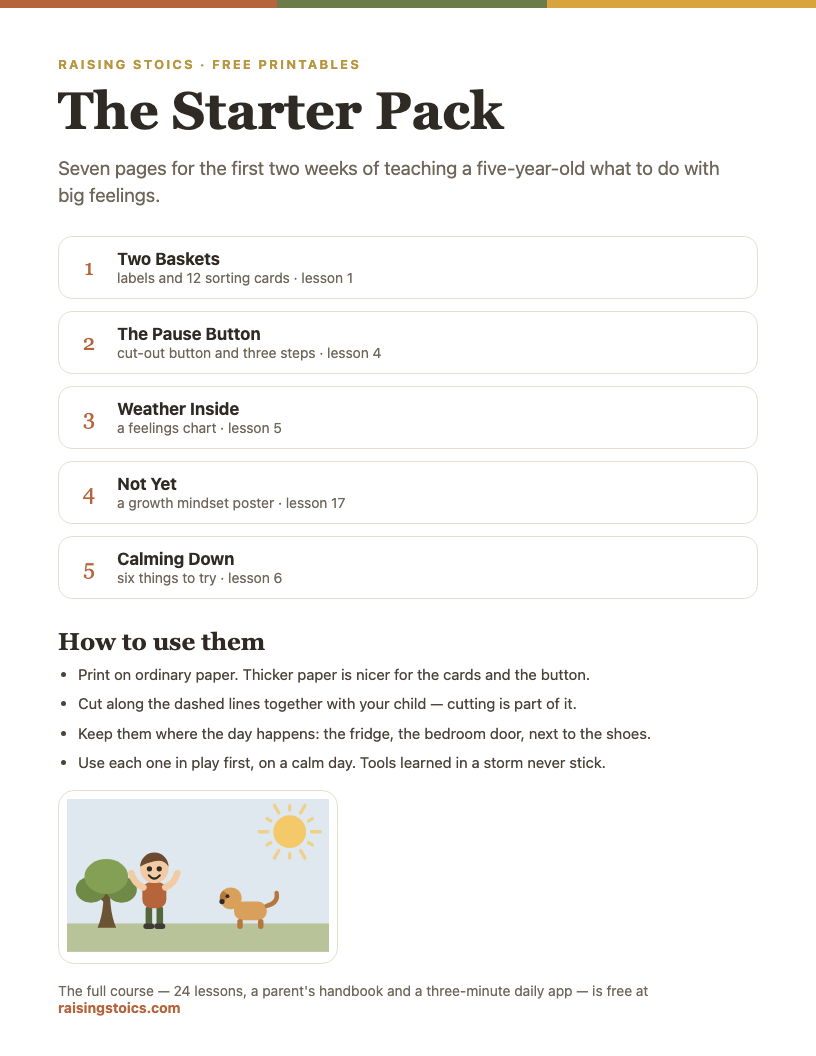
The Big Feelings Starter Pack
Nine pages for the first two weeks: a sorting game, a pause button, a feelings chart and a calm-down poster.
Download the free PDF See all 9 pages
Part of a free 9-page starter pack. Sign in with a code from your email — no password.
What is the best curriculum for preschoolers?
There isn't one best preschool curriculum for every family or classroom, and we haven't tested these programs ourselves. What the table can do is narrow the list by what you need. Each group below follows from what the publishers state, not from our opinion of the programs.
Options for play-based learning: Playing Preschool, Oak Meadow, and Mother Goose Time all describe themselves as play-based. Playing Preschool is a PDF you print and supply yourself; Oak Meadow is books organized by the seasons; Mother Goose Time ships a box of materials every month.
Options for a secular preschool year: Playing Preschool and Oak Meadow call themselves secular, and Timberdoodle sells a Nonreligious edition with the same learning materials as its Classic one. BookShark's company FAQ says it is faith-neutral, though its Pre-K page doesn't address faith. The Good and the Beautiful and Sonlight are Christian. More on this in our guide to secular homeschool curriculum.
Shortest published daily time: few publishers state one. Among the full homeschool programs, Sonlight's Pre-K estimate starts at 20 minutes a day. Playing Preschool lessons run 45 to 60 minutes, and Timberdoodle's parent estimate is up to 2 hours, so plan for those to take longer. Social-emotional programs such as Second Step are shorter still (about 5 to 7 minutes an activity), but they cover only one area and don't replace a full curriculum.
Lowest published price among full homeschool programs: Playing Preschool, at $39.90 for a year. The Good and the Beautiful's preschool language arts set is $48.97 but covers one subject. ABCmouse's free tier is a supplement, not a full curriculum. A library card covers the books for almost any program.
Options built for classrooms: The Creative Curriculum for Preschool, HighScope, and Mother Goose Time are built for groups, with teacher guides and assessment. Creative Curriculum is priced on request; HighScope's Preschool Curriculum Kit is $1,944.
What is a good preschool curriculum for a 4-year-old?
For a 4-year-old, look at the Pre-K levels: Sonlight Pre-K (ages 4 to 5, four days a week), BookShark Pre-K, and Timberdoodle's Pre-K kit. Timberdoodle describes its Pre-K level as being for children who will be ready to start learning to read the following year. Playing Preschool Year 2 is another option, but the publisher says to complete Year 1 first.
For a 3-year-old, the lighter programs fit better. Playing Preschool starts at 2.5, Oak Meadow is written mainly for 3- and 4-year-olds, The Good and the Beautiful's preschool language arts is for ages 3 and up, and Mother Goose Time starts at 2.5. Sonlight also sells a separate Preschool package for ages 3 to 4: three days a week for 30 weeks, $396.72 Without Required Resources ($475.72 With Required Resources) when we checked.
Age ranges overlap, and children don't move through them on schedule. A 4-year-old who loves being read to may be happy with a literature-based program; one who wants to build and move may do better with a play-based one. If your child turns 5 soon, our kindergarten readiness checklist can help you decide between a Pre-K and a kindergarten level.
Homeschool preschool curriculum: how much time it takes
Much less than a school day. Among the homeschool programs we checked, Sonlight estimates 20 minutes to 1.5 hours a day for its Pre-K level. Playing Preschool lessons are about 45 to 60 minutes. Timberdoodle's parent estimate for its Pre-K kit is up to 2 hours. BookShark's FAQ gives a general guideline of 30 to 60 minutes of structured learning in short blocks. The others don't publish a figure.
These numbers come from the publishers, including parent estimates they publish. For a 3- or 4-year-old, a structured activity of 10 to 20 minutes, a lot of reading aloud, and long stretches of play can make a full day. If a planned activity isn't working, stopping and trying another day is a reasonable choice at this age.
If you're also planning the next year, our guide to kindergarten homeschool curriculum compares programs for 5- and 6-year-olds.
Preschool curriculum for classrooms and centers
These are full curricula built for group settings. Most don't publish prices; you request a quote.
The Creative Curriculum for Preschool (Teaching Strategies): for 3- and 4-year-olds, play-based, organized into 20-day projects called Studies, with nine teaching guides, 262 bilingual intentional teaching experiences, 100 Mighty Minutes, and 44 children's books. A digital version adds more than 200 books. Pricing on request.
HighScope Preschool Curriculum: built around a daily plan-do-review routine and eight content areas with 58 key developmental indicators. HighScope's shop lists the HighScope Preschool Curriculum Kit (SKU P4002SET) at $1,944: the nine-book curriculum set, lesson plans for the first 30 days, daily routine cards, and activity books.
Mother Goose Time's Experience Preschool: monthly themed kits for ages 2.5 to 5, with materials for each child. The brightwheel store lists it from $110 a month; centers and districts are asked to contact a specialist for pricing. Homeschool families can order the same kits.
Frog Street Pre-K (dual-language, with weekly teacher guides) and Get Set for School from Learning Without Tears (Pre-K and transitional kindergarten) are two more classroom options; both price on request.
What are some good curriculum topics for preschoolers?
Many preschool curricula are organized by themes, and common ones include the child and their family, feelings, the seasons and weather, animals, plants and gardens, water, the neighborhood and community helpers, transportation, colors and shapes, and the body. Playing Preschool's 19 units run alphabetically from Apples to Water. Oak Meadow follows the seasons of the year. The Creative Curriculum builds each theme into a 20-day investigation, and Mother Goose Time sends one theme a month.
If you're writing your own preschool lesson plans, one theme a week or every two weeks is plenty. A simple week can look like this:
- Monday: read a picture book on the theme and talk about it.
- Tuesday: a hands-on activity, such as sorting, building, or a nature walk.
- Wednesday: counting or matching with real objects from the theme.
- Thursday: art or pretend play.
- Friday: reread the favorite book, and let your child retell it.
Add one social-emotional idea a week, such as waiting, trying again, or naming a feeling. Our SEL activities for preschool has short ones that fit any theme.
Free preschool curriculum: what's actually free
We found few complete preschool curricula that are free. What you'll usually find is a free tier or free samples of a paid program. ABCmouse has a free basic tier with up to 10 lessons a day. The Good and the Beautiful offers free science lessons for preschool through grade 2. Conscious Discipline offers a free introductory course and printables for adults. Many publishers post free sample weeks.
Our own circle-time program at /for-schools is free: 12 weeks, 24 activities, printables, and weekly notes home. It covers only the social-emotional part of the day, so it's not a full preschool curriculum.
Your public library is the other big free resource: picture books, story times, and often early literacy kits you can borrow. For many families, a library card, a simple weekly routine, and a few good activity ideas are enough for a preschool year.
Social-emotional programs you can add to any preschool curriculum
Some programs teach only the social-emotional part and sit next to whatever curriculum you already use.
Second Step Early Learning: 28 weekly themes, five activities a week of about 5 to 7 minutes each, with puppets, songs, and lesson cards. It describes itself as an "evidence-based curriculum with measurable results."
Al's Pals, now sold by Teaching Strategies: for ages 3 to 6, 52 lessons of about 20 minutes, twice a week, with puppets and songs. It lists a CASEL SELect designation. Pricing on request.
Conscious Discipline: not a lesson-by-lesson curriculum but a training system for adults, aimed at building self-regulation and connection.
Raising Stoics, the site you're on, makes a free 12-week circle-time program for classrooms: 24 activities of about 15 minutes, twice a week, with a weekly note home. Families can use the at-home version or fit it into a homeschool year. It's new and has not been evaluated in a study, so treat it as an option to try, not an evidence-rated one. For a wider comparison, see big feelings programs compared.
How to read "research-based" and ESSA claims
Most classroom curricula we looked at describe themselves as research-based. Those words can mean very different things, so it helps to look one level deeper.
The federal Every Student Succeeds Act (ESSA) describes four tiers of evidence: strong (Tier 1, usually a randomized controlled trial), moderate (Tier 2), promising (Tier 3), and "demonstrates a rationale" (Tier 4). Teaching Strategies says The Creative Curriculum was validated by a randomized controlled trial at the ESSA Tier 1 level; we haven't read the study. Learning Without Tears says Get Set for School meets the "demonstrates a rationale" level. HighScope says its curriculum has been validated through a direct evaluation.
These are the publishers' statements; we haven't checked them against the studies. If evidence matters for a funding decision, ask the publisher for the study itself: who took part, what ages, what was measured, and how big the effect was. "Based on research" about child development is not the same as a study showing that this curriculum works.
How to choose a preschool curriculum
A few questions narrow the list quickly.
Who will teach it? A trained teacher with a group needs different materials from a parent with one child. Classroom curricula assume group routines and planning time; homeschool programs assume a parent reading the guide that morning.
What do you have to meet? Licensed programs may have state standards, assessment, or funding requirements. Check those first.
How structured do you want it? Some programs give you a day-by-day plan; others give you themes and ideas. Neither is better for every child.
Do you want faith in it? Use the Faith column: two homeschool programs in the table are Christian, Playing Preschool and Oak Meadow call themselves secular, BookShark's company FAQ says it's faith-neutral, and Timberdoodle sells a Classic and a Nonreligious edition. Several pages don't say.
Is the social-emotional part covered? Look at what the curriculum actually does each week for feelings, waiting, sharing, and frustration, not just whether the phrase appears on the box. If it's thin, a short add-on program can fill it.
Finally, look at the sample pages before you buy. Ten minutes with a real lesson tells you more than any comparison table.
FAQ
What is The Creative Curriculum for Preschool?
The Creative Curriculum for Preschool is a classroom curriculum from Teaching Strategies for 3- and 4-year-olds. It's play-based and organized into 20-day projects called Studies, with teaching guides, bilingual teaching activities, children's books, and online tools. Teaching Strategies prices it on request, so centers and schools buy it more often than families do. The classroom section above lists what's in the box.
Where can I buy preschool curriculum in bulk?
Buy classroom curricula directly from the publisher, or through an authorized dealer if the publisher uses one. The Creative Curriculum, HighScope, Frog Street, and Get Set for School all sell to schools and centers, often through a quote based on the number of classrooms. When you ask, check the price of classroom sets, digital licenses per teacher, and training, which are often priced separately.
Do I need a curriculum to homeschool preschool?
No, you don't need a curriculum to teach a preschooler at home. Reading aloud every day, talking a lot, counting real things, play, and time outside cover most of what programs list. A curriculum helps if you want a plan, a book list, and ideas ready each morning. If you're unsure, start with a low-cost option or a publisher's free samples, and see whether the structure helps you.
How many days a week should you do homeschool preschool?
There's no fixed rule, and most publishers leave it to you. Sonlight is one that does set a schedule: three days a week for its Preschool level and four days a week for Pre-K. Many families do a short planned activity three to five days a week and let reading and play fill the rest. At this age, missing a day matters much less than keeping it enjoyable.
Can I use two preschool curricula at once?
Yes, you can use two preschool curricula if they cover different things. A common pairing is a play-based or literature-based program plus a separate piece for one area, such as a language arts set or a short social-emotional program. Two full programs at once usually means twice the planning and more than a 3- or 4-year-old needs, so pick one main program and add only what it lacks.
Kindergarten Readiness Checklist: Skills by Area, With a Printable
A kindergarten readiness checklist adapted from the CDC's milestones: social, emotional, language, early math, and self-care skills, plus a printable.
Read next →Raising Stoics has a free 12-week circle-time program for preschool and kindergarten: 24 activities of about 15 minutes, one key phrase a week, and a weekly note home.