 Raising
Riddles for Kids: Easy to Hard, With Answers, for Ages 4–8
A good riddle turns a car ride or a wait at the doctor's office into a game. We wrote these riddles for kids for this page; some use classic riddle patterns. They're sorted by age: easy riddles for 4- and 5-year-olds, trickier ones for 6- and 7-year-olds, and hard riddles for 8-year-olds. The answers are listed below each set, so you can read the riddles aloud without giving anything away. There's also a set of trick riddles, where the quick answer is wrong, that make good practice in stopping to think.

Riddles for kids: how to use this list
Short answer: Read one riddle aloud, give your child time to guess, and offer a clue before the answer. Start one level below their age; an easy win makes them want another.
Each set is numbered, and the answers come in a separate list right after it. If you're reading from a phone, scroll only as far as the riddles.
A few ground rules make riddle time more fun:
- Wait longer than feels natural. Ten seconds of quiet thinking is a long time for a young child, and that's fine.
- Give clues, not answers. "It's something in the kitchen." "You used it this morning."
- Every guess counts. A wrong answer that fits the clues is a good guess. Say so: "Ooh, a cat does have whiskers. But this one lives in water."
- Swap roles. Once they've solved a few, let them ask you, and take your time guessing.
Easy riddles for kids ages 4 and 5
These are "What am I?" riddles about everyday things a preschooler knows. Each clue is something they can picture.
1. I'm round and bouncy. You can kick me, throw me, and catch me. What am I? 2. I live on your bed. I'm soft and squishy, and your head rests on me every night. What am I? 3. I'm orange, I grow under the ground, and bunnies love to munch me. What am I? 4. I come out after the rain. I'm shaped like a bow, and I have lots of colors. What am I? 5. I say "woof," I wag my tail, and I love to fetch. What am I? 6. You put me on your feet before your shoes. I come in pairs, and sometimes one of me gets lost. What am I? 7. I'm cold and sweet, and I melt if you wait too long. You lick me on a hot day. What am I? 8. I'm yellow, and I shine in the sky all day. At night I go away, and the moon comes out. What am I? 9. I'm full of water and bubbles, and you sit in me before bedtime. What am I?
Answers: 1. A ball. 2. A pillow. 3. A carrot. 4. A rainbow. 5. A dog. 6. A sock. 7. Ice cream (or a popsicle). 8. The sun. 9. A bath.
If a 4-year-old shouts "a cat!" for the dog riddle, ask which clue doesn't fit: "Does a cat say woof?" Checking a guess against the clues is worth praising.
Riddles for kids ages 6 and 7
Some children ages 6 and 7 enjoy riddles where a clue means something a little different from what it seems to.
1. I have a mouth that's always open, and you feed me letters. What am I? 2. I get shorter every time you draw a picture with me. What am I? 3. I copy every move you make outside, but I never say a word, and I hide when it's cloudy. What am I? 4. You peel off my jacket before you eat me, and I'm shaped like a smile. What am I? 5. When it rains, I open up. When it's sunny, I fold myself up small. What am I? 6. I hang on the wall and have a box for every day. I know when your birthday is. What am I? 7. I'm what many kids call their father. I have three letters, I start and end with D, and I read the same backward. What am I? 8. I'm full of words, but I never talk. Open me, and I'll tell you a story. What am I? 9. I have lots of seats, big round wheels, and a long yellow body, and I pick up kids in the morning. What am I? 10. You can't see me, but you can hear me whistle, and I can make the trees dance. What am I?
Answers: 1. A mailbox. 2. A crayon (or a pencil). 3. Your shadow. 4. A banana. 5. An umbrella. 6. A calendar. 7. "Dad." 8. A book. 9. A school bus. 10. The wind.
Riddle 7 is a good door into palindromes, words that read the same both ways. Ask your child to find more: mom, pop, wow, noon.
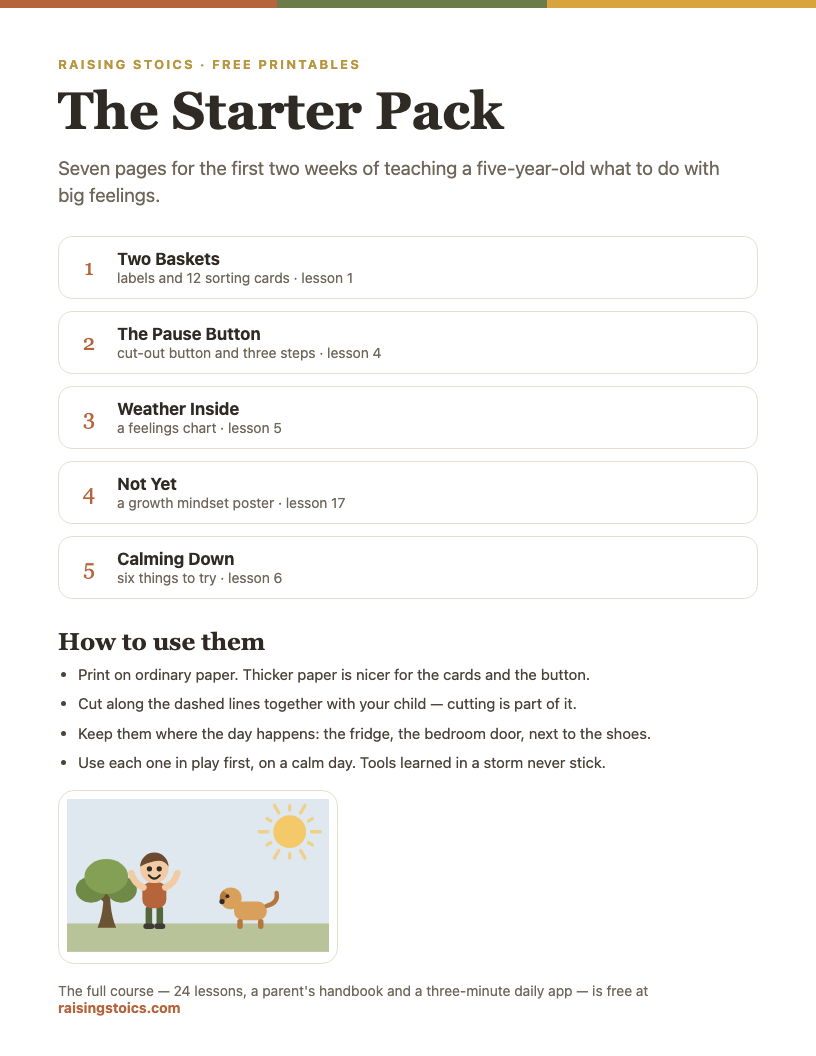
The Big Feelings Starter Pack
Nine pages for the first two weeks: a sorting game, a pause button, a feelings chart and a calm-down poster.
Download the free PDF See all 9 pages
Part of a free 9-page starter pack. Sign in with a code from your email — no password.
Hard riddles and math riddles for 8-year-olds
These take a bit more thinking: some are math riddles, some are word riddles, and some have more than one fair answer.
1. Mia is taller than Leo. Leo is taller than Sam. Who is the shortest? 2. In the yard, there are 2 dogs, 1 chicken, and 1 kid. How many legs are there in all? 3. I'm a number. Double me and add 2, and you get 10. What number am I? 4. Take the first letter off a fruit, and you get something you hear with. What's the fruit? 5. Ana, Ben, and Cal stand in a line. Ben is not first. Ana is right behind Ben. Who is first? 6. I'm a number, but not zero. Add me to myself, or multiply me by myself, and you get the same answer. What number am I? 7. I'm a three-letter word for something you cook soup in. Spell me backward, and I'm the opposite of "bottom." What am I? 8. Four kids share 12 grapes equally. Then each kid gives 1 grape to the dog. How many grapes does each kid have now?
Answers: 1. Sam. 2. Twelve: 4 + 4 for the dogs, 2 for the chicken, and 2 for the kid. 3. Four. 4. A pear (pear without the p is ear). 5. Cal (Cal, then Ben, then Ana). 6. Two: 2 + 2 = 4, and 2 × 2 = 4. 7. A pot (backward, it spells "top"). 8. Two each: 12 ÷ 4 = 3, and 3 − 1 = 2.
For math riddles, paper helps. Drawing the dogs and the chicken and counting the legs is still solving the riddle.
Funny riddles for kids
These riddles have silly answers, so they work well with a group: everyone groans or laughs when the answer comes out.
1. I'm green, I hop, and I'm terrible at hiding in a red room. What am I? 2. I'm slow, I have a shell, and I bring my whole house to every sleepover. What am I? 3. I'm brown and sticky, and I glue the roof of your mouth shut. What am I? 4. I'm orange with black stripes, I roar, and I'd lose every game of hide-and-seek in the snow. What am I? 5. I tickle your nose first, and then I come out with a loud "ah-choo!" What am I? 6. What's always in the middle of every cookie?
Answers: 1. A frog. 2. A snail (a turtle works too). 3. Peanut butter. 4. A tiger. 5. A sneeze. 6. "OK": look at the middle of c-o-o-k-i-e.
Riddle 6 is a spelling riddle. If your child is just learning letters, write the word down and let them find the answer on paper.
Trick riddles that teach kids to stop and think
In these riddles, the first answer that pops into your head is wrong. That's on purpose. These riddles may give children a chance to practice noticing a fast answer and checking it before saying it out loud.
1. A spider has 8 legs. How many legs do 2 spiders and 1 goldfish have in all? 2. Leo picks 4 apples, then eats 1 banana. How many apples does Leo have? 3. Max is 5, and his sister is 3. When Max turns 6, how old will his sister be? 4. Which weighs more: a big dog, or the same big dog wearing a tiny hat? 5. Nora has 6 crayons. She lends 2 to a friend for one picture, and the friend gives them back. How many crayons does Nora have now? 6. A cat sits far away at the end of the yard. A mouse sits right in front of you, so it looks bigger than the cat. Which animal is bigger in real life? 7. Which is longer: a week, or seven days?
Answers: 1. Sixteen (8 + 8; the goldfish has no legs). 2. Four (the banana doesn't change the apples). 3. Four; Max is always 2 years older. 4. The dog wearing the hat, by a tiny bit. 5. Six; she got them back. 6. The cat; the mouse only looks bigger because it's close. 7. Neither; a week is seven days.
When your child falls for one, laugh together and point out what happened: "Your brain jumped to an answer really fast! That happens to grown-ups too. Let's try the next one slowly."
How to play "Pause first" with trick riddles
Trick riddles turn into a small practice game for something many young children find hard: not saying the first thing that comes to mind.
In our program, lesson 4, "The Pause Button," teaches a three-step routine: Stop. Breathe. Choose. You can borrow it for riddle time:
- Stop. After you ask the riddle, everyone puts their hands on their head. No answers yet.
- Breathe. One slow breath out, together.
- Choose. Now your child says the answer they choose, and why.
The point isn't to get every riddle right. It's to practice the gap between "I know!" and saying it. Some children who rehearse that gap in a game may find it a little easier to use when the stakes are higher, like when a sibling grabs a toy. That's our hope, not a research finding. For more games built on the same pause, see our list of self-control activities.
What to do when a riddle is too hard
A riddle that feels impossible can lead to tears, especially for a child who hates getting things wrong. A few ways to keep it fun:
- Use a clue ladder. Give clues from vague to obvious: "It's in the house." "It's in the bathroom." "You use it with toothpaste."
- Offer two choices. "Is it a pillow or a spoon?" Picking from two is still solving.
- Let the riddle wait. "Let's save this one for after lunch." Some children come back with the answer an hour later, very proud.
- Say what they did well. "You checked every clue. That's exactly how riddle solvers think."
If frustration comes fast, the ideas in how to teach kids patience may help, and a joke can lighten things up: our jokes for kids are sorted by age too.
What riddles practice, and what they don't
Riddles are a game first, and they don't need a learning goal to be worth doing. Still, a riddle asks a child to do several things at once: hold a few clues in mind, compare them, set aside a guess that doesn't fit, and try again. For some riddles, they also have to notice that a word can mean two things.
Those are useful habits, and riddles may give children a playful way to practice them. We don't know of good evidence that riddles on their own make children smarter or better at school, so it's best to treat them as fun practice, not a lesson.
What riddles do reliably give you is a few minutes of talking and thinking together, with no screen and no equipment. That alone makes them worth keeping in your pocket for the next long wait.
How to make up riddles with your child
Making up riddles is often more fun than solving them, and it's easier than it sounds. Use a simple pattern: three clues, then the question.
- What I look like: "I'm long and green."
- What I do or where I live: "I live in a pond."
- One extra hint: "I say ribbit."
- Then the question: "What am I?"
Start with things your child can see right now: a spoon, the car, the cat. Young children often give the answer away in the first clue ("I'm a dog and I say woof"). That's fine. Laugh, and show them how to hide the name: "Let's say 'I have four legs' instead of 'I'm a dog.'"
Hiding the answer may also help children think about what the other person knows and doesn't know yet. Writing riddles down, or drawing a picture for each answer, makes a small riddle book your child can share with grandparents or friends.
FAQ
What is a riddle?
A riddle is a question or a short description that hides its answer, so the listener has to figure it out from clues. Some riddles describe a thing without naming it ("I have a long neck and spots"). Others play with words, use a trick, or hide a little math problem. For young children, the simplest riddles are "What am I?" riddles about everyday objects and animals.
What are "What am I?" riddles for kids?
"What am I?" riddles are written as if the answer is talking about itself: "I have a long neck, I eat leaves from tall trees, and I have spots. What am I?" (A giraffe.) They're a good first kind of riddle for ages 4 and 5, because each clue describes something real. They're also simple for a child to invent; the pattern is in the section on making up riddles.
What are "Who am I?" riddles for kids?
"Who am I?" riddles describe a person instead of a thing, usually a job or a character: "I wear a helmet, I drive a big red truck, and I spray water on fires. Who am I?" (A firefighter.) They work well for ages 4–7. You can make family versions too: "I make pancakes on Sundays, and I snore. Who am I?"
What are some riddles for kids?
Here are a few riddles for kids that aren't in the lists above: "I'm white and fluffy, I float in the sky, and sometimes I bring rain. What am I?" (A cloud.) "I'm big and gray, I have a trunk, and I never pack a suitcase. What am I?" (An elephant.) "I get bigger when you blow into me and pop if you blow too much. What am I?" (A balloon.)
Jokes for Kids: Knock-Knock, Animal, and Dad Jokes for Ages 4–8
Jokes for kids ages 4–8: knock-knock jokes, animal, school, and food jokes, dad jokes, plus why kids love puns and how a joke can ease frustration.
Read next →Stop. Breathe. Choose. "The Pause Button" is lesson 4 of the program, and it's open in full.