 Raising
Jokes for Kids: Knock-Knock, Animal, and Dad Jokes for Ages 4–8
A 5-year-old who has just learned one joke will tell it twelve times before lunch, and that's part of the fun. We wrote these jokes for kids for this page, for ages 4–8; some use classic joke patterns. They're grouped by type: knock-knock jokes, animal jokes, school jokes, food jokes, dad jokes, and silly jokes for the youngest. At the end, there's a short section for parents on why puns land at this age and how a joke can help with a frustrating moment.

Jokes for kids: how this list works
Short answer: Start with the silly jokes if your child is 4 or 5, move to knock-knock and animal jokes next, and save the puns and dad jokes for 6- to 8-year-olds, who are more likely to catch the double meaning.
Every joke here is short enough to remember and tell out loud. Many are puns, where one word sounds like another: "pasta" for "pass the," "moose" for "must." If your child doesn't get one, explaining it once is fine. Some children laugh hardest at a joke the third time, once they know the ending and can say it with you.
Read them aloud together, take turns, and let your child pick favorites to tell at dinner or in the car.
Knock knock jokes for kids
Knock-knock jokes have a fixed pattern, which is why young children like them: they know their lines. You say "Knock knock," they say "Who's there?" and the last line turns a name or a word into a sentence.
- Knock knock. Who's there? Juicy. Juicy who? Juicy my other sock anywhere?
- Knock knock. Who's there? Moose. Moose who? Moose I keep knocking all day?
- Knock knock. Who's there? Pasta. Pasta who? Pasta salt, please. I'm making lunch!
- Knock knock. Who's there? Owl. Owl who? Owl tell you when you open the door!
- Knock knock. Who's there? Wanda. Wanda who? Wanda build a pillow fort with me?
- Knock knock. Who's there? Carrot. Carrot who? Carrot to come out and play?
- Knock knock. Who's there? Muffin. Muffin who? Muffin to worry about. It's just me!
- Knock knock. Who's there? Butter. Butter who? Butter hurry, the bath is getting cold!
- Knock knock. Who's there? Bean. Bean who? Bean out here so long, I grew a beard!
- Knock knock. Who's there? Interrupting sheep. Interrupting sh— BAAAA!
The interrupting joke works with any animal: an interrupting duck, an interrupting lion, an interrupting frog. Some 4-year-olds enjoy it more than a pun, perhaps because the surprise is easy to get.
Funny jokes for kids about animals
Animal jokes work at almost every age: younger children laugh at the picture, and older ones catch the wordplay.
- What do penguins put on their tacos? Chilly sauce.
- What do you call a cat on a road trip? A purr-senger.
- Why did the giraffe get picked first for basketball? Its head was already up by the hoop.
- What sound does a sleepy owl make? Whoooo-yawwwn.
- Why did the elephant bring a suitcase to the beach? It didn't want to leave its trunk at home.
- What's a puppy's favorite day of the week? Chews-day.
- Why did the kangaroo carry a backpack? Its pocket was already full of snacks.
- What do you call a fish that won't share its toys? Shellfish. (Selfish, get it?)
- Why don't ducks like rainy days? They do. That's the whole joke.
That last one is an anti-joke: the answer is the boring truth instead of a pun. Some children ages 6–8 love them, because the joke is that there's no joke.
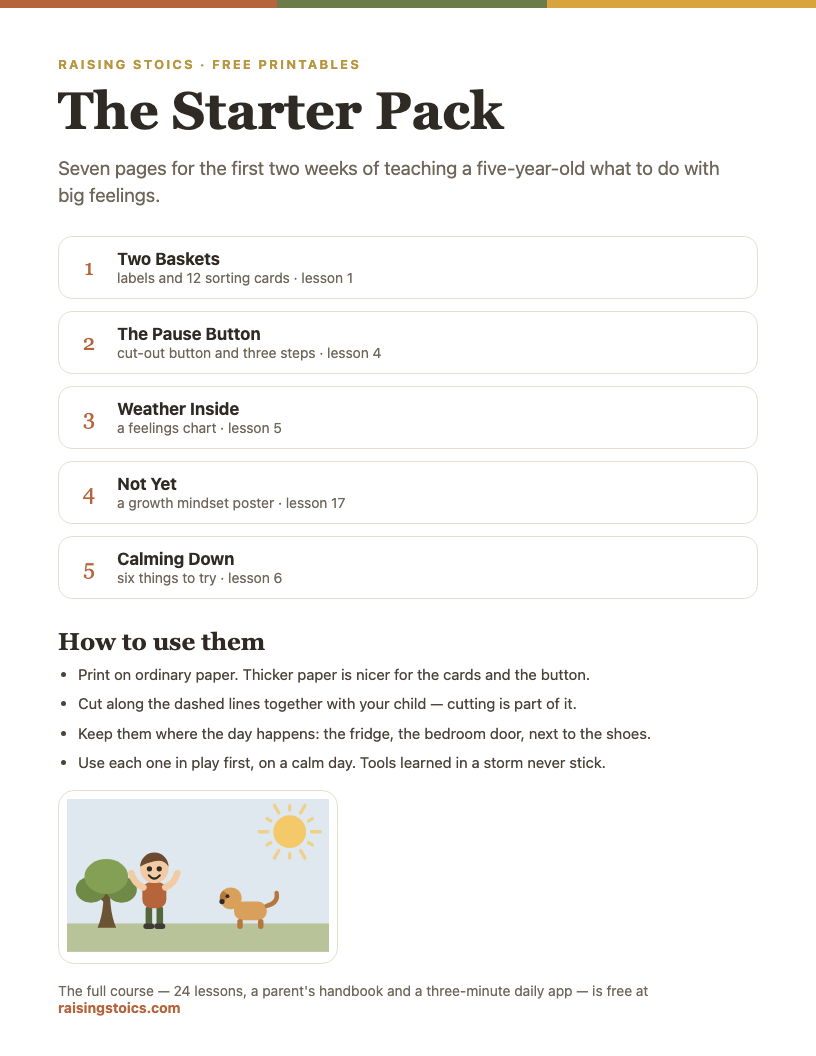
The Big Feelings Starter Pack
Nine pages for the first two weeks: a sorting game, a pause button, a feelings chart and a calm-down poster.
Download the free PDF See all 9 pages
Part of a free 9-page starter pack. Sign in with a code from your email — no password.
School jokes kids can tell
These are good for the drive to school or for a lunchbox note.
- Why did the pencil go to the nurse? It was feeling a little dull.
- Why did the clock get sent to the principal's office? It kept tocking in class.
- Why did the crayon go home early? It was feeling blue, and a little green.
- Why was the eraser so popular? It helped everybody fix their mistakes.
- What did the glue stick say at recess? "Let's stick together."
- Why did the backpack keep its zipper shut during the test? It didn't want to give away the answers.
- What do you call a bus full of sleepy kids? A snooze bus.
- Why did the lamp do so well on the test? It was very bright.
The crayon joke is a handy way into a real talk about feelings: "Have you ever felt blue at school? What color are you today?"
Food jokes kids can tell at dinner
Dinner is where many children try out their jokes first, so here's a set that fits the table.
- Why did the noodle go to bed so early? It was pasta its bedtime.
- What did the pancake say to the syrup? "You're so sweet. Let's stick together."
- Why did the egg run across the playground? It was too chicken to stay.
- Why did the toaster go to bed early? It was feeling burned out.
- What's a lemon's favorite thing to do on a hot day? Make lemon-aid for its friends.
- Why did the cheese stay home from the party? It wasn't feeling very gouda.
A small game for picky eaters: ask your child to make up a joke about the food on the plate. Some children are more willing to try a bite of something they've just been laughing at.
Dad jokes for kids
Dad jokes are the puns that make people groan and smile at the same time. Anyone can tell them, and the groan is part of the fun. Some children ages 6–8 love to tell them back to a parent.
- Where do lost socks go? On a sock-ation.
- Our refrigerator is the coolest member of the family.
- My socks have holes in them. The good news is that now my toes can see outside.
- Why can't you trust shoes with a secret? They've always got their tongues out.
- What did the blanket say at bedtime? "Relax, I've got you tucked in."
- I used to think tying shoelaces was hard. Then I got the hang of it, and now I'm totally knot worried.
A dad-joke tradition can be as simple as one joke at breakfast. Some families keep a jar of joke slips and let the child draw one each morning.
Silly jokes for 4- and 5-year-olds
Short answer: Some 4- and 5-year-olds laugh more at silly pictures and surprises than at puns. A joke that puts something where it doesn't belong often works better than wordplay.
- What's yellow and goes "quack-quack-zoom"? A duck on a scooter.
- What's purple and says "moo"? A cow wearing grape pajamas.
- What's pink, round, and goes "oink-oink-splash"? A pig in a swimming pool.
- What's green, has four legs, and wears rain boots? A frog that doesn't like wet feet.
- What's the loudest thing in the bathtub? A rubber duck with a big idea: "QUACK!"
- What's fuzzy, buzzes, and wears sunglasses? A bee on vacation.
Children this age also love to make up jokes that make no sense at all, like "Why did the banana wear boots? Because PIZZA!" Laughing along is fine. They may be learning that a joke has a setup and an ending, with the meaning coming later.
How to help your child tell a joke
Telling a joke is a small performance, and young children often rush the ending or give it away. Three simple tips may help:
- Pause before the punchline. Teach the "wait for it" moment: ask the question, count to two in your head, then answer.
- Practice on a friendly audience. Let them try a joke on you, a grandparent, or a stuffed animal before they try it on friends.
- Let them tell it wrong. If the punchline comes out backward, laugh at the effort. Correcting the joke mid-tell can take the fun out of it.
When a joke falls flat, show that it's no big deal: "That one didn't land. Want to try another?" A child who sees you shrug off a joke that didn't work may learn something useful about small setbacks.
Why do kids ages 4–8 love puns?
A pun works because one word has two meanings, or sounds like another word. To enjoy it, a child has to notice both meanings at once and see why the switch is funny.
The authors of one study note that understanding jokes like these is said to emerge between ages 7 and 11. Their own study was a small study of four children ages 5 to 6½. The children were taught to understand double-meaning jokes through training with many examples and step-by-step error correction. All four came to understand and enjoy the jokes, and they still did at a later check. With only four children, the study can't tell us how most children learn jokes.
It's common for some 4-year-olds to laugh at a pun without understanding it, and for some 7-year-olds to start explaining jokes to you. Puns may also give children a playful way to notice how words work: sounds, rhymes, and words that mean more than one thing.
How jokes can help with frustration
A joke can change the size of a moment. When a tower falls or a shoe won't go on, a light, kind joke may help some children step back from the frustration long enough to try again.
A few ways to use humor without brushing off the feeling:
- Name the feeling first. "That's really frustrating. That shoe is being so stubborn." Then, if they're ready: "Maybe it wants to go on the other foot?"
- Joke about the thing, not the child. The shoe, the tower, the rain can be silly. Your child's tears shouldn't be the joke.
- Watch their face. If a joke makes them angrier, drop it. Some children need a hug or quiet before they can laugh.
- Let them make the joke. A child who says "My block tower is having a nap" has found their own way to make the problem smaller.
In our program, lesson 11, "Wisdom," gives children one question for moments like this: "Is this big, or is this small?" A joke often works only on the small ones, and that's a useful sign too. For bigger feelings, see our guides to coping skills for kids and calming strategies.
Joking or teasing? Where to draw the line
Around this age, some children try out jokes about other people: their looks, their names, their mistakes. A simple test to try: is everyone laughing, including the person the joke is about? If not, it's teasing, even if it was meant to be funny.
You can also model it. Laugh at your own small mistakes, apologize when a joke of yours hurts someone, and point out jokes that make everybody feel good. Bathroom jokes are a separate topic: many families allow them at home but not at the dinner table or at school, and a clear rule may work better than a lecture.
If your child keeps losing games and gets teased for it, our guide to a child who can't handle losing has ideas for both sides of that moment.
FAQ
What do you call jokes for kids?
Short, silly jokes for children are usually just called kid jokes. Common types include knock-knock jokes, riddle jokes, puns, and "What do you call..." jokes. That last kind names something odd and answers with a made-up word: What do you call a sleepy sock? A snoozie. What do you call a dinosaur that's always on time? A clock-asaurus. Pick an animal, give it one problem, and invent a word together.
What are some "Why did the chicken cross the road" jokes for kids?
They're new versions of "Why did the chicken cross the road? To get to the other side," a well-known anti-joke with a plain, obvious answer. Swap the animal and the place: Why did the turtle cross the road? It's still crossing; give it a minute. Why did the snail cross the sandbox? Nobody knows yet; it hasn't gotten there. Ask your child to make one up about their favorite animal.
What are guess what jokes for kids?
Guess-what jokes start with "Guess what?" and, when the other person says "What?" end with a silly rhyme on "what." "Guess what?" "What?" "A duck in a hut." "Guess what?" "What?" "My sock fell in the pot." Most of the fun is in getting someone to say "What?" again and again, so let your child invent the rhymes.
What are some good jokes for kids?
Good jokes for kids are short, easy to remember, and about things children know: animals, food, school, and home. For ages 4–5, pick jokes with a silly picture in them, like the ones in the silly-jokes section above. For ages 6–8, puns and dad jokes usually work better. The best joke is the one your child can tell on their own, so let them choose.
What are some knock knock jokes?
Here are a few knock-knock jokes to start with: "Knock knock." "Who's there?" "Window." "Window who?" "Window we eat dinner?" Or: "Hugo." "Hugo who?" "Hugo first, I'll go second." To make your own, pick a name or a word that sounds like the start of a sentence, like "Wanda" for "want to," and finish the sentence.
Riddles for Kids: Easy to Hard, With Answers, for Ages 4–8
Riddles for kids ages 4–8, with answers: easy "What am I?" riddles, harder word and math riddles, and trick riddles that teach kids to stop and think.
Read next →"Is this big, or is this small?" is lesson 11 of the program, "Wisdom." It helps 5- and 6-year-olds sort everyday troubles by size, and a good laugh often belongs with the small ones.