 Raising
What Time Should a 5-Year-Old Go to Bed? Bedtimes by Wake-Up
School starts early, and evenings seem to get shorter. What time should a 5-year-old go to bed? It depends mostly on when they have to get up: count back the hours of sleep they need, and the bedtime follows.

What time should a 5-year-old go to bed? Why it depends on wake-up time
Short answer: count back from wake-up time. The American Academy of Sleep Medicine recommends 10–13 hours of sleep per 24 hours for children ages 3–5, naps included, and 9–12 hours for ages 6–12. A 5-year-old who no longer naps and wakes at 7 a.m. would need to fall asleep between about 6 and 9 p.m. Our page on how much sleep a 5-year-old needs has the full table and US survey data.
Some examples for a 5-year-old without a nap, for falling asleep (not for starting the routine):
- Wakes at 6:00 a.m.: asleep between 5:00 and 8:00 p.m.
- Wakes at 6:30 a.m.: asleep between 5:30 and 8:30 p.m.
- Wakes at 7:00 a.m.: asleep between 6:00 and 9:00 p.m.
The ranges are wide because the recommendation itself is a range and children differ; most children won't need the extremes. A child who wakes up cheerful and gets through the day may be getting what they need. A tired 5-year-old may not look sleepy; they may seem wound up, tearful, or irritable instead.
What parents argue about
On parenting forums, the hardest part is often the start of kindergarten. A bus before 7 a.m., a full school day, after-school activities, and dinner can leave little room for a 5-year-old sleep schedule that adds up to 10 hours or more.
How early is realistic. Some parents say a very early bedtime is unrealistic for a 5-year-old and only leads to a long fight in bed. Others say an earlier bedtime on school nights was what finally calmed their evenings. Some found that moving bedtime a little later, so their child was actually tired, worked better.
Staying or leaving. When a child wants a parent nearby, some parents stay until they fall asleep. Others step out gradually, checking in less and less often.
Charts and supplements. Some parents use sticker charts for staying in bed, while others ask what works besides a chart. Melatonin also divides parents; ask your pediatrician before giving any sleep supplement.
What to do today
1. Pick the bedtime from the wake-up time. Work back from when your child has to get up on school days, and keep it close to the same on most nights. Say: "In our house, bedtime is the same on school nights." 2. Make the routine short and the same every night. A simple order, for example: bath or wash, pajamas, teeth, bathroom, one book, lights out. Screens go off before the routine starts. Say: "First pajamas, then teeth, then our book." 3. Give two small choices, not open questions. Choices give a 5-year-old some control without reopening the whole bedtime. Say: "Which pajamas, the blue or the striped ones? Which book, this one or that one?"
If evenings fall apart after school, look at the hour after pickup too: see after-school restraint collapse.
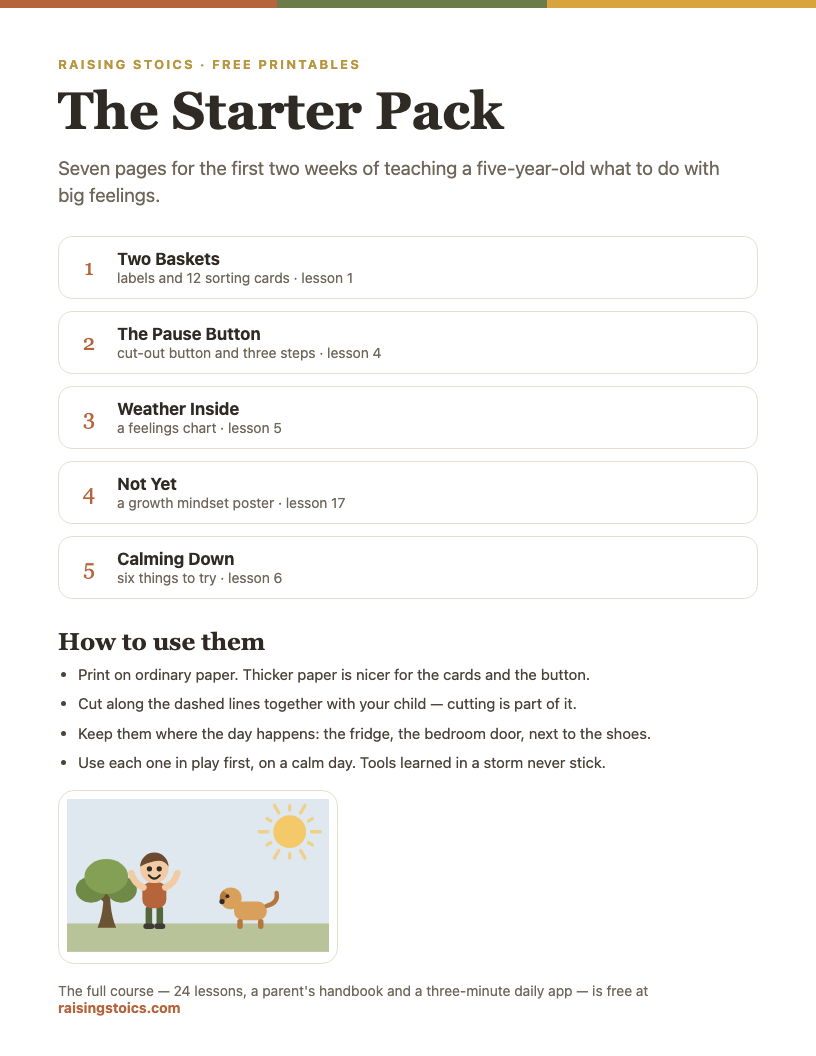
The Big Feelings Starter Pack
Nine pages for the first two weeks: a sorting game, a pause button, a feelings chart and a calm-down poster.
Download the free PDF See all 9 pages
Part of a free 9-page starter pack. Sign in with a code from your email — no password.
What to say at bedtime
Keep the words short and the same every night, so bedtime feels familiar.
- "Book's done. Lights out. I love you."
- "It's sleep time now. You can tell me tomorrow at breakfast."
- If they get up: "It's sleep time," and walk them back with as little talk as you can.
If your child is scared rather than stalling, a different approach helps; see a child afraid at bedtime.
When to talk to your pediatrician
Talk to your pediatrician if sleep problems are frequent, severe, lasting, or happening in more than one setting, such as tiredness that affects behavior at school as well as at home. Also mention loud snoring, pauses in breathing, frequent night waking, or daytime sleepiness. If your child talks about hurting themselves, contact your pediatrician right away. If they're in danger, call 911 or call or text 988.
In the program
In our program for children ages 5–6, the closest lesson is "My Fort" (the rules I keep). Children pick a few rules in their own words and keep them somewhere they can see. Rules a child chose are easier to remember than rules handed to them, and some families include a bedtime rule. Your child's app ends the day with a few short questions, which you can use earlier in the evening, before screens go off. See the program for all 24 lessons.
What parents ask
Paraphrased from questions parents often post on Reddit, Mumsnet, BabyCenter, and other parenting forums.
“My kindergartner gets home late, then it's dinner and bath, and there's no time left before bed. How do other families manage?”
Short answer: many families simplify the evening instead of pushing bedtime later. A bath only on some nights, a simple dinner, and packing the backpack the night before can all free up time. Screens are often the first thing to go on school nights. A short routine that's the same every night helps bedtime start on time even when the evening is tight.
“Is it okay if bedtime is later on weekends?”
Short answer: a little later now and then is common. Big shifts on weekends may make Sunday night and Monday morning harder, because your child gets used to the later time. Many families keep weekend bedtime and wake-up time close to the school-night schedule, and save later nights for special occasions.
“My 5-year-old lies awake for ages after lights out. Is bedtime too early?”
Short answer: it might be. Some parents found that moving bedtime a little later, so their child was actually tired, worked better than a long fight in bed. Check the rest of the day too: a late nap, screens close to bedtime, or a long routine may all play a part. Keep the time your child falls asleep within the range for their wake-up time.
“My 5-year-old keeps coming out of their room after lights out. What do I do?”
Short answer: use the same short phrase every time, "It's sleep time," and walk them back with as little talk as you can. If they seem scared rather than stalling, a different approach may help; see a child afraid at bedtime. A picture chart of the bedtime routine may also help a child see that the day is done.
FAQ
What is a good sleep schedule for a 5-year-old?
A good 5-year-old sleep schedule fits 10–13 hours of sleep in 24 hours, naps included, and keeps the same wake-up time and bedtime on most days. For a child who wakes at 7 a.m. and no longer naps, that means falling asleep between about 6 and 9 p.m. A short, predictable routine before bed helps.
Is 8 p.m. too late for a 5-year-old to go to bed?
Not necessarily. If your child falls asleep at 8 p.m. and wakes at 6 a.m. or later, they get at least 10 hours, the low end of the recommended 10–13. If they have to be up earlier, or seem tired, cranky, or wound up during the day, an earlier bedtime may help.
What is a good bedtime routine for kids?
A good bedtime routine for kids is short, calm, and the same every night. A common order is bath or wash, pajamas, teeth, bathroom, a book, and lights out. Turning screens off before the routine starts and keeping the order the same helps a child know what comes next, and leaves less to argue about.
Should a 5-year-old still nap?
Some do and many don't. The recommended 10–13 hours for ages 3–5 include naps, so a child who naps may need less sleep at night. If a nap makes it hard for your child to fall asleep at bedtime, you might shorten it or replace it with quiet rest.
Child Afraid of the Dark? Bedtime Fears and What Helps, Ages 4–7
Child afraid of the dark? Why bedtime fears and nightmares are common at ages 4–7, what parents disagree about, and a calm plan to try tonight.
Read next →The lesson "My Fort" helps your child choose a few rules of their own and keep them, including at bedtime.