 Raising
Child Afraid of the Dark? Bedtime Fears and What Helps, Ages 4–7
The lights go off and the questions start: what if there's a monster, what if someone comes in, can you stay just a little longer? A child afraid of the dark is one of the most common bedtime worries on parenting forums. Bedtime fears at this age often come with a growing imagination, and there's a lot you can do.

Why your child is scared at bedtime
Short answer: at ages 4–7, imagination often grows faster than the ability to check it against the facts. In the dark, with nothing else to look at, a shadow or a noise is easy to fill in with something scary.
Bedtime is also when a child is tired, alone, and finally still, so worries from the day may come out. Some children are starting to understand that bad things can happen in the world, and they begin asking "what if." A sudden new fear sometimes follows something specific: a scary show, a change at school, or a new sibling. Many bedtime fears are ordinary and often ease with time and a steady routine.
What parents argue about
Stay or fade out. On parenting forums, some parents lie down with a scared child until they fall asleep. Others gradually move out of the room, with check-ins that get further apart over the weeks.
Accommodate or practice. Some parents remove whatever scares the child: night-light on, closet checked, door open. Others worry that too much checking keeps the fear going, and help the child face it in small steps.
Supplements. Some parents mention melatonin; others say to fix the routine first. Ask your pediatrician before giving your child any supplement.
What gets the most agreement: a consistent wind-down routine, no screens right before bed, and looking for a trigger when a fear appears suddenly.
What to do today
1. Check the fear together, in daylight. Look under the bed and in the closet with the lights on, and let your child be the inspector. Say: "Let's be detectives. What's really in here?" 2. Give them a job in the dark. A small flashlight, a night-light they control, or a favorite toy on guard. Say: "You're in charge of the flashlight tonight." 3. Promise check-ins, and keep them. Short, calm visits make your leaving easier to trust. Say: "I'll come back to check on you after I finish the dishes."
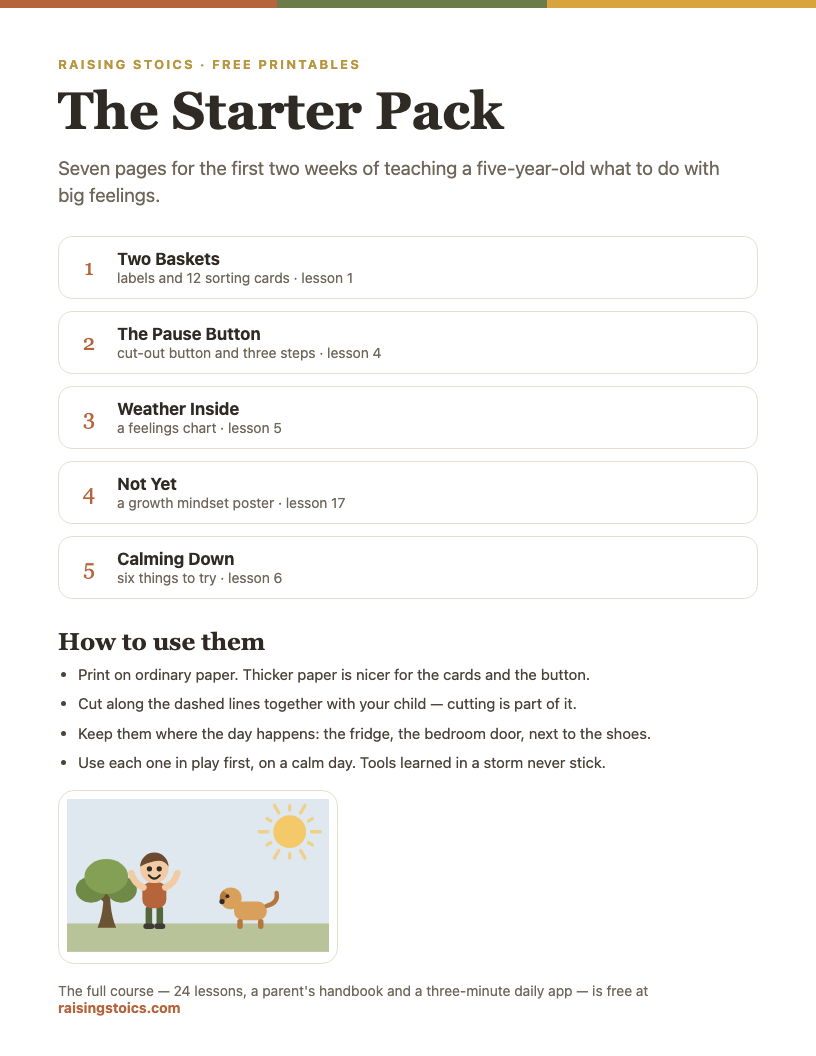
The Big Feelings Starter Pack
Nine pages for the first two weeks: a sorting game, a pause button, a feelings chart and a calm-down poster.
Download the free PDF See all 9 pages
Part of a free 9-page starter pack. Sign in with a code from your email — no password.
What to say to a child afraid of the dark
- "I hear that you're scared. You're safe, and I'm close by."
- "Is it true, or did your mind make it up? Let's check."
- "Let's breathe out slowly together, like blowing out a candle."
Avoid "There's nothing to be scared of." The feeling is real even when the monster isn't. If a nightmare wakes them, keep it short and warm: "That was a dream. You're safe. I'm here." Save the longer talk for the morning. Our article on kids scared of Halloween has more on pretend-versus-real fears, and our research summary on the fear ladder for kids explains the small-steps approach.
When to talk to your pediatrician
Talk to your pediatrician if nightmares are frequent, if fear keeps getting in the way of sleep, if the fears spread into the daytime, or if your child seems anxious in more than one setting. Also mention loud snoring, gasping, or frequent night waking, since poor sleep is worth checking on its own.
In the program
In our program, this is the lesson "True or Made Up": checking a fear against the facts. Children practice the question "Is it true, or did I make it up?" in daylight, so it's ready when the lights go off. It comes in the program's second month, after "The Bravery Ladder," one small step into the fear. Your child's app ends the day with three short evening questions, a calm way to talk before sleep. See the program, or read more answers to questions parents often ask.
What parents ask
Paraphrased from questions parents often post on Reddit, Mumsnet, BabyCenter, and other parenting forums.
“My 7-year-old suddenly won't fall asleep unless I lie down with them. Are they just stalling?”
Short answer: it may be a bit of both. A sudden new fear sometimes follows something specific, such as a scary show or a change at school, so ask about it during the day. At night, some parents sit by the bed and gradually move toward the door, with check-ins they always keep. If it's mostly stalling, see what time a 5-year-old should go to bed.
“My 4-year-old has endless 'what if' questions at bedtime. What actually helps?”
Short answer: answer the first question calmly and briefly, then gently close the topic: "That's a good question for breakfast." Some families set aside a little time earlier in the evening for worries, or keep a worry book where a child can draw them. Slow breathing, like blowing out a candle, may help a child settle once the lights are off.
“My child saw a scary movie at a friend's house and now won't sleep alone.”
Short answer: this is common, and it often eases. Talk about the movie in daylight rather than only at bedtime, and let your child draw the scary character, then give it a silly hat. Looking at how the movie was made may help too. Keep bedtime the same, and see our Halloween movies guide for more on what to do after a scary movie.
FAQ
When do kids start having nightmares?
Many children begin having nightmares they can describe in the preschool years, as imagination and language grow, and nightmares stay common through early childhood. Most are occasional. If nightmares are frequent, keep disturbing sleep, or follow something frightening that happened, mention them to your pediatrician.
What's the difference between a nightmare and a night terror?
After a nightmare, a child usually wakes up fully, is scared, and can often tell you about the dream. During a night terror, a child may scream or thrash but isn't fully awake, may not recognize you, and usually doesn't remember it in the morning. Keep them safe and let it pass; mention frequent episodes to your pediatrician.
Should my child sleep with a night-light?
If it helps your child feel safe, a night-light is a simple fix many families use. A dim light that lets them see the room can take the mystery out of shadows. Letting your child switch it on themselves gives them some control, which helps many children with bedtime fears.
Is it okay to let my scared child sleep in my bed?
Families make different choices, and there's no single right answer. If you'd like your child to sleep in their own room, a gradual plan, like sitting by the bed, then the door, with regular check-ins, is usually easier than a sudden change. Keep the routine calm and predictable whichever you choose.
My Child Has No Friends at School: What Helps When No One Plays
My child has no friends at school: a worry many parents share. Why it happens at ages 4–7, what parents disagree about, and three steps to try this week.
Read next →The lesson "True or Made Up" teaches children to check a fear against the facts, a skill that helps most at bedtime.