 Raising
Child Says "I Hate You"? What It Means and What to Say Back
Few words land harder. When your child says "I hate you" after you turn off the TV or say no to a cookie, it's hard not to take it personally. Here's what those words usually mean at ages 4–7, and how to respond without starting a bigger fight.

Why your child says "I hate you"
Short answer: for most young children, "I hate you" means "I'm really angry right now" or "I hate what you just did." It's often the strongest phrase they know, and they may use it because it gets a big reaction.
Children ages 4–7 have big feelings and a small vocabulary for them. Disappointed, frustrated, embarrassed, and jealous may all come out as the same three words. Some children say it when a limit is set; others when they feel left out, after a new sibling arrives, or when they're tired. It usually says much more about the feeling of the moment than about how your child feels about you.
What parents argue about
On parenting forums, parents tend to split into two camps.
Consequence or calm. Some parents treat it as disrespect and give a consequence, so the child learns those words aren't okay. Others say punishing the words teaches a child to hide the feeling, and they respond to the anger underneath instead.
New rules or a closer look. When a child who used to be easygoing starts saying it often, some parents tighten the rules. Others look first for a change at home, like a new baby or a move, and add one-on-one time instead of new rules.
Where many parents agree: a calm, short response works better than a hurt or angry one.
What to do today
1. Answer the feeling, not the words. Say: "You're really mad that the TV is off. I still love you." 2. Give them better words to use. At a calm time, practice a few: "I'm mad," "That's not fair," "I'm disappointed." Say: "Next time you can tell me, 'I'm so mad at you!' I'll still listen." 3. Plan a little one-on-one time every day. A short stretch of play, phone away, where your child chooses. Say: "This is our time. You pick the game."
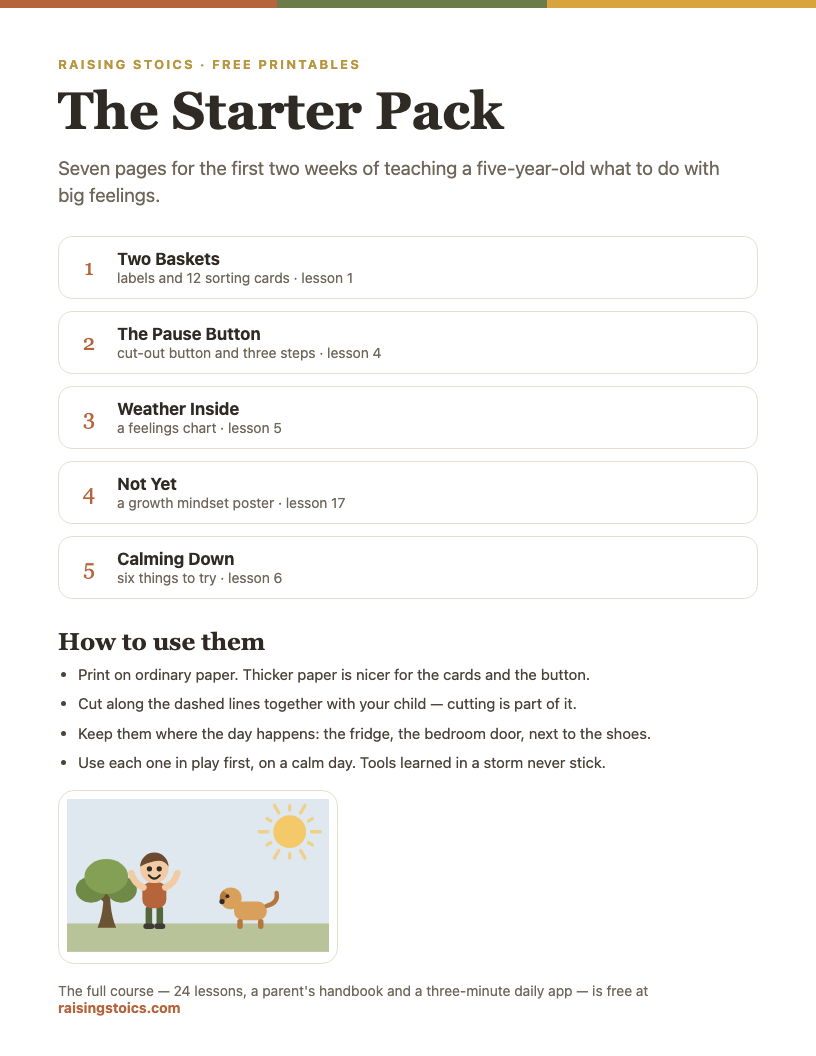
The Big Feelings Starter Pack
Nine pages for the first two weeks: a sorting game, a pause button, a feelings chart and a calm-down poster.
Download the free PDF See all 9 pages
Part of a free 9-page starter pack. Sign in with a code from your email — no password.
What to say instead
Instead of "That's a terrible thing to say" or "Well, I don't like you much right now either," try:
- "You're really angry. That's okay."
- "I love you even when you're mad at me."
- "I'm not changing my mind, and I'm right here."
Then let it go. If you don't react strongly, the phrase may lose much of its power. Later, when everyone's calm, you can come back to it: "You were so mad earlier. What made you feel that way?" If the words came after you lost your temper, our page on how to stop yelling at your kids covers repair. A feelings chart for kids can help them find the right word.
When to talk to your pediatrician
Mention it if hurtful words come with frequent aggression, if your child seems sad, withdrawn, or angry most of the time, or if it keeps happening at school as well as at home. If your child ever says they want to hurt themselves or wish they were dead, contact your pediatrician right away. If you think they're in immediate danger, call 911 or call or text 988, the 988 Suicide & Crisis Lifeline.
In the program
In our program, this is the lesson "Weather Inside": naming what you feel. Children practice the phrase "Right now I feel…" and describe their mood as weather, so "I hate you" has a chance to become a weather word, for example "I feel stormy." Our research summary on naming feelings explains what studies do and don't show about this. Your child's app asks three short questions each evening, including how today felt. See the program, or read more answers to questions parents often ask.
What parents ask
Paraphrased from questions parents often post on Reddit, Mumsnet, BabyCenter, and other parenting forums.
“When my 6-year-old gets angry, they say 'I wish I was dead.' Is that just something kids say?”
Short answer: take it seriously, even if it comes out in anger. Stay calm and ask gently what they mean, without scolding. Contact your pediatrician right away to talk it through. If you think your child is in immediate danger, call 911 or call or text 988, the 988 Suicide & Crisis Lifeline. Your pediatrician can help you look at what's behind it and find support.
“Since the new baby arrived, my 4-year-old says they hate me and the baby. Is this normal?”
Short answer: strong words after a new baby are common, and they're often about sharing your attention. Name the feeling for them: "It's hard to share me. You can be mad and still be loved." A short stretch of one-on-one time each day, with your phone away, may help more than new rules. See sibling rivalry for more on new babies.
“My kid only ever says it to me, never to the other parent. What am I doing wrong?”
Short answer: probably nothing. Children often aim their biggest feelings at the person they feel safest with, or at the parent who sets most of the limits. Keep your response short and calm, such as "You're really mad. I still love you," and ask the other parent to respond the same way if it happens with them.
“I snapped and said something hurtful back. How do I fix it?”
Short answer: a short, calm repair often helps. Once everyone has calmed down, name what you did, say you're sorry, and say what you're working on: "I said something unkind. I'm practicing taking a breath first." There's no need for a long apology. Our page on how to stop yelling at your kids covers repair in more detail.
FAQ
Is it normal for a 5-year-old to say "I hate you"?
Yes, it's common. Many 5-year-olds say "I hate you" when they're angry, disappointed, or told no, because it's the strongest phrase they know. It's usually about the moment, not the relationship. A calm response and practice with other words tend to make it less frequent over time.
Should I punish my child for saying "I hate you"?
Usually a calm response works better than a punishment. Punishing the words may teach a child to hide their anger rather than to express it in a better way. Acknowledge the feeling, keep your limit, and practice other words later. If the words come with hitting or name-calling, respond to that behavior calmly and consistently.
Does my child really hate me?
Very unlikely. Young children use "hate" for a strong feeling in the moment, much as they might say they hate broccoli. The same child who says it after a limit will often want a hug soon after. What they need is a calm adult who can hear the anger without giving in or turning away.
Why does my child say I don't love them?
Young children sometimes say "You don't love me" when they feel disappointed, left out, or corrected. It's usually a way of saying they feel hurt right now. Answer simply and warmly, "I love you, even when I say no," and look for patterns, like a new sibling or busy weeks, that might call for more one-on-one time.
How to Encourage Kids to Share (Without Forcing It)
How to encourage kids to share at ages 4–6: why forced sharing backfires, why turn-taking and timers tend to work better, and why finishing a turn matters.
Read next →The lesson "Weather Inside" gives children words for what they feel, so "I hate you" can become a weather word like "stormy."