 Raising
Sibling Rivalry: When to Step In and How to Help Kids Make Up
Two children, one toy, and a shout from the next room: "He started it!" Sibling rivalry is one of the most familiar parts of family life, and with children ages 4–8 it can feel like a full-time refereeing job. Here's what often sits behind it, when to step in and when to let your kids work it out, and how to help them make up afterward.

Sibling rivalry at ages 4–8: what it usually looks like
Short answer: competition, jealousy, and quarrels between brothers and sisters are a normal part of growing up together. At ages 4–8 they often look like arguments over toys, turns, and seats in the car, complaints that something isn't fair, tattling, teasing, and sometimes pushing or hitting.
Siblings are each other's first peers. The American Academy of Pediatrics notes that children can learn a lot from each other about relationships, including how to work through conflict and how to show support and respect. That learning is often loud.
Some children compete mainly for a parent's attention; others mostly clash over space and belongings. Temperament, age gaps, tiredness, and hunger may all play a part. A 5-year-old may still find it hard to wait, share, or lose, and a younger sibling may grab or knock things over before they can explain what they want. None of this means your family is doing something wrong.
When a new baby arrives
A new baby is one of the most common starting points. An older child who had a parent's full attention now has to share it, and the baby can't be blamed or argued with the way a toy thief can.
Some children show it directly ("Send him back"). Others show it sideways: baby talk, new trouble at bedtime or with the potty, more tantrums, or extra clinginess. Some of this is a common reaction to a big change, not a problem to stamp out.
Advice that comes up often on parenting forums is fairly simple. Let the older child help with the baby in ways they choose, such as picking a song or fetching a diaper. Keep some time that is only theirs, even a short stretch of play with your phone put away. And say the mixed feelings out loud for them: "It's hard to wait while I feed the baby. You can be mad about it and still be my big kid." Wanting to be little again often fades when being big feels worth something.
Fair isn't always the same
"That's not fair!" may be the most common sentence in a house with two young children. For a 5-year-old, fair usually means the same: the same size slice, the same bedtime, the same number of turns.
Sometimes same is exactly right. Clear rules that apply to everyone (no hitting, ask before you take, kind words) are easier to keep when nobody gets an exception. The AAP suggests keeping family ground rules like these clear for everyone.
Other times, children need different things. A 3-year-old needs more help getting dressed; a 7-year-old gets a later bedtime. You can say so plainly: "In this family, everyone gets what they need. Right now your sister needs help. When you need help, you get it too."
Comparisons tend to make rivalry worse: "Why can't you sit still like your brother?" turns a sibling into a measuring stick. It also helps to take turns choosing family activities, so a younger child's wishes don't always win because the older one "understands."
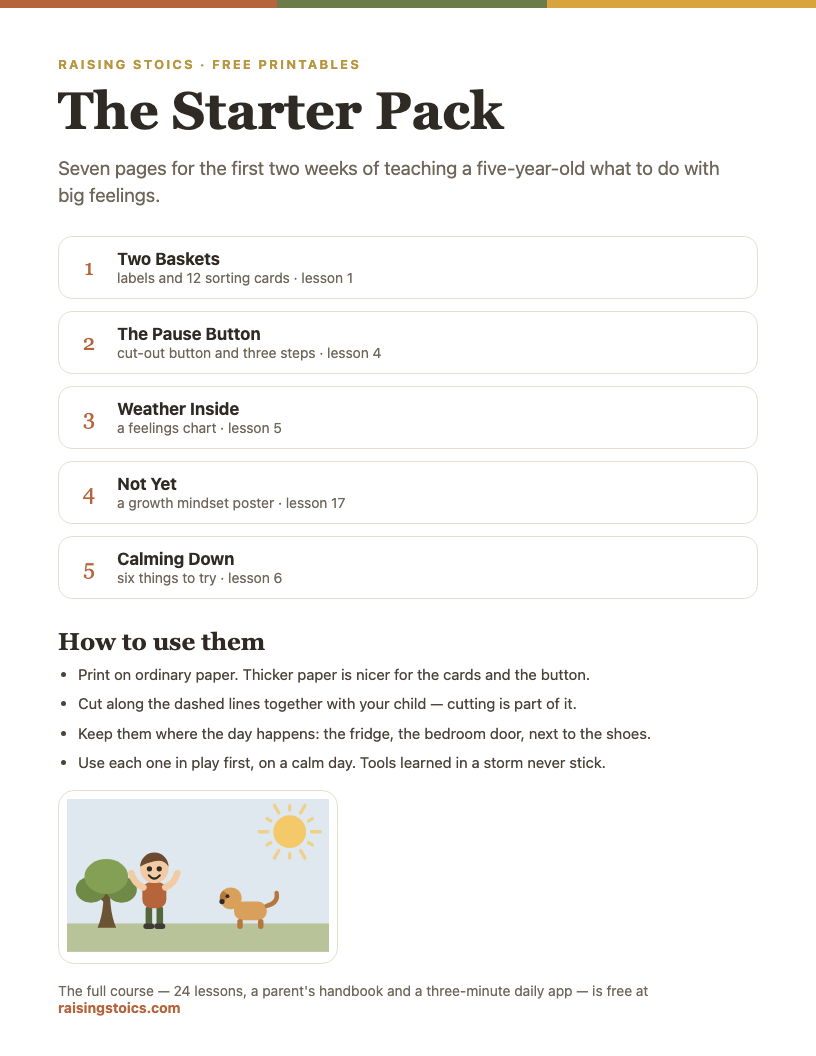
The Big Feelings Starter Pack
Nine pages for the first two weeks: a sorting game, a pause button, a feelings chart and a calm-down poster.
Download the free PDF See all 9 pages
Part of a free 9-page starter pack. Sign in with a code from your email — no password.
"He started it": you don't have to find the guilty one
When two children both say "He started it," there is often no way to know who did. Each child is usually telling the truth as they felt it. One grabbed; the other had been teasing first; the grab came after a push nobody saw.
Trying to establish the facts can turn you into a judge and the fight into a trial, with each child arguing their case. A different approach is to skip the verdict and move to what happens next: "I don't need to know who started it. I need to know how you two will fix it."
This doesn't mean ignoring a child who was clearly hurt. If someone was hit, take care of them first, out loud, and then deal with the child who hit, calmly and the same way each time. Our guide to a child who hits covers that response in more detail.
Siblings fighting: when to step in and when to let them solve it
Short answer: stay out of simple disagreements when you can, and step in calmly when someone is getting hurt, when one child is clearly overpowered, or when they can't get anywhere on their own.
The AAP's guide to sibling relationships says younger siblings need a parent to step in more often, and that you can lessen your involvement as children mature. For a simple disagreement, it suggests giving children a chance to solve it themselves, even if they need to spend some time apart first. If they can't reach a resolution or you're worried about a child's physical or emotional well-being, it suggests stepping in as a calm, neutral party and listening fairly before deciding anything.
In practice, with children ages 4–8, it can help to sort fights into three kinds:
- Bickering ("Stop looking at me"). Stay out of it, or make a light comment from the next room.
- A real dispute over a toy, a game, or a space. Coach without judging: describe the problem and ask what they could try.
- Hitting, kicking, or one child being picked on. Step in right away and separate them. Safety comes first; the talking can wait.
Younger children usually need more coaching. A 4-year-old may know the rule and still not be able to stop their hands in the middle of a fight.
How to stop siblings from fighting in the moment
When you do step in, keep it short and boring. A long speech in the middle of a fight tends to reach no one.
1. Stop the action. Get between them or take the toy for now. Say: "I'm going to hold this while we figure it out." 2. Describe what you see, without blame. Say: "Two kids, one truck. Both of you want it." 3. Hand the problem back. Say: "What could you try? You can take turns, play with it together, or find something else for now." Three choices are easier than an open question for a 5-year-old. 4. Walk away when they're working on it. Come back to notice what they did.
If feelings are too big for any of that, separate them first and talk later. Some children need to calm down before they can think about turns at all. Our guide on how to teach kids sharing goes deeper into turn-taking, which is behind many sibling fights.
What parents argue about
On parenting forums, some parents treat sibling fighting as normal, and others worry about it. They also disagree about what to do with it.
Firm or gentle. When an older child is mean to a younger one or hits, some parents call for immediate, firm consequences and say gentle approaches let it go on too long. Others say connection comes first: the child who lashes out often feels pushed aside, and punishment alone can make that worse. A common middle ground is to stop the hitting right away, calmly and the same way every time, and to talk about the feeling afterward.
Letting the younger one win. Some parents let a younger child win games. Others prefer to play fair every time, so that children practice losing safely at home.
Repair after sibling fighting
The end of a fight is a chance to practice something more useful than "Say sorry." A forced apology can sound flat, and both children often know it.
Instead, try making repair a small action. After everyone is calm, ask the child who hurt: "Your brother is still sad. What could you do to help him feel better? You could bring him an ice pack, help rebuild the tower, or ask him to play." If they pick one, notice it in specifics afterward.
It helps to show repair yourself. If you yelled at both of them, a brief apology and a word about what you're working on ("I shouted. I'm practicing taking a breath first") shows children that grown-ups fix things too.
And look for moments when they're getting along. Teamwork games, or games where nobody keeps score, are one idea the AAP suggests for siblings who struggle with rivalry. Shared jobs, like making a snack together, can work too.
When to talk to your pediatrician
Most sibling fighting is part of ordinary family life. Talk to your pediatrician if the aggression is frequent, severe, lasting, or happening in more than one setting, such as at home and at school. Also talk to them if one child is regularly getting hurt, seems afraid of a sibling, or the fighting is part of a wider change in mood, sleep, or eating.
If your child talks about hurting themselves, contact your pediatrician right away. If anyone is in danger, call 911 or call or text 988.
In the program
Our program for children ages 5–6 has two lessons that fit sibling rivalry closely. In "Fair Play" (fair means the same rules for everyone), children make up a game with rules they choose and keep those rules even when they're losing. In "Stepping In" (we're here to help each other), they practice three things to do when someone is having a bad time: sit with them, ask what happened, or get a grown-up. For anything physical, getting a grown-up is always the brave choice. You can invite a sibling to join, or do the lessons one-on-one. For other everyday struggles, see more answers to questions parents often ask.
What parents ask
Paraphrased from questions parents often post on Reddit, Mumsnet, BabyCenter, and other parenting forums.
“My 7-year-old is jealous of the toddler because 'everyone thinks they're cuter.' What do I say?”
Short answer: name the feeling without arguing about it: "It feels like the baby gets all the attention. That's hard." Then make some time that's only theirs, and notice what they do in specifics. Avoid comparing the two, even kindly. Letting the older child help with the toddler in ways they choose may help them feel bigger, not replaced.
“My 4-year-old is rough with the baby when I'm not looking. Should I worry?”
Short answer: some roughness after a new baby is a common reaction, but keep the baby safe: for now, don't leave them alone together. Show gentle hands, give the older child a real job with the baby, and protect a little one-on-one time. If the roughness is frequent or severe, or comes with other changes, talk to your pediatrician.
“My kids fight nonstop in the car. What can I do?”
Short answer: plan for the car as a known hot spot. Some families take turns choosing seats or music, put a soft toy between car seats, or play an audio story everyone listens to. Decide before you leave what happens if fighting starts, and keep your response calm and short. Our list of podcasts for kids has ideas for car rides.
“One of my kids always gives in to the other. Should I step in?”
Short answer: sometimes. Simple disagreements can be left to the children, but when one child is regularly overpowered, a parent may need to step in as a calm, neutral coach. Help the quieter child practice words like "I'm still using it" or "It's my turn next," and notice when they stand up for themselves.
FAQ
What is sibling rivalry?
Sibling rivalry is the competition, jealousy, and conflict between brothers and sisters. In young children it often shows up as arguments over toys and turns, complaints about fairness, tattling, and sometimes hitting. It's a normal part of growing up with siblings, and it often changes as children get older and their reasons for disagreeing change.
What causes sibling rivalry?
There is usually no single cause. Children may compete for a parent's attention, clash over shared space and toys, or feel that one sibling is treated better. A new baby, a move, or a stressful stretch may stir it up. Age gaps, temperament, tiredness, and hunger can all make fights more likely, and comparisons between siblings tend to add fuel.
How to deal with sibling rivalry?
Deal with it mostly before the fights happen. Keep a few clear rules for everyone, avoid comparing children, and give each child some one-on-one time with you. During fights, stay out of minor bickering, coach on real disputes, and step in right away when someone is getting hurt. Afterward, help the children repair with a small action instead of a forced apology.
How to handle sibling rivalry?
Handle it as calmly and as consistently as you can. Children tend to fight harder when every fight brings a parent running to judge. Describe the problem without blame, ask what they could try, and offer a few choices. Separate them first if anyone is hitting. When they solve something on their own, tell them specifically what they did well.
How to get siblings to stop fighting?
You probably can't get siblings to stop fighting completely, and that's normal. You can make fights shorter and less frequent. Notice when fights tend to happen, such as before dinner or after school, and plan around those times. Give each child some things they don't have to share, and praise them in specifics when they work something out themselves.
Why Does My Child Hit Me? What to Do When a 5-Year-Old Hits
Why does my child hit me? Why 4- to 7-year-olds hit parents when they're upset, what to do in the moment, and three steps to teach their hands what to do.
Read next →The lessons "Fair Play" and "Stepping In" help children keep the same rules for everyone and practice what to do when someone is having a hard time.