 Raising
What Age Should a Kid Get a Phone? The Steps Before a Phone
Some parents of 5- and 6-year-olds hear the question early, sometimes from a child whose friend has a watch that calls. What age should a kid get a phone? There's no single agreed age, but for children ages 4–7 the more useful question is what comes before a phone, and how you'll decide later.

What age should a kid get a phone?
Short answer: There's no single agreed age. The decision usually depends on the child, the device, and what it's for.
One frequently cited benchmark is the Wait Until 8th pledge, which asks parents to hold off on a smartphone until at least the end of 8th grade, usually age 13 or 14. The organization says the average age for a first smartphone is 10.
For children ages 4–7, the question is rarely "smartphone or not." It's "Do they need to reach us, and what's the smallest device that does that?" A device that only calls a few approved people is a very different thing from a phone with an app store and a browser. The rest of this guide goes through those in-between steps, from a shared family tablet to a kid phone, and how to tell when your child may be ready for the next one.
What screen-time research and the AAP say
Short answer: Research links more screen time to slightly more behavior problems, but it doesn't show that screens cause them. It's about screen time overall, not phones specifically.
A large 2022 meta-analysis of 87 studies with about 159,000 children ages 12 and under found small links between more screen time and more acting out and more anxiety and withdrawal. Most of those studies were correlational: children who already struggle may also be given more screen time.
The American Academy of Pediatrics' 2026 policy statement, Digital Ecosystems, Children, and Adolescents, argues that children's media use can't be judged by screen limits alone. It points out that media designed to maximize engagement can displace sleep and movement, and it still mentions time limits, but as one tool among several.
For a first device, that suggests asking what it will replace and how it's designed, not just how many minutes it's on. Our screen time rules for kids put that into a simple family plan.
Phone for kids under 8: the steps before a phone
Short answer: Some families move through a few smaller devices before a phone, each with more freedom than the last.
A rough ladder, from the most limited to the most open:
- A shared family tablet that lives in the kitchen and belongs to everyone.
- A home landline, such as Tin Can or Pinwheel Home, for calling approved friends and family.
- A kid smartwatch with calls, texts, and GPS for a few approved contacts.
- A kid phone with no browser or social media, managed by a parent.
- A smartphone, often with parental controls set up first.
The ladder isn't a schedule. Some families skip steps, and some stay on one for years. What it gives you is a next step that's smaller than "a phone."
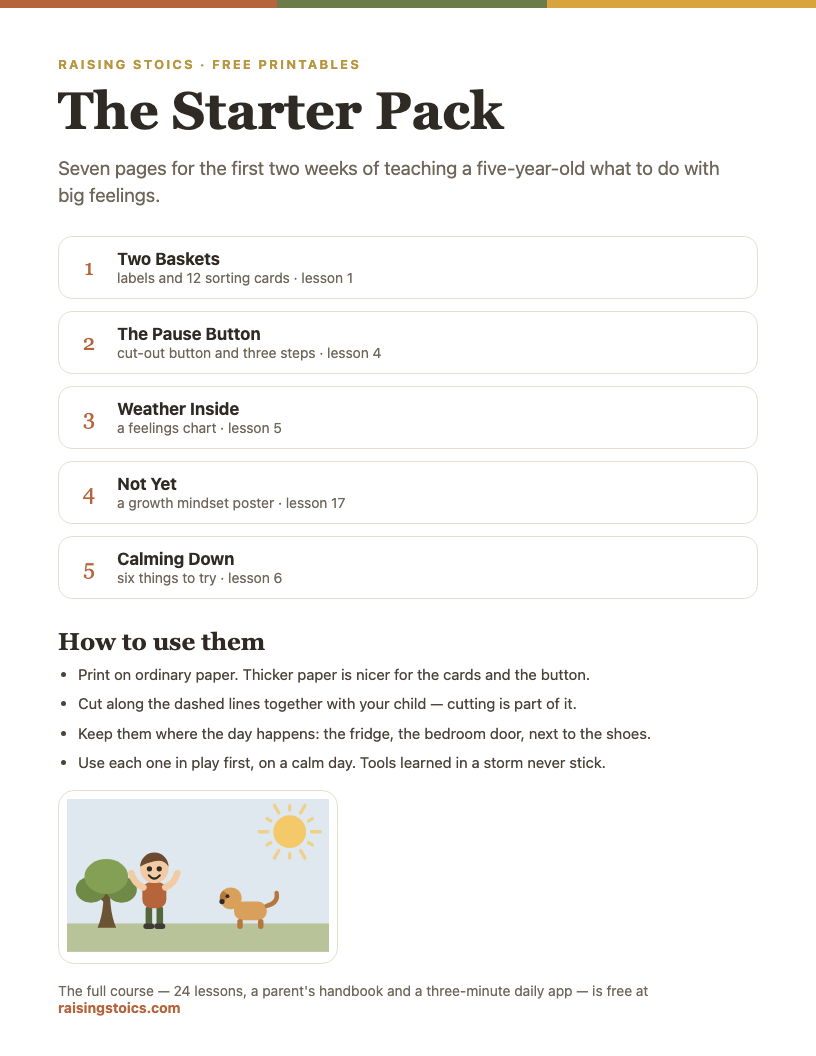
The Big Feelings Starter Pack
Nine pages for the first two weeks: a sorting game, a pause button, a feelings chart and a calm-down poster.
Download the free PDF See all 9 pages
Part of a free 9-page starter pack. Sign in with a code from your email — no password.
A shared family tablet
Short answer: For some families with a 4- to 7-year-old, the first device isn't the child's own. It's a family tablet with family rules.
A shared tablet stays in a common room, charges outside the bedroom overnight, and gets handed back when time is up. Because it belongs to everyone, it's easier to say "the tablet is resting" than "you can't use your tablet."
On an iPad or iPhone, Screen Time can set app limits and downtime, and Ask to Buy sends purchase requests to a parent. Our iPhone parental controls guide walks through the settings step by step. If a tablet has already become a struggle, our guide to the iPad kid question covers endings and transitions that may help.
A home landline: Tin Can and similar
Short answer: A Wi-Fi "landline" lets a child call friends and grandparents without a screen.
Tin Can is a corded Wi-Fi phone for kids. As of October 2026, it costs $100. Calls to other Tin Cans are included, and the Party Line Plan, $9.99 a month, adds regular phone numbers. Only contacts a parent approves in the parents-only app can call in or out, there are no apps or texts, parents can set quiet hours, and 911 is always enabled.
Pinwheel sells a similar home phone with no screen, Pinwheel Home, with calls to other Pinwheel Homes at no charge and plans of $6.99 or $9.99 a month for outside numbers.
For a 5-year-old, a home phone can be practice in answering, taking a message, and saying goodbye, skills a later phone will need too.
Kid smartwatches: Gabb Watch and Apple Watch with Family Setup
Short answer: A watch gives calls, texts, and location without apps or a browser, which is why many families try one first.
Gabb Watch 3e: $229.99, listed by Gabb for ages 5–12, with a plan of $12.99 to $17.99 a month, depending on the contract. It calls and texts up to 100 parent-approved contacts, has GPS with Safe Zone alerts, and has no browser, social media, or camera. Its SOS button calls the child's SOS contact, not 911.
Apple Watch with Family Setup (Apple now calls it Apple Watch For Your Kids): a cellular Apple Watch, Series 4 or later or SE or later, set up and managed from a parent's iPhone. Apple's page lists the Apple Watch SE 3 from $249 for the GPS-only model. Family Setup needs a cellular model, which costs more, and the cellular plan comes from your carrier. Parents can approve contacts, turn on Schooltime to limit the watch during school hours, see location in Find My, and turn on Ask to Buy.
Location sharing raises its own questions; our page on Life360 covers one of the most common apps.
First phone for kids: Bark Phone, Gabb Phone, and Pinwheel
Short answer: These are real phones with the risky parts removed or locked, so a parent decides what gets added. Prices are as of October 2026.
- Bark Phone: a Samsung phone, $15 a month for 24 months ($25 for the Pro), plus a plan from $29 a month; Bark is sold in the US only. The Starter plan allows calls and texts with approved contacts and no apps, games, or browser. Bark's software scans texts, photos, and apps and alerts parents.
- Gabb Phone 4: $249.99, listed by Gabb for ages 9–14, with plans from $29.99 a month. Gabb says the Phone 4 has no app store, browser, or social media; the Gabb Phone 4 Pro on the Advanced plan can use Gabb's parent-enabled app store. Contacts are child-managed by default; parents can switch that in the MyGabb app.
- Pinwheel: Android phones from $119 to $299, with parent controls at $17.99 a month on a SIM from most major carriers (Pinwheel says the Genesis 4 isn't compatible with Verizon or 5G) or $29.99 with Pinwheel Wireless. There's no social media or browser by default, and Pinwheel says only approved numbers can call or text.
Gabb lists its phone for ages 9–14; Bark and Pinwheel don't state a minimum age on their pages. For many children ages 4–7, a watch or home phone covers the same need with fewer features.
The Wait Until 8th pledge
Short answer: It's a parent pledge to wait on a smartphone until at least the end of 8th grade, and it only counts once 10 families in the same grade and school sign.
Parents sign online. When at least 10 families from a child's grade and school have pledged, the pledge becomes active, and those families receive each other's contact details. The idea is that a child is less likely to be the only one without a phone.
The pledge covers smartphones only. Families who sign can still give a child a basic phone that calls and texts; its FAQ also suggests a two-way calling watch. After 8th grade, the organization says, each family decides again. The organization's site says more than 155,000 parents have signed (checked October 2026).
For parents of a kindergartner, the useful part may be the timing: grade-level groups are easier to form while children are young and no one has a phone yet.
New under-16 social media rules in Australia and the UK
Short answer: Australia's rules are in force; the UK's are announced but not yet in effect, as of October 2026.
Australia: since December 10, 2025, age-restricted social media platforms must take reasonable steps to stop people under 16 from creating or keeping accounts. The obligation and the penalties fall on the platforms, not on children or parents.
United Kingdom: on June 15, 2026, the government announced that social media companies will no longer be able to offer their services to under-16s. Its July 2026 response says it intends to put the first regulations before Parliament by the end of 2026, which it expects to come into effect in early to spring 2027.
Both sets of rules are about social media accounts, not about owning a phone.
At what age should a kid get a phone? Signs of readiness
Short answer: Readiness depends more on a child's habits than a birthday. Some signs to look for (our suggestions, not a tested checklist):
- They can stop. When a show or game ends, they can switch to something else most of the time, even if they complain.
- They follow rules without you watching, such as screens out of the bedroom.
- They take care of their things, such as a water bottle or a library book.
- They tell you when something online felt strange or scary.
- There's a real need, such as getting home from an activity or a parent who travels.
If most of these aren't there yet, that may be common at 5 or 6. It may simply mean the next step on the ladder is a smaller one.
A first device agreement
Short answer: Write down a few rules before the device arrives, together, and keep them short enough for a child to remember.
A first device agreement for a young child might include:
1. The device sleeps in the kitchen at night. 2. We only call or message people Mom or Dad have added. 3. If something feels strange or scary, I show a grown-up, and I won't be in trouble. 4. No device at meals. 5. When time is up, I put it down, and I can be grumpy about it. 6. Grown-ups can look at the device anytime. 7. We'll talk about these rules again on my next birthday.
Let your child draw a picture for each rule and sign it. Revisiting it on a set date makes it a plan that grows with them.
Waiting for a device is also practice in waiting itself. In our program, the lesson "I'm the Boss of My Want" teaches 5- and 6-year-olds tricks for the pause between wanting something and getting it: turning around, singing, counting.
What parents ask
Paraphrased from questions parents often post on Reddit, Mumsnet, BabyCenter, and other parenting forums.
“My 7-year-old says two friends have phones and they're the only one without. What do I say?”
Short answer: acknowledge the feeling first: "It's hard to feel left out." Then explain that each family decides, and say what your plan is. Often "everyone has one" means a few children. If there's a real need to reach you, a smaller step, like a home phone or a kid watch with approved contacts, may cover it.
“Should my kindergartner have a GPS tracker or a watch with location?”
Short answer: some families use a kid watch with location for a specific need, such as getting home from an activity. Think about what the device is for and what it can do. For example, the Gabb Watch's SOS button calls the child's SOS contact, not 911. Talk with your child about how location sharing works. Our Life360 page covers one common app.
“Can my child wear a smartwatch to school?”
Short answer: it depends on the school, so check its device policy before you buy. Some schools limit watches that can call or text during class. With an Apple Watch set up through Family Setup, Schooltime can limit the watch during school hours. Asking the teacher early may keep the watch from becoming a problem on the first day.
FAQ
What age should a kid get a phone in 2026?
There's still no official age in 2026. The Wait Until 8th pledge asks families to wait on a smartphone until at least the end of 8th grade. What's new is the range of in-between devices, from Wi-Fi landlines to kid watches and phones without browsers, and Australia's under-16 social media rules, with UK rules planned for 2027.
What is a Tin Can phone for kids?
Tin Can is a corded Wi-Fi home phone for kids. It calls only contacts a parent approves in an app, and it has no screen, apps, or texts. As of October 2026, it costs $100. Calls to other Tin Cans are included, and a $9.99 monthly plan adds regular phone numbers. Calls to 911 are always enabled.
Is a smartwatch a good first device for a 6-year-old?
For some families, a watch is the first step because it offers calls, texts, and location without a browser or apps. Kid watches such as the Gabb Watch let parents approve every contact. Some watches allow more than others, so check whether the watch can download apps, and keep it off during school if the school asks.
Should a kid's first phone be a smartphone?
It doesn't have to be. Kid phones such as Gabb, Pinwheel, and the Bark Phone on its Starter plan have no browser or social media by default (Pinwheel and Bark's Advanced plans can add apps), so a child can call and text first and get more features later. Many families start with a watch or home phone and move up one step at a time.
Can a 5-year-old have a phone?
Some families give a 5-year-old a limited device, most often a kid watch or a home phone that calls a few approved people. A smartphone with apps and a browser is a different decision. At this age, the device usually stays with a parent's rules, and the main skill to build is putting it down when time is up.
Screen Time Rules for Kids: A Simple Family Plan for Ages 4–7
Screen time rules for kids ages 4–7 that don't end in a meltdown: eight simple family rules, how to introduce them, and what to do when a rule breaks.
Read next →Waiting on purpose is lesson 13 of the program, "I'm the Boss of My Want," and "My Fort" turns family rules into rules a child keeps.