 Raising
Rainy Day Activities for Kids: 24 Screen-Free Ideas at Home
A rainy afternoon with a 5-year-old can feel very long by 3 p.m. These rainy day activities for kids ages 4–8 need no screens and almost nothing you'd have to buy. There are 24 ideas in four groups: active games for burning energy, quiet ones for winding down, creative projects, and kitchen activities. Each one lists roughly how long it holds attention and what you need, so you can plan a whole day or just the next half hour.

How to plan a rainy day with kids
Short answer: Alternate. Follow an active game with a quiet one, and a messy project with something you can do on the couch. A rainy day usually goes better as a string of short blocks than as one big plan.
A simple shape for a full day at home:
1. Morning: one active game while energy is high. 2. Late morning: a creative or kitchen project. 3. After lunch: a quiet hour: books, an audio story, a puzzle. 4. Afternoon: another active game, then a kitchen activity before dinner.
Three habits make the day easier:
- Offer three options, not twenty. "Obstacle course, fort, or painting?" A short menu is easier to pick from than an open question.
- Set up before you announce. Tape on the floor or a tray of paint on the table starts the game on its own.
- Plan the cleanup as part of the activity. "When the timer rings, cushions go back" is easier to agree on before the game starts than after.
The times below are rough. Some children spend an hour on something we've marked as 15 minutes, and that's a good day.
Active rainy day activities for kids
These six games are for the moment when your child is bouncing off the furniture. Clear a space first, and move anything breakable.
1. Couch-cushion obstacle course. Lay cushions, pillows, and a blanket into a path: crawl under the table, hop across three cushions, walk the "bridge" (a line of tape). Time it, then try to beat the time. *About 20–30 minutes. You need: cushions, pillows, a blanket, painter's tape.*
2. Painter's tape floor games. Tape a hopscotch grid, a long zigzag line to walk like a tightrope, or a big square to jump in and out of. Painter's tape peels off most floors cleanly; test a corner first. *About 15–30 minutes. You need: painter's tape.*
3. Keep-up. Keep a beach ball or a light scarf off the floor using only hands, then only heads, then only elbows. Count the hits out loud. If you use a balloon instead, play along with your child, and pick up any pieces of a popped balloon right away, since they may be a choking hazard. *About 10–20 minutes. You need: a beach ball or a light scarf.*
4. Animal walk dice. Write six animals on paper and roll a die: 1 is a crab walk, 2 a bear crawl, 3 a frog jump, 4 a penguin waddle, 5 a snake slither, 6 a flamingo stand. Your child can draw the animals first. *About 15 minutes. You need: a die, paper, a pencil.*
5. Hallway bowling. Set up six empty plastic bottles (a little water in each makes them steadier) and roll a soft ball. Let your child keep score with tally marks. *About 20 minutes. You need: plastic bottles, a soft ball.*
6. Freeze dance. Play music, and when it stops, everyone freezes like a statue. Take turns being the one who stops the music. *About 10–15 minutes. You need: a speaker or radio.*
Quiet rainy day activities
Quiet doesn't have to mean dull. These ideas fit the hour after lunch, or the stretch when everyone is a little tired.
7. Blanket fort reading. Drape a sheet over two chairs, add pillows and a flashlight, and bring in a stack of books. Reading in a fort feels different from reading on the couch, even with the same books. *About 30–60 minutes. You need: a sheet, chairs, pillows, a flashlight, books.*
8. Raindrop races. Sit at a window, each pick a raindrop at the top of the glass, and watch which one reaches the bottom first. Give the drops names. *About 10 minutes. You need: a rainy window.*
9. The sorting game. Our printable starter pack includes Two Baskets labels for two boxes and sorting cards to sort into "up to me" and "not up to me." The rain itself goes in the second basket, and what we do with a rainy day goes in the first. Find it on our printables page. *About 15–20 minutes. You need: the printed cards, two bowls or boxes.*
10. Audio story under a blanket. A podcast or an audio book gives your child a story without a screen. Our list of podcasts for kids has shows sorted by age. *About 20–40 minutes. You need: a speaker or audio player.*
11. Flashlight I spy. Close the curtains, turn off the lights, and take turns finding things with a flashlight beam: "I spy something red." *About 15 minutes. You need: a flashlight.*
12. Puzzles and matching. A jigsaw puzzle, or a real-life matching game: a basket of clean socks to pair. Some 4- and 5-year-olds may enjoy the socks more than you'd expect. *About 15–30 minutes. You need: a puzzle or a laundry basket.*
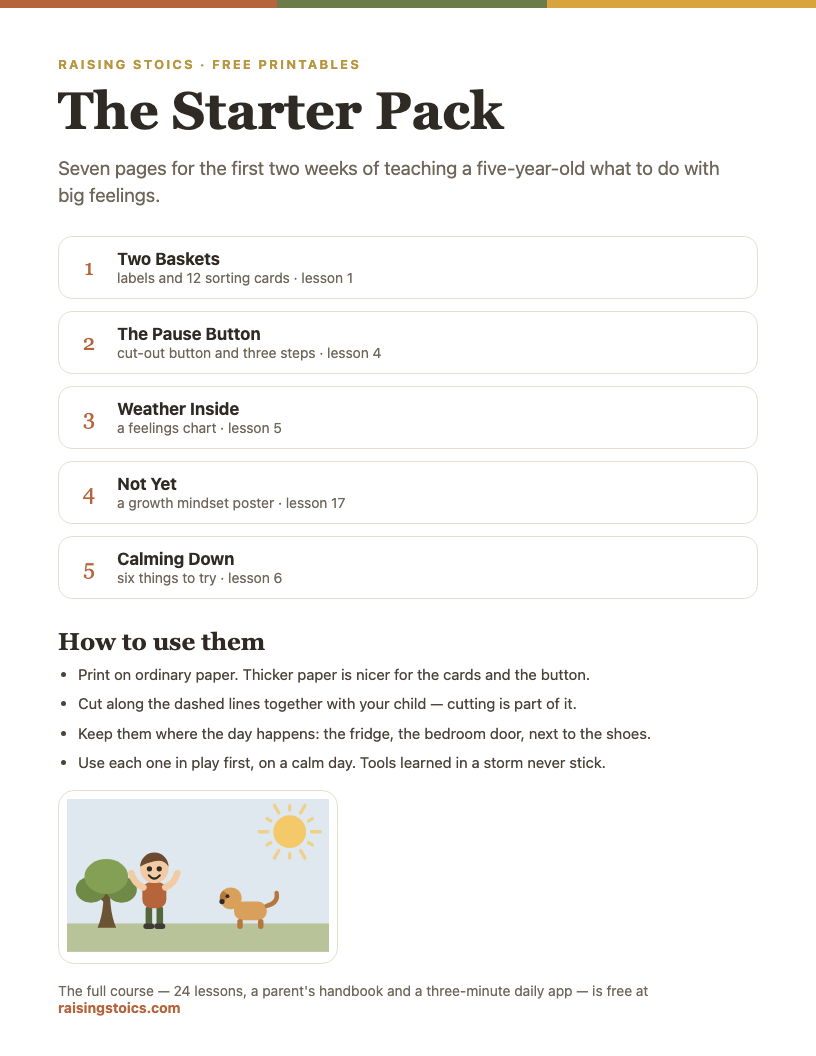
The Big Feelings Starter Pack
Nine pages for the first two weeks: a sorting game, a pause button, a feelings chart and a calm-down poster.
Download the free PDF See all 9 pages
Part of a free 9-page starter pack. Sign in with a code from your email — no password.
Creative rainy day activities for kids
Creative projects often keep children busy for a while, and many children stay with them longer when they choose what to make.
13. Rain paintings. Paint with watercolors, then hold the paper out the door for a few seconds and see what the raindrops do to the colors. If it's only drizzling, a spray bottle works, too. *About 20–30 minutes. You need: watercolors, thick paper, a brush.*
14. A cardboard box house. One big box becomes a house, a car, a rocket, or a store. Cut doors and windows (the adult does the cutting) and let your child decorate. *About 45–90 minutes, often spread over a day. You need: a large box, markers, tape.*
15. Weather inside drawing. Ask your child to draw the weather outside, then the weather inside them right now: sunny, stormy, foggy, or rainy. In our program, this is lesson 5, "Weather Inside," a simple way to name a feeling. Our feelings wheel for kids comes with a printable if they want more words. *About 15 minutes. You need: paper, crayons.*
16. Sock puppet show. Draw faces on old socks with markers, or glue on yarn for hair. Skip buttons and other small pieces for children who still put things in their mouths. A table turned on its side is the stage. *About 30–45 minutes. You need: old socks, markers, glue.*
17. A paper road town. Tape sheets of paper together on the floor and draw roads, houses, and a park. Toy cars and blocks move in. *About 30–60 minutes. You need: paper, tape, markers, toy cars.*
18. A rainy day book. Fold three sheets of paper in half, and an adult staples the fold to make a small book. Your child draws one thing from today on each page, and you write down what they tell you. *About 20–30 minutes. You need: paper, a stapler, crayons.*
Rainy day activities in the kitchen
The kitchen is warm, it has a table, and it has a sink nearby, which makes it the best room in the house for messy projects. Keep knives, the stove, and hot water as adult jobs.
19. Slime. Glue slime and cornstarch slime for ages 6–8, with an adult at the table. Our guide on how to make slime has four recipes with exact amounts, plus what Poison Control says about borax. *About 15 minutes to make, 30 minutes or more of play. You need: depends on the recipe.*
20. Oobleck. For ages 4–8, and a good pick for the youngest. One cup of cornstarch and half a cup of water, mixed in a tray. It feels solid when you squeeze it and runny when you let go. *About 20–30 minutes. You need: cornstarch, water, a tray.*
21. Sink or float. Fill a big bowl with water and collect objects bigger than your child's fist: an apple, a plastic cup, a large spoon, a bath toy, a sponge. Keep coins, corks, and other small items out for children who still put things in their mouths, and an adult stays at the bowl. Your child guesses first, then tests, and you keep a two-column list. *About 15–20 minutes. You need: a bowl, water, large objects, a towel.*
22. Color mixing cups. Fill three clear cups with water and add red, yellow, and blue food coloring. Use a spoon or a dropper to mix new colors in empty cups. *About 15 minutes. You need: clear cups, food coloring, water, a spoon.*
23. Snack plate faces. Your child builds a face on a plate from cut fruit, cheese, and crackers, then eats it. Cut grapes lengthwise into quarters for young children. For more ideas, see healthy snacks for kids. *About 15 minutes. You need: fruit, cheese, crackers.*
24. Bake together. Use a muffin or cookie recipe you already know. A 4-year-old can pour and stir, a 6-year-old can measure, and an 8-year-old can read the recipe out loud. Then comes the hardest part: waiting for them to bake. *About 45–60 minutes. You need: your usual recipe.*
When they say "I'm bored"
At some point on a rainy day, you'll hear it. Boredom isn't always a problem to fix right away. Some children may find a game of their own a few minutes after complaining that there's nothing to do.
A few ways to respond:
- Keep a rainy day jar. Write a dozen ideas from this list on slips of paper. When your child is stuck, they pull one out. Drawing from a jar feels like a game, not a chore.
- Name the feeling and wait a little. "You're bored. That's an uncomfortable feeling. Let's see what you come up with." Then give it a few minutes before stepping in.
- Offer a job. Helping with something real, like matching socks, setting the table, or watering plants, may help with boredom. Our chore chart for kids has a printable with picture jobs.
On a long day indoors, many families notice the tablet comes out more. If that's a battle in your house, our guides to screen time rules for kids and what to do when your child won't turn off the tablet may help.
Keeping a long day indoors calm
A full day inside can bring more arguments: over who goes first, who won, and whose turn it is. Arguments are common, especially with siblings in a small space.
Agree on the rules before the game. "Everyone gets three turns. The timer decides when we switch." It's easier to point at a rule you made together than to judge in the middle of a fight.
Expect losing to be hard. Bowling and races have winners and losers. Losing can sting for many 4- to 6-year-olds. Our guide to the child who can't handle losing has phrases that help in the moment.
Build in a pause. When everyone is getting loud, stop the game for a minute: three slow breaths, a drink of water, then decide together whether to keep going. In our program, this is lesson 4, "The Pause Button": stop, breathe, choose.
Give each child some space. A fort, a corner with a book, or a separate room for 20 minutes may help siblings who have been together since breakfast. For more, see our guide to sibling rivalry.
End the day on purpose. Before bed, ask: "What was the best part of today?" A rainy day can end up a good day.
FAQ
What to do on a rainy day?
Go outside, if there's no thunder or lightning. A puddle walk in rain boots and a raincoat is one of the best rainy day activities there is. Jump in puddles, float leaves, and listen to the rain on an umbrella. The National Weather Service's lightning slogan is "When thunder roars, go indoors." On stormy days, pick an idea from the lists above.
Where to take kids on a rainy day?
Try the public library, which often has story times and play areas. Children's museums, science centers, aquariums, and indoor pools are other good options, and some offer reduced-price days or library passes. Check opening hours and how crowded it gets, since rainy days are busy. Even a trip to a big grocery store can feel like an outing for a 4-year-old.
Are there any indoor play areas for kids?
Yes, most towns have some: indoor playgrounds, play cafes, trampoline parks, and community or recreation centers with open gym hours. Many have age zones or age limits, and trampoline parks often require grip socks and a signed waiver. Call ahead or check the website, since rainy days can mean waits or capacity limits.
What are some fun indoor games for kids at home?
Card and board games work well for ages 4–8: Go Fish, memory, Uno, and simple dice games. Classic party games need no equipment at all: Simon Says, hide-and-seek, charades with animals, and Hot or Cold to find a hidden toy. For more movement, try freeze dance or balloon keep-up from the active list above.
What are the best movies to watch on a rainy day?
For a family movie with children ages 4–7, start with films rated G by the MPA, then check each title's scary scenes. Our list of G-rated movies explains what the rating does and doesn't tell you. A movie can be a good end to a rainy afternoon, especially after a day of active play.
How to Make Slime: 4 Easy Recipes for Kids Ages 4–8
How to make slime with kids ages 4–8: exact amounts for glue slime, fluffy slime, slime without glue, and oobleck, plus what Poison Control says about borax.
Read next →The Pause Button and Weather Inside are lessons 4 and 5 of the program, and both work on a long day indoors. The Pause Button is open in full.